When Startups Should Hire a Video Producer
Hire in-house only when you need eight to twelve videos monthly.

Summary
Hire in-house only when you need eight to twelve videos monthly.
91% of businesses use video to market themselves now, and 93% of marketers say it delivers real return. Both stats came out of surveys with sample sizes nobody bothers to check, but the underlying point holds anyway: video isn't optional anymore. The real question is who makes it and when paying someone full-time stops being vanity and starts being math.
Budget is where people trip over their own feet. Vidico's 2026 State of Creative in Tech report has 28% of teams naming budget as their biggest obstacle to producing video. Translation: this was never a creative problem. It's a spreadsheet problem wearing a turtleneck.
What a video producer actually does versus what founders assume
Ask a founder what a producer does and nine times out of ten you get "the camera person," which is an understandable but wrong guess. A producer runs the whole pipeline: concept, shoot logistics, directing on set, editing, delivery. Holding the camera is maybe a fraction of the job on a good day, less on a bad one.
That mix-up costs real money. Someone needs a camera operator for one Tuesday afternoon, posts a job listing for "video producer," then can't figure out why every applicant expects a salary built around fifty videos a year instead of one shoot. Wrong title, wrong expectations, wrong hire, and it happens constantly.
Get the scope wrong and the production model you pick doesn't matter. Freelance, agency, full-time, it's all the same mistake dressed differently. Figure out which slice of "producer" you're actually missing before you touch a budget line.
The three production models and what each one actually costs
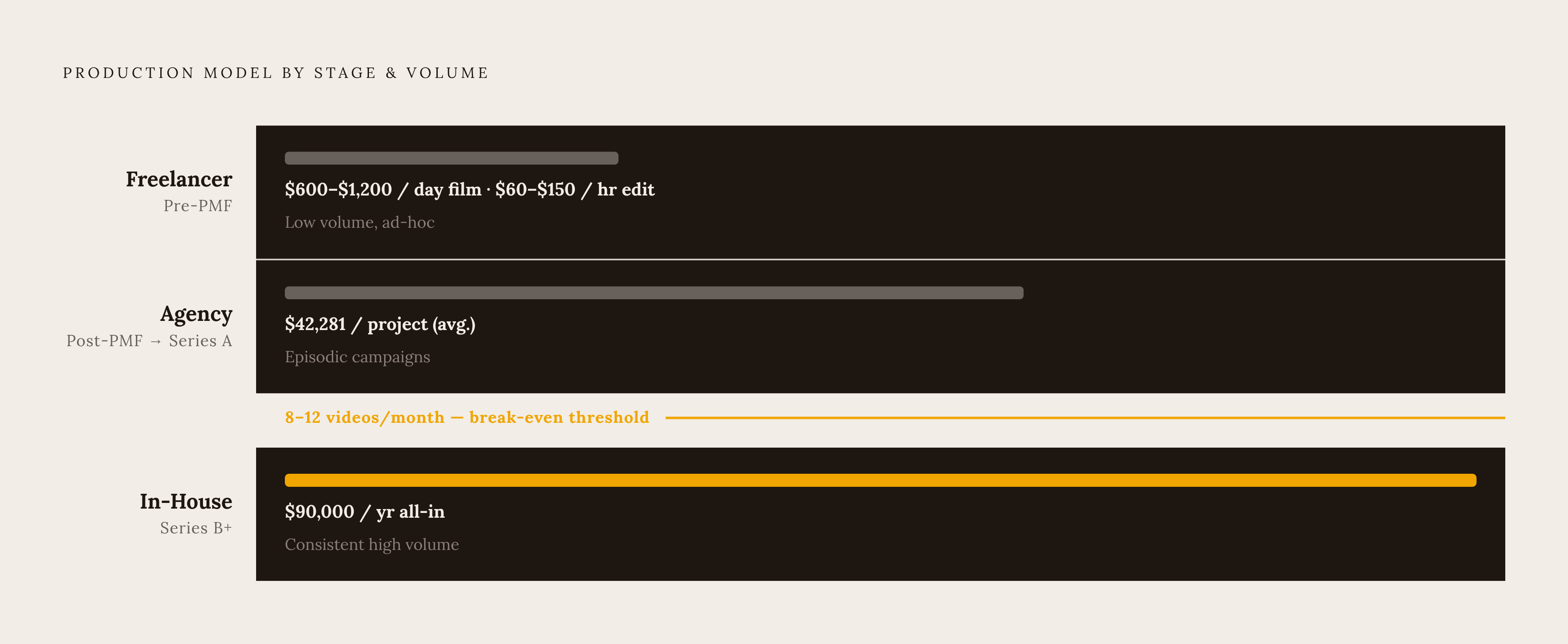
Three ways exist to get video made, and they land at three very different price points.
Freelancers run $600 to $1,200 a day to film, $60 to $150 an hour to edit. Great for a one-off shoot, a social clip, an event recap. The wheels come off once volume climbs, because now you're juggling five schedules and the brand voice drifts depending on who you booked that month.
Agencies make sense for bounded, high-stakes work, the kind where you need a full team instead of one very tired freelancer. Mid-range projects start around $5,000 to $15,000, though Clutch's survey data puts the average agency project at $42,281, with hourly rates averaging $100 to $149. You're paying for the bundle: strategist, writer, director, editor, all pointed the same direction without you playing conductor.
In-house lands between $58,000 and $87,500 a year in base salary according to ZipRecruiter, or $61,006 to $109,496 per Glassdoor, depending who's counting and how they define "experience." Add equipment and you're near $90,000 all-in. That makes it the cheapest option per video, but only at scale. Without volume, you're paying a full salary for someone to be occasionally busy, which is a strange thing to plan on purpose.
None of these models has wiped out the others, either, since 72% of companies blend outsourced and in-house talent right now. Hybrid isn't a phase; it's just what production looks like at most companies today.
Pre-product-market fit: why almost no startup should hire a video producer yet
Before product-market fit, your messaging is wet cement that hasn't set. Step on it now with a full-time hire locking in a brand voice you'll rewrite in twelve weeks, and you'll spend real money watching someone sit around confused.
What you need is one video. A single explainer, under 90 seconds, shot once by a freelancer, covers the fundraising deck, the landing page, and the LinkedIn post, all from one afternoon of work.
You shouldn't feel bad about this either: 62% of companies make their videos with people who already work there, according to Wistia/HubSpot survey data. Founder on camera, a little rough around the edges, is the norm, not a red flag. A freelancer at $30 to $100 an hour handles the talking-head interview or quick demo, no retainer, no idle salary humming in the background.
Hiring full-time before there's volume to justify it is the most common video mistake at seed stage, full stop. That salary runs every month whether there's anything to film or not, kind of like a gym membership you swore you'd use.
Post-PMF through Series A: when an agency relationship starts to earn its cost
Sales needs a library of use-case videos, and you're launching a product and need an actual campaign. The need is real now, but it's still episodic rather than constant, which is exactly the shape agency work is built for.
An agency hands you a strategist and a full production team in one engagement, no headcount, no camera gear rotting in a closet somewhere. Almost 40% of companies spent under $5,000 on video last year, and a Series A team can run a structured freelancer relationship or a scoped project inside that range.
What you're buying is reliability. Work doesn't stall because one person caught a cold, and the output holds up in front of an investor or an enterprise buyer. Ask one question to sort this out: is this bounded, campaign-shaped work, or a weekly need that never stops? The first goes to an agency, and the second is telling you something about headcount.
The volume threshold that makes a full-time hire financially rational
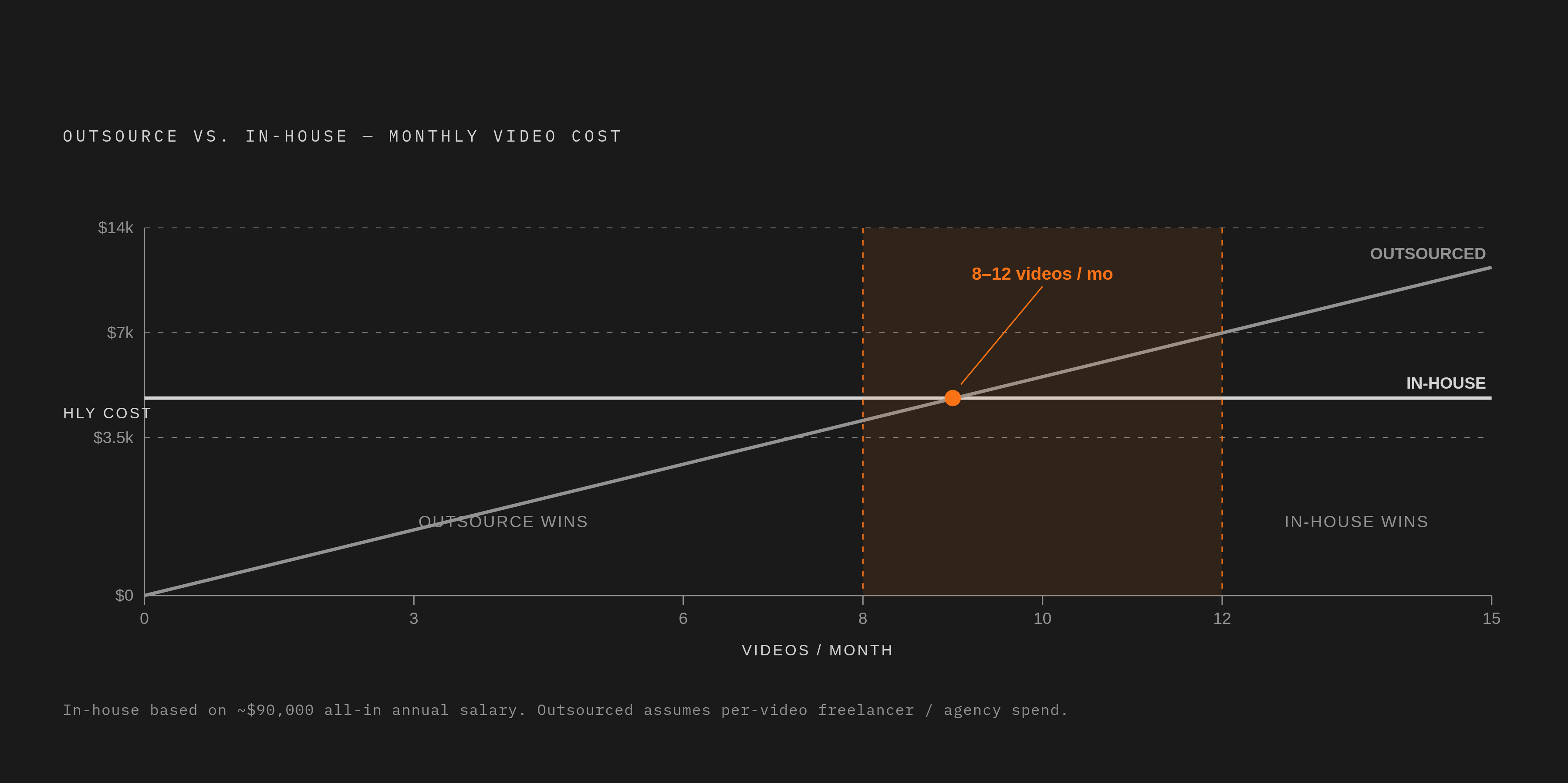
Here's the number that decides this: 8 to 12 videos a month. Below it, a salary loses to outsourcing almost every time you run the math. Above it, in-house wins, consistently.
More than 40% of companies now put out at least one video a week, and 71% of that work happens in-house, up from 63% the year before. In-house's overall share climbed from 43% in 2024 to 58% in 2026, and teams hit break-even earlier than they used to, mostly because the appetite for content keeps climbing with them.
Volume alone doesn't settle it, though, because output needs to stay steady, not spike around one launch and go dark for two months after. A full-time producer who finishes four videos in a slow month costs exactly what one finishing twelve costs. Break-even only holds if demand is consistent month over month, not just consistent on the slide deck that talked you into the hire in the first place.
Three strategic bets — beyond volume — that justify an earlier in-house hire
Volume isn't the only reason to hire early. Sometimes a strategic bet justifies an earlier in-house hire, even if you haven't hit the 8-to-12 threshold yet.
Video as your main acquisition channel. If demos or explainers or a YouTube presence are already driving pipeline, the case has already made itself. Bringing it in-house just tightens the grip on something that's clearly working.
Recruiting at scale. Culture and recruiting videos earn their keep once hiring moves fast, but only after a company actually knows what it stands for. Otherwise you're re-briefing an agency on your own values every quarter like it's a first date, every time.
Sales enablement speed. A sales team that wants fresh testimonials and one-pagers on a constant drip will eventually outrun any freelancer's calendar. In-house wins the moment requests come in faster than a contractor can reasonably turn them around.
One more pattern worth flagging is a freelancer who's on-site so often that the invoices alone start looking like a salary. And oddly enough, budget cuts trigger the same move. When every outside line item is under a microscope, in-house production tends to survive while agency spend gets gutted around it.
What the in-house ramp actually looks like, and what to expect in the first six months
A new hire needs time to absorb your brand voice, your internal workflows, how each team likes to brief and review work. Month one output won't look like month six output. Expecting otherwise is how founders talk themselves into thinking the hire didn't work.
Pay tracks with independence. Entry-level producers with under a year of experience average around $45,366 total, while one to four years of experience bumps that to roughly $57,741. Hire at the lower end and you save money upfront. But you're also signing up to hand-hold someone for a few extra months before they can run solo.
Equipment is the line item everyone forgets to budget. That $90,000 all-in figure, salary plus gear, is the honest number here, more honest than the salary alone. Treat the first 60 to 90 days as setup, not output: templates, a style guide, workflows the producer will actually own once they're up to speed.
Hiring in-house doesn't mean firing your freelancer. 55% of marketers produce video in-house, but 31% still run a mix of internal and external help. Keeping a freelancer around for overflow, or for a niche skill nobody in-house has, is common, and usually the right call.
How AI tools are shifting the break-even point and the skillset worth hiring for
AI has cut production costs enough to quietly move the agency-versus-in-house line. Outsourced work costs less than it did two years ago, and that changes the math on both sides of this decision.
Most of the real use right now sits in scripting during pre-production, plus captions and social clip generation on the back end. Work that used to chew through editor hours is compressing fast. A producer fluent in these tools simply outputs more per day than one running the old manual pipeline by hand. The measure that matters shifted from "how many videos a month" to "how many videos per producer, per month," and that's a very different number to plan a hire around.
Good news if you're still under the 8-to-12 threshold: AI lowers the bar for keeping production with a generalist marketer a little longer, which pushes the hiring decision out for some teams. It also changes who you should be interviewing. Screen for someone who can run the full AI-assisted pipeline end to end, not someone still cutting everything by hand the old way. It's a newer profile, and you have to ask about it directly, because plenty of experienced producers haven't touched it yet.
A decision framework: matching each growth stage to the right production model
Pre-PMF: the founder or a marketer shoots what's needed with a freelancer on call, no hire, no retainer, no drama.
Post-PMF through Series A: an agency or a structured freelancer relationship covers campaign work. Don't hire yet unless volume is already steady, not just promised for next quarter.
Once you're consistently at 8 to 12 videos a month, in-house pays for itself, especially with one of the three strategic bets, main channel, recruiting scale, sales speed, sitting underneath it.
One signal cuts through all of this regardless of stage: a freelancer already working full-time hours for you in everything but title. Convert that relationship before their limited availability turns into a scheduling problem you swear you didn't see coming, because you will see it coming. It just won't feel that way until it's already a problem.