Measuring Video ROI in B2B SaaS
Track which videos actually move deals forward by connecting viewer behavior to your CRM.

Summary
Track which videos actually move deals forward by connecting viewer behavior to your CRM.
Nine out of ten businesses use video for marketing, and 82% say it delivers a positive return. Fine. But ask how anyone actually measured "positive," and the conversation gets quiet fast, because most of that number is self-reported survey data, not a video view tied to a closed-won deal sitting in Salesforce. The real problem in B2B video has never been whether it works, but whether almost anybody can point to the dollar figure it produced. Most B2B marketers struggle to measure marketing ROI with any real confidence, and the rest are just nodding along in the meeting.
This piece isn't going to relitigate whether you should be making video. It's about which signals actually connect video spend to pipeline, and what it takes to build something that captures them without lying to yourself along the way.
What makes video attribution structurally harder in B2B than in B2C
Nobody in B2B watches a video and buys. A B2B deal is a VP watching a demo in March, a technical lead reading docs in June, and a CFO getting dragged into budget sign-off in September. Each person touches different content at a different point in the year, and almost none of it lands in the same report. Good luck stitching that into a single tidy conversion path.
Standard analytics tools default to last-touch attribution: all the credit goes to whatever the buyer clicked right before converting, and everything before that gets erased. A large share of B2B marketing teams still run on this model, even though enterprise sales cycles can stretch across many months. That's a lookback window built for a hundred-meter dash, slapped onto a race that takes most of a year to finish.
Then there's the dark funnel, which is exactly as ominous as it sounds. Somewhere between 70% and 80% of B2B buying activity happens in places no platform can see: a private Slack channel, a forwarded video link, a coworker muttering "just watch this, trust me" by the coffee machine. None of that leaves a trail, so it tracks that ROI measurement consistently ranks as one of B2B marketers' biggest headaches. Fixing this means rebuilding the attribution model from the studs up, not bolting on a pixel and calling it done.
The vanity metrics that dominate video dashboards and what they actually tell you
Open almost any video dashboard and the same three numbers greet you like old friends: views, watch time, social shares. They feel like progress, yet none of them are revenue, and treating them like revenue is how marketing teams end up defending budgets with numbers that mean nothing to the CFO.
View count tells you reach, not intent, and a thousand views from people who will never buy your product is just noise in a nice blazer. Watch time is a little more honest, at least it tells you whether the content holds attention, but it says nothing about whether the person watching works anywhere near your pipeline. Social shares and likes are the least useful of the bunch, since there's no path from a "like" back to a CRM record.
Vidyard looked at close to a million B2B videos and found the ones under a minute hit a 65% watch-through rate, while anything past twenty minutes drops to around 20%. Handy for content strategy, but useless for revenue, because a watch-through rate from a random newsletter clicker and a watch-through rate from the champion inside an active six-figure deal are the same number wearing two very different outfits. None of these metrics are garbage, exactly. They just don't get a vote in the revenue conversation until somebody joins them to an actual CRM record.
Which metrics genuinely connect video to pipeline
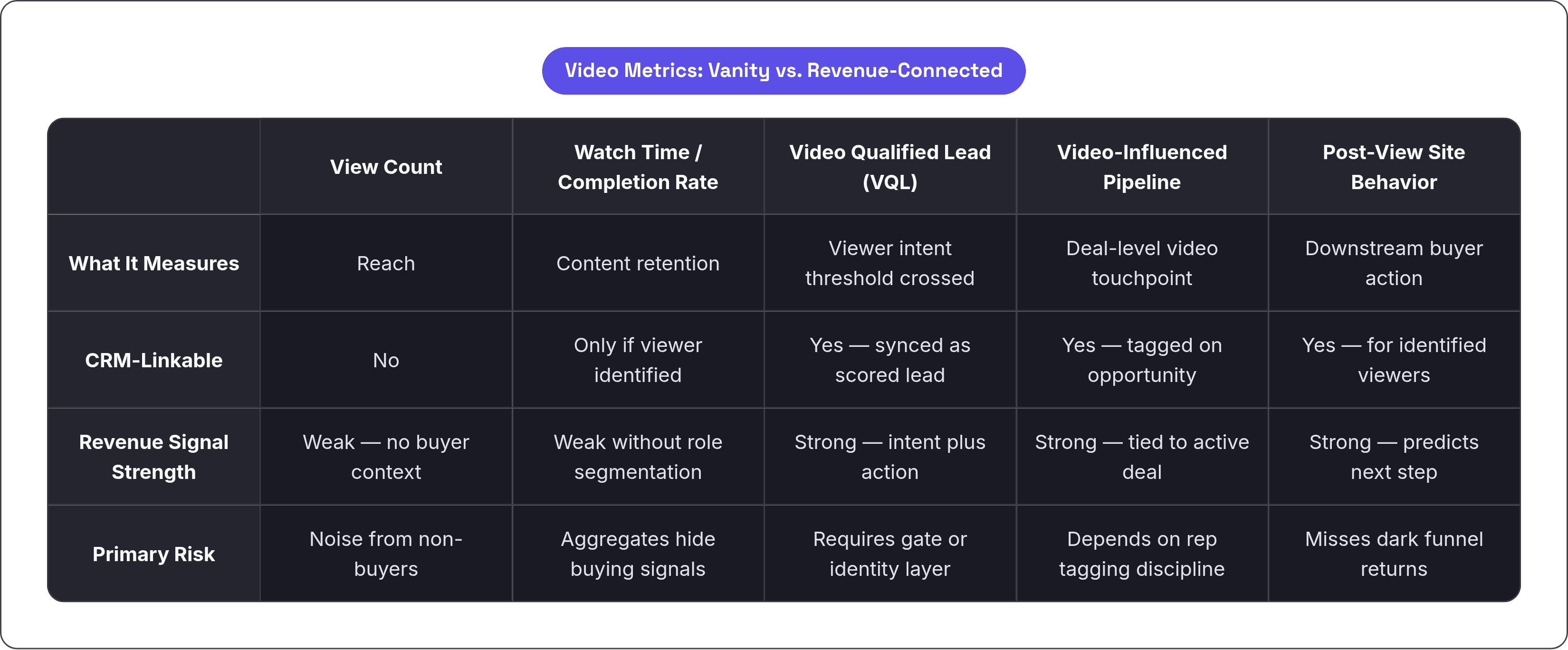
A handful of signals actually earn their seat at the table.
The Video Qualified Lead, or VQL: a viewer who crosses a set watch-depth threshold, finishing most of a demo, say, and then does something else, clicks a CTA, fills out a form. Sync that into the CRM as a scored lead and sales can call while the interest is still warm instead of three weeks later, once the moment's gone cold and the buyer's forgotten your name.
Video-influenced pipeline tags a deal where the buyer watched a key asset before or during an active opportunity, confirmed by the rep or by matching viewer identity. Completion rate segmented by buying role tells you something too, since a champion rewatching a demo three times mid-deal is sending a signal a random anonymous viewer never could.
In-player CTA click-through runs 1.5% to 3% as a general benchmark, though the aggregate matters less than how it splits across account tiers. Post-view site behavior, what someone does the moment the video ends, often predicts more than the video engagement itself. And 72% of B2B buyers say video shapes which vendors make the shortlist, which is worth tracking against which assets show up in deals that reach late-stage evaluation versus the ones that quietly die.
Don't ignore the cost side either. More than half of businesses using video report fewer support tickets, and that's a real dollar figure you don't need a single CRM join to count.
How post-view site behavior becomes a measurement layer in its own right
Here's the moment intent stops being a theory: the session right after the video ends. Someone finishes a product demo and goes straight to the pricing page in the same sitting, and that tells you more than the view itself ever will.
65% of executives visit a vendor's website after watching a video, and 39% go as far as contacting the vendor directly. Those downstream clicks, not the view count, are what belongs in your report.
You don't need a rebuild to get there. Put UTM parameters on video embeds and hosting links so post-view sessions show up separately in GA4 or whatever you're running. For gated or identified viewers, where the video platform talks to the CRM, append the pages they visited after watching straight onto the contact record. Suddenly a passive view is a behavioral note on a named account, which is a very different thing to hand a sales rep.
It won't catch everything, and it shouldn't pretend to. Someone who watches an embedded video, forwards it to three coworkers, and comes back four days later on their phone is still invisible, dark funnel and all. But for teams starting near zero, post-view behavior is the cheapest, fastest signal available, and it doesn't ask you to rip out anything you've already built.
Building the measurement stack: what tools connect video data to CRM records
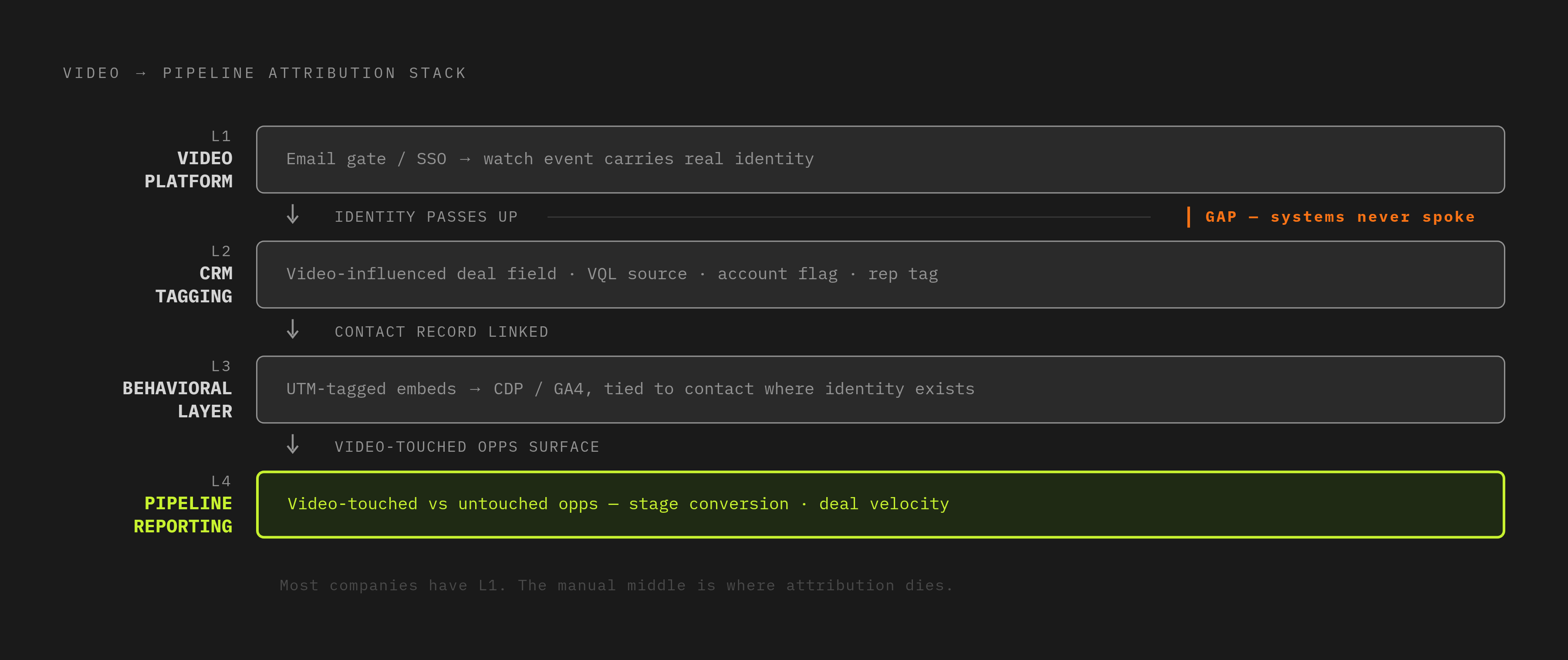
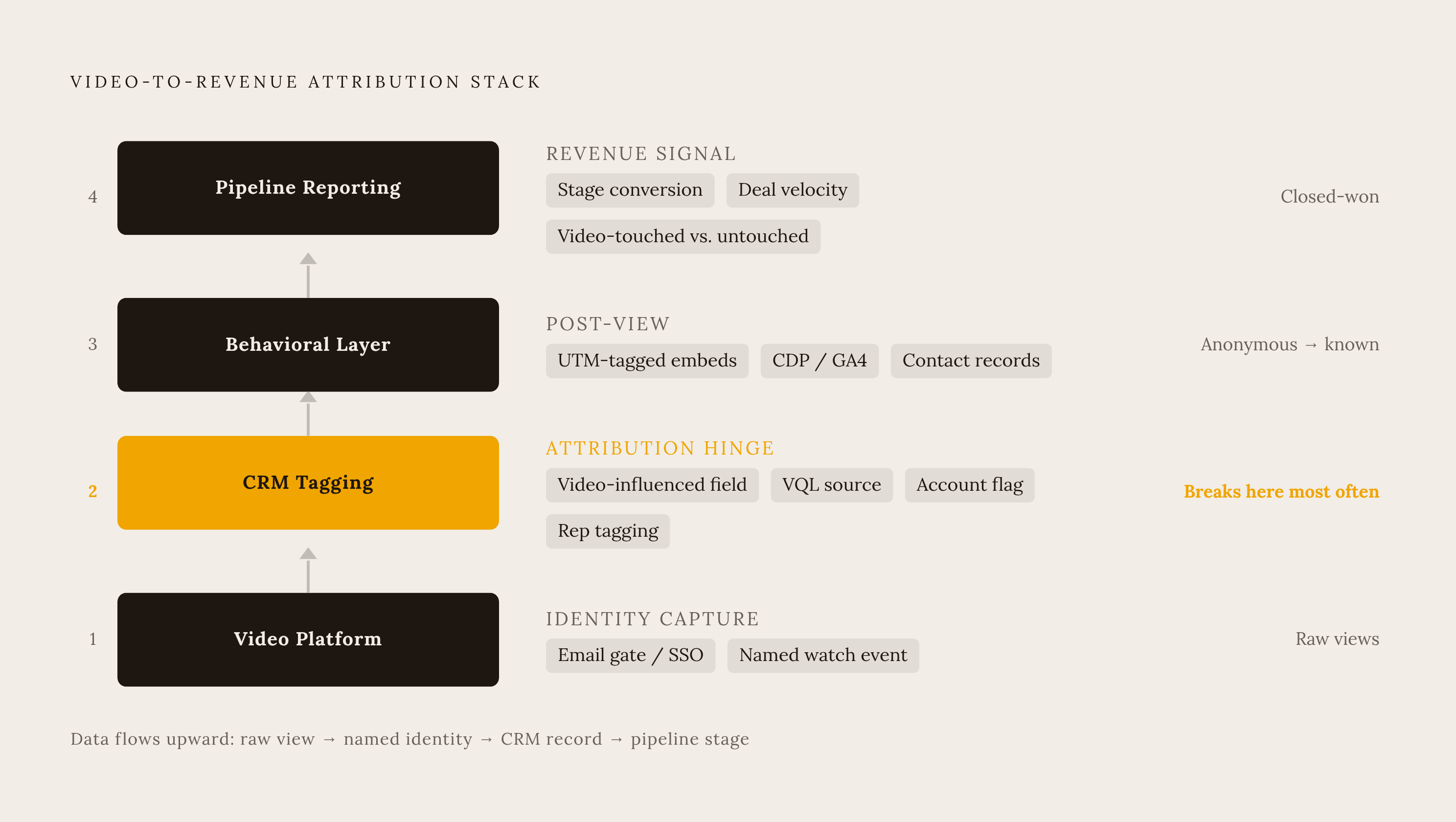
Here's the part nobody likes to say out loud: video platforms track views, CRMs track deals, and in most companies those two systems have never once spoken. Someone in ops is quietly cross-referencing spreadsheets at 6pm on a Friday, and that manual middle step is exactly where attribution goes to die.
By most accounts, only a small fraction of teams run integrated attribution across channels, which means most of the industry is running blind.
Think of it in layers, because that's genuinely how it gets built. Layer one is a video platform with viewer identification, gating content behind an email or SSO so a watch event carries a real identity into the CRM. Layer two is CRM tagging: a video-influenced deal field, a VQL lead source, an account-level "video engaged" flag, and reps actually trained to tag a deal when a buyer mentions a video on a call. Layer three is the post-view behavioral layer, UTM-tagged embeds feeding a CDP or GA4, tied to contact records wherever identity exists. Layer four is pipeline reporting, a dashboard stacking video-touched opportunities against untouched ones by stage conversion and deal velocity.
One mistake to avoid outright: don't run a 30- or 90-day attribution window against a sales cycle that lasts six to eighteen months. The math simply doesn't survive that mismatch; you'll exclude most of the touchpoints that mattered before they even get counted. And some of this will never be captured, full stop, because shared links, embedded replays, and a screenshot dropped in Slack leave nothing behind. The aim here is accurate measurement of the slice you can actually see, not full visibility.
What a working video ROI report actually looks like, with a concrete example
One documented B2B SaaS case put real numbers on this: an 8:1 return on a modest video investment, driven by a shorter enterprise sales cycle and the pipeline velocity that came with it that quarter. That's what it looks like when the stack is actually built instead of aspirational.
Structurally, a report like that runs in order: video spend by asset type, then VQLs generated, then video-influenced pipeline, then stage conversion for video-touched deals against untouched ones, then closed-won revenue with a video touchpoint attached, then support tickets deflected as a cost offset.
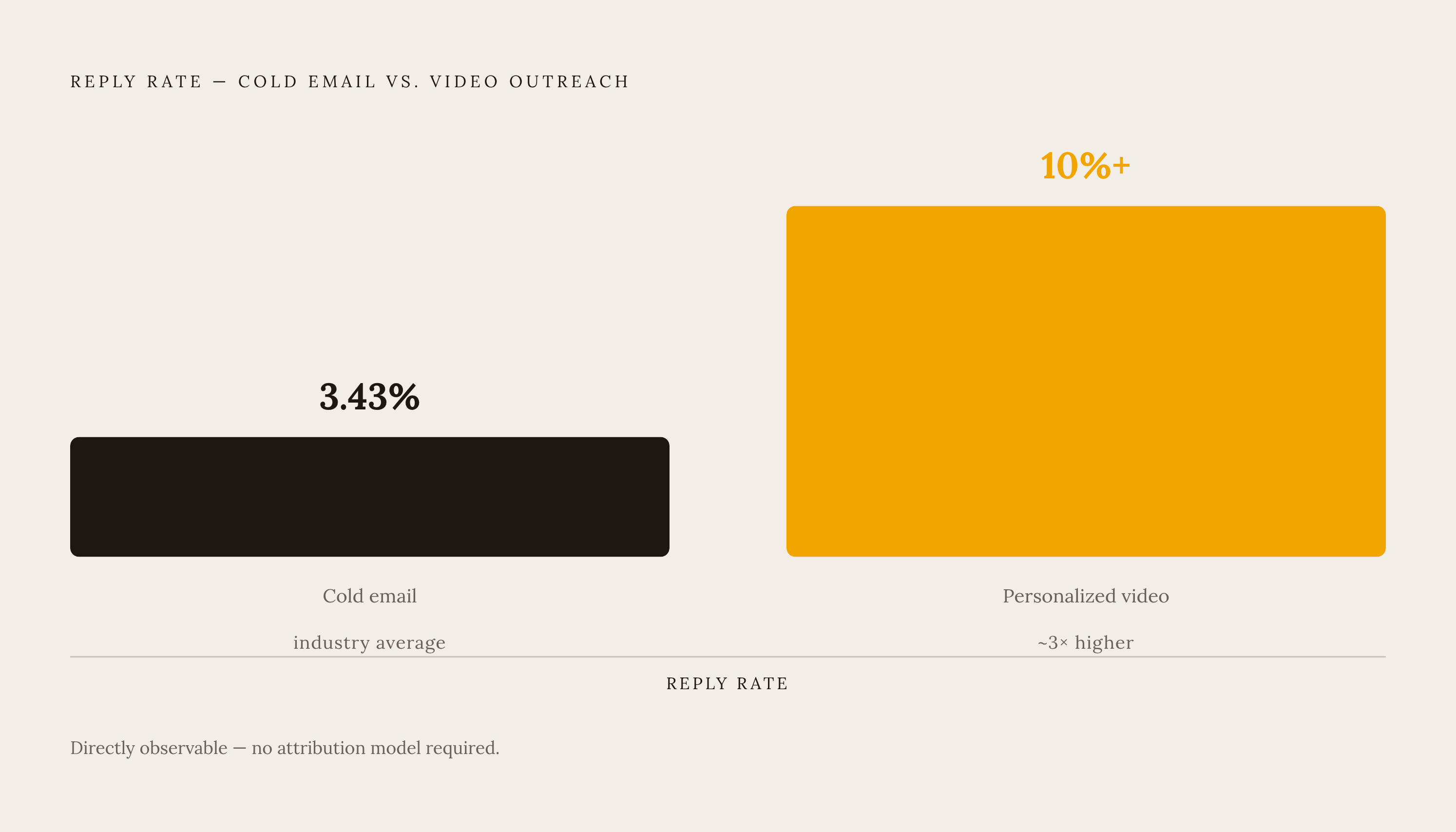
Sales outreach video deserves its own line, because it's one of the rare corners of video where attribution is genuinely clean. Reply rate and meeting-booked rate are directly observable, and nobody's modeling anything. Cold email lands around a 3.43% reply rate industry-wide, while personalized video outreach runs at 10% or more. That gap alone makes the case, no multi-touch model required.
Whatever report you build, attach its denominator: sample size, lookback window, a plain sentence stating what the dark funnel excludes. A number without that context is a guess with a tie on, not evidence. And for the fuller picture, track the expansion side too: video-influenced net revenue retention, repeat views of feature content, post-watch trial-to-paid conversion, closing the loop across the whole customer lifecycle instead of stopping the second the first deal closes.
Where measurement breaks down even with the right stack in place
Even with all four layers humming, the buying committee problem doesn't budge. 73% of B2B buyers say video is their preferred way to learn about a product, but one play from one person on a five-person committee tells you nothing about what the other four saw, or whether they saw anything at all.
Shared links and third-party embeds remain the black box most teams underestimate. The video gets watched, but the viewer never gets identified, and no CRM join fixes that after the fact. Meanwhile a large share of B2B content marketers still call attribution a struggle even though they know content drives revenue, which says less about the tools (they exist, they work) and more about the discipline it takes to keep CRM tagging clean week after week, quarter after quarter, long after the novelty wears off.
There's a newer wrinkle worth naming. AI-generated summaries and answer engines are starting to surface video content indirectly. Your brand gets mentioned in a transcript, that transcript gets indexed or cited by a model, and a real influence pathway opens up that no video analytics stack currently built can see.
The bigger risk might be false precision, honestly. A multi-touch model spreading credit across five touchpoints can spit out a confident, polished ROI figure that rests entirely on assumptions nobody bothered to test. It looks like evidence, but it might just be an artifact of whatever weights somebody picked while building the spreadsheet. The unglamorous, necessary discipline: report what's cleanly measurable, label what's an estimate, and never let a good-looking dashboard number substitute for actually knowing what's underneath it.
Where to start when the current measurement setup is close to zero
Starting from nothing isn't a crisis, just a starting point, and there's an obvious first move.
Gate a high-intent asset, a product demo or a detailed use-case walkthrough, behind an email field. Sync those submissions into the CRM as a video-sourced lead source and track what share turn into real opportunities. That single loop produces one real attribution data point, no full stack build required.
From there, run sales outreach video as a controlled test. One rep cohort sends personalized video, another sends plain text, and you compare reply rate and meeting rate over 60 days. This is one of the few corners of video measurement clean enough to trust outright. Add a "video engaged" field to the opportunity record, and get reps into the habit of flagging it whenever a buyer brings up a video on a discovery or demo call. Small signal. Qualitative. But it compounds into something usable over a quarter.
B2B organizations using video report MQL rates 27% higher than those that don't, and that gap alone is the business case for building real measurement instead of just making more videos and hoping the algorithm smiles on you. Quarter one doesn't need a fully attributed ROI figure. It needs a baseline that quarter two can actually beat, and don't forget that transcripts and written content pulled from video extend its reach into search and AI discovery in ways raw video analytics never will, so treating the video as a source for other content amplifies the signal from both ends.