Choosing a Video Distribution Channel for B2B Startups
B2B startups should pick channels by stage and goal, not borrow from consumer playbooks.

Summary
B2B startups should pick channels by stage and goal, not borrow from consumer playbooks.
Most B2B founders, when they sit down to figure out video distribution, borrow their logic from consumer brands. It's an understandable mistake. The playbooks are everywhere. The platforms are the same. And a video that lands well feels like a video that lands well, regardless of who's behind it.
The problem is that B2B is structurally different in ways that make most of those borrowed instincts backfire. Applying B2C logic to a B2B distribution problem is like using a map of Paris to navigate Tokyo — the streets look like streets, but you're going to get lost.
Start with audience size. Consumer brands think in millions. Most B2B startups are trying to reach thousands of decision-makers, sometimes hundreds. Platforms built for mass reach are often a poor fit from day one.
Then there's the buying process. A B2B deal rarely comes down to one person watching one video and clicking buy. There are multiple stakeholders, multiple rounds of comparison, and a timeline long enough for people to completely forget they ever watched your video. Wyzowl's 2026 data shows 73% of B2B buyers prefer video for learning about a product. "Prefer" doesn't mean "will convert immediately." It means they want the format, not that they're ready to act.
Video's real job in B2B is shortlist survival, not mass awareness. 72% of B2B buyers say video influences which vendors make their shortlist. That's what you're actually playing for. Not going viral. Getting through the filter when a procurement committee sits down to compare options.
Budget is real too. Startups typically spend somewhere between 15 and 25% of revenue on marketing, with a chunk already committed to performance channels. Video distribution has to justify its place, not just fill a slot on the strategy deck.
The Two Variables That Should Drive Channel Selection: Stage and Goal
Channel selection starts with two questions, and almost everything else follows from there.
What stage are you at?
Stage determines resources and network density. A pre-product-market-fit startup has a small but potentially high-quality network and almost no budget for paid amplification. A Series A company has real customers to reference, more budget, and some brand recognition starting to build. Those are fundamentally different starting points that call for different channels.
What is this video actually supposed to do?
This is where most teams go sideways. They measure whatever the platform surfaces most easily (views, follower counts, likes) instead of the thing that actually matters for their stage. The real options look like this:
Awareness: getting new people to recognize a problem you solve
Consideration: helping decision-makers evaluate your category
Pipeline: moving qualified leads into a sales process
Retention: helping existing customers get more value out of the product
Thought leadership, product education, social proof, and personalized outreach don't belong on the same channel. They're not interchangeable. Once you know stage and goal, a third variable, content type, falls out almost automatically. Those three answers knock out most of the field and leave you with a short list of channels that actually make sense.
LinkedIn as the Default First Channel for Early-Stage B2B Startups
If you're early-stage and picking one channel, this is it. The data is pretty direct about where B2B video is actually happening right now.
Wistia's 2026 State of Video Report surveyed nearly 1,000 marketing professionals and analyzed more than 13 million videos. LinkedIn has overtaken YouTube as the primary B2B video channel. 81% of companies now cite it as their top platform versus 76% for YouTube, a gap that widened by 33 percentage points in two years. LinkedIn video engagement is up 44% year over year. 62% of B2B marketers call it their most effective platform for video distribution.
The part that matters if you're scrappy: 97% of LinkedIn videos are vertical format, and 78% are shot on a smartphone. The production barrier is nearly nothing. You need a phone and something worth saying.
A few things that get missed:
The founder's personal profile outperforms the company page, consistently. CEO video posts rose 52% over two years as founders lean into unscripted formats. LinkedIn's algorithm favors people over logos.
Only 24% of businesses use LinkedIn video ads regularly. Organic early movers still have real advantage in a channel that hasn't been fully commoditized yet.
Native uploads significantly outperform YouTube links. If you're dropping YouTube links into LinkedIn posts and wondering why nobody watches, that's your answer. The platform suppresses external links. Upload natively.
The real limitation is that LinkedIn organic reach is network-dependent. A founder with 500 connections is playing a different game than one with tens of thousands. It's a compounding asset that builds over time through consistency. If you're expecting fast results, you'll be disappointed. That part is predictable, so plan for it.
When to Add YouTube, and What Role It Actually Plays in a B2B Stack
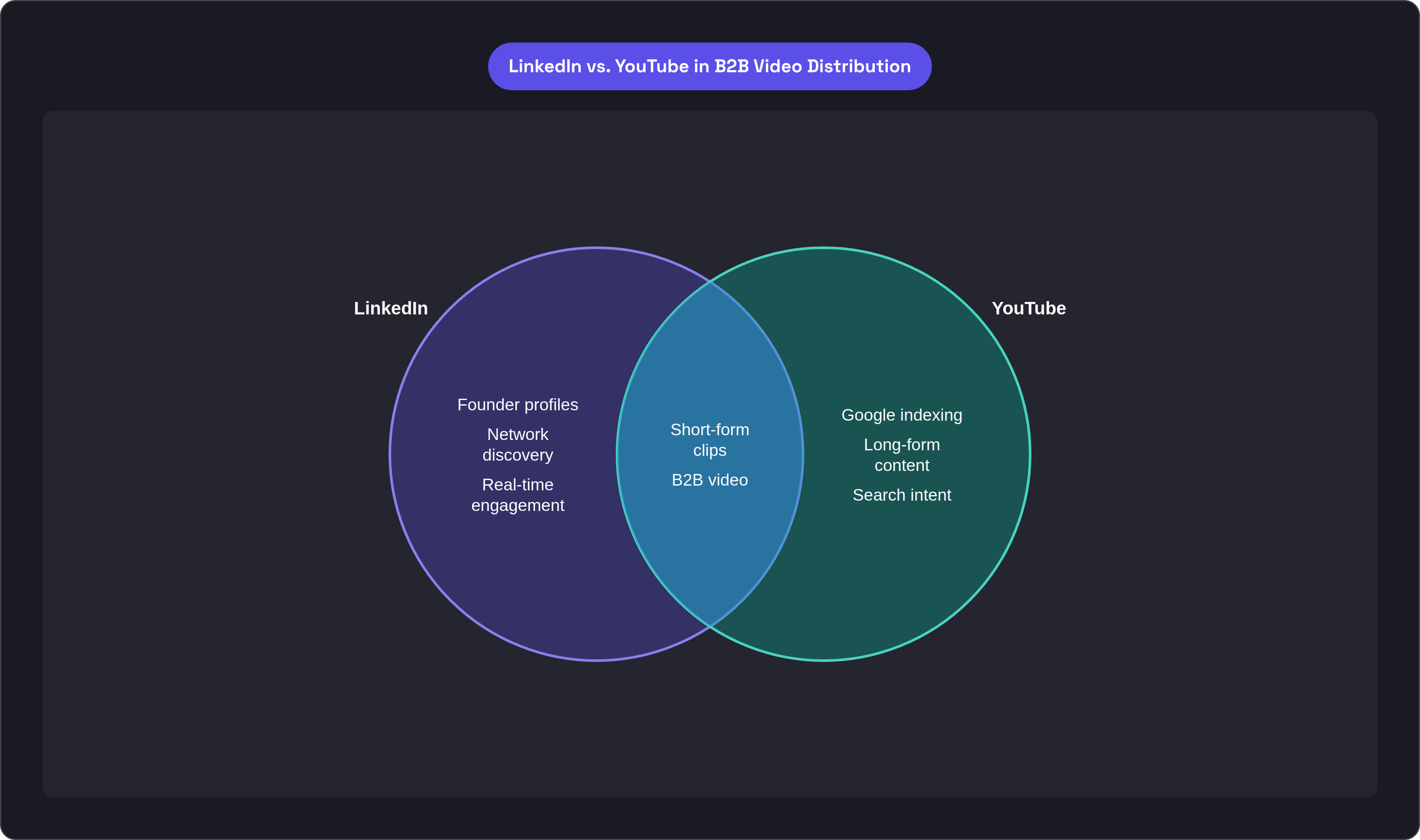
YouTube is not LinkedIn's competitor in B2B. They do different jobs. Once you understand that, the "which one?" question mostly goes away. The answer is usually both, eventually, starting with LinkedIn.
LinkedIn is a relationship and discovery channel. YouTube is a search and education channel — think of it as the library where buyers go when they already know what they're looking for. YouTube's B2B value comes primarily from Google indexing its content. A well-optimized product explainer or category overview can pull in inbound leads for years after you publish it. That's a genuine long-term return, but only if the content matches what buyers are actually searching for.
The content fit breaks down pretty cleanly:
YouTube: product walkthroughs, category explainers, long-form thought leadership, anything someone would search for by topic
LinkedIn: quick founder takes, event clips, short commentary, anything that benefits from being seen in a professional network feed
There's also a repurposing angle worth noting. YouTube Shorts averaged over 70 billion daily views in the first half of 2025 and had the highest engagement rate of any short-form platform in that period. Clips already made for LinkedIn can live there too, with minimal extra effort.
For most early-stage B2B startups, YouTube is channel two. Add it when you have enough content volume and enough search intent in your category to justify a real publishing rhythm. A channel that publishes once a month reliably beats one that uploads ten videos in January and goes dark.
What YouTube genuinely cannot do well: precision targeting of a specific buyer persona, real-time engagement with decision-makers, relationship building. Those stay on LinkedIn.
The Company Website as the Conversion Layer That Ties Channels Together
Social channels are where people discover you. Your website is where they decide about you. Most early-stage startups underinvest in the second while chasing the first, and then wonder why their LinkedIn numbers don't translate into anything.
67% of video marketers say the company website is their top distribution point. Videos on landing pages increase conversions by an average of 34%. At the bottom of the funnel, a product demo or customer story embedded on a pricing page does work that no LinkedIn post can do, because the attention state is completely different. When someone is on your website, they came there on purpose. There's no competing feed, no next post loading underneath. That focus is an asset, and the video you put in front of them should be built for it.
The highest-priority placements for a B2B startup:
Homepage: category framing, what you do and who it's for
Product pages: feature demos, how it actually works
Case study pages: social proof from customers who look like your prospects
One thing that gets overlooked: 65% of B2B organizations include video in customer onboarding. The website's video job doesn't end at the sale. For SaaS startups where expansion revenue matters, post-sale video on customer portals or help pages is part of the distribution stack. It just doesn't get counted because most people stop thinking about marketing once the contract is signed.
Email as the Nurture Channel That Makes Earlier Touchpoints Pay Off
Email is follow-through. It's the channel that converts the awareness your other channels built into something that actually moves a deal.
Email campaigns with video average a 22% open rate, versus 15% for campaigns without. That's a meaningful lift in a channel where open rate is the first thing standing between you and anything else mattering. In B2B, email is embedded in how people work, which makes it a reliable re-engagement surface even when other channels get noisy or crowded.
The specific job email does best in this mix: re-engaging buyers who watched a webinar, visited a product page, or engaged with a LinkedIn post but didn't take a next step. The video in that email should be short, specific, and pointed at exactly one action. Skip the general overview. Respond to where they actually are.
For outbound sales, personalized video in outreach emails lifts reply rates in ways that generic text sequences don't. This matters for any startup running outbound where response rate is the actual bottleneck.
The production note that often gets skipped over: email video doesn't require new content. Repurposed clips from webinars, LinkedIn posts, or YouTube videos inserted into nurture sequences extend the life of what's already been made. You're getting more mileage out of something you already spent time on.
Webinars for the Startup That Needs Pipeline, Not Just Awareness
Webinars have a reputation problem. People picture dry slide decks, panelists talking over each other, and 45 minutes of content that should have been a blog post. Some of that reputation is earned. But the pipeline numbers are strong enough to work past the association.
a large majority of marketers say webinars outperform other channels for qualified lead generation. Most marketers spend only a small fraction of their marketing budget on the format, yet it consistently delivers outsized pipeline returns relative to that spend. That gap between investment and output is unusual enough to pay attention to.
A few things to know before you commit:
Format matters more than most people realize. Per Contrast's 2026 survey of 524 B2B marketers, educational sessions generate significantly more ROI than product demo webinars. Teach first, sell second. The session that opens with "here's how to solve a problem you already have" will beat the one that opens with "here's our product" almost every time.
Live is only half the story. About half of webinar attendees now watch on-demand, and replays generate more than twice the unique viewers of the live session. The recording is the deliverable. The live event is just the launch.
Stage fit is real. Webinars require some market presence to actually draw attendees. They work better post-product-market-fit, when there's at least a real customer base and some brand recognition to lean on. If you can't get 50 people to show up, the format won't rescue you.
Personalized 1:1 Video for Late-Stage Deals and High-Value Accounts
This one is different from everything else on this list. It's not a broadcast channel. It's not a discovery tool. It's a conversion tool used by individual sales reps to move specific deals forward, one at a time.
The use cases with the clearest return for early-stage startups:
Personalized cold outreach where an actual video references the prospect's specific situation, not a mass blast with their first name dropped in
Post-demo follow-ups that summarize next steps and keep momentum alive between meetings
Late-stage objection responses where a text email feels impersonal and a phone call feels like pressure
The production standard here is intentionally low. Authenticity and specificity beat polish every time. A 60-second screen recording that references the prospect's actual pain point and names their company outperforms a beautifully produced product video sent to a list. Prospects know the difference between "we made this for you" and "we made this for everyone."
Vidyard is built for this use case specifically. It handles quick recording, watch tracking (who watched, how long, how many times), and CRM integration. That tracking data turns out to be more useful than it sounds. Knowing a prospect watched your follow-up video three times before going quiet tells you something that a text email open rate simply cannot.
Stage fit here is tied to deal size. 1:1 sales video pays off when the average contract value justifies the time a rep spends per deal. High-ACV enterprise startups benefit from this earlier. High-volume, low-ACV models are better served by automated nurture.
How to Build a Channel Stack That Matches Your Current Stage
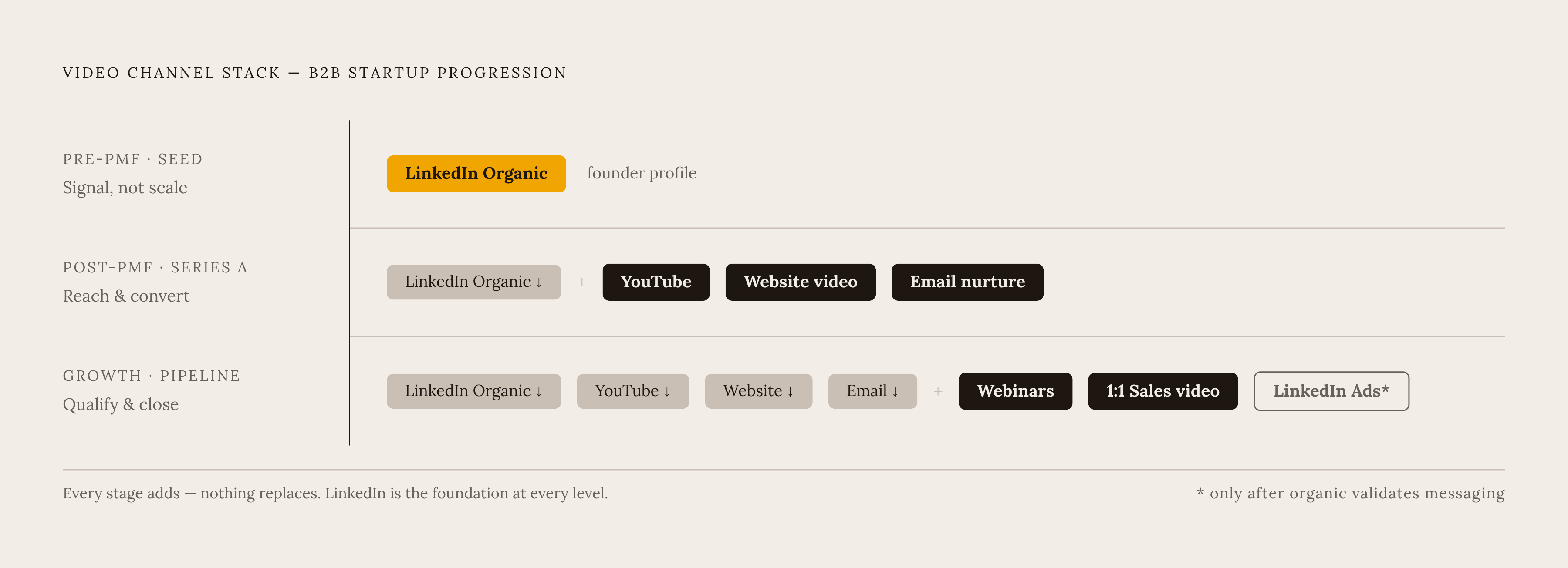
The stack builds over time in a pretty predictable sequence.
Pre-PMF or seed stage: one channel, just LinkedIn.
Organic, from the founder's profile. The goal is signal, not scale. You're trying to learn whether your target buyers respond to your framing, not build a media operation. Measure engagement from the people you're actually trying to sell to, not total view counts. Those are different numbers.
Post-PMF, early growth (Series A range): start stacking.
Add YouTube for search-driven content. Add video to key conversion pages on your website. Start building an email nurture sequence using repurposed clips from what you're already making. The additional production effort is minimal if you're repurposing intelligently, and you should be.
Growth stage with real pipeline pressure: layer in the heavier channels.
Add webinars for qualified lead generation. Activate 1:1 sales video for outbound sequences and late-stage deals. Consider LinkedIn video ads, but only after organic has validated your messaging. Paying to amplify something you haven't tested for free yet is a reliable way to burn budget.
The throughline across every stage: produce once, distribute intentionally. A single pillar piece, whether a webinar, a long-form YouTube video, or a founder interview, should yield LinkedIn clips, email content, and website embeds. The channel stack should multiply the value of your production investment, not multiply the production work itself. If you're building completely separate content for every channel, the stack has outgrown the team running it.
As the stack grows, managing assets across platforms and keeping distribution workflows from falling apart becomes a real operational problem. Prioritize channels you can actually maintain over channels that look good on a strategy slide. The question worth asking before adding anything new: does your current audience actually live here, does your content type fit the format, and do you have the capacity to publish consistently? If two of those three are no, the channel isn't ready. Neither are you.


