When to Hire In-House Video Versus Outsource Production
The volume threshold where in-house video production actually saves money compared to agencies.

Summary
The volume threshold where in-house video production actually saves money compared to agencies.
I've made about a hundred of these build-vs-buy calls, for myself and for clients who thought the answer was obvious until they saw their own numbers. People love to frame it as a philosophy question, like you're choosing between control and expertise. The real answer sits in three unglamorous variables: how often you shoot, how hard the work actually is, and how much creative control the content demands. Nail those three and the model picks itself. You don't need a consultant for this part. You need a spreadsheet and twenty honest minutes.
Storyblocks put out a number recently that stuck with me: 91% of businesses use video marketing in 2026. The more interesting question buried in there is who's actually making it at your company, and whether that got decided on purpose or happened by accident three hires ago because Dave from sales "used to do this in college." Every office has a Dave. Ours filmed a wedding once in 2015 and has been "the video guy" ever since. That's not a hiring strategy, that's a staffing gap with a legend on top of it.
How Video Demand Is Reshaping Staffing Decisions
Understanding the scale of demand helps you size your team correctly. The global video production services market was $62.4 billion in 2025, and it's projected to hit $118.7 billion by 2034. That's an entire industry rewiring its supply chain while output demands keep climbing.
Adobe's research backs it up from the demand side, with 96% of marketers saying content demand has at least doubled in the last two years. Wistia looked at over 14 million videos and surveyed more than 1,300 businesses, and found over 40% of companies were already producing at least one video a week back in 2024. A week, not a quarter, not a launch cycle.
So naturally, 36% of marketers say they can't find time to create, and 31% blame slow approvals. Read those two stats side by side and you're looking at a staffing problem wearing a workflow costume. If your team was sized for what 2022 needed, it's already too small for today's demands. Any framework you use must account for where volume is headed, not where it sits this quarter.
The True Cost of In-House Production
Nobody puts the real number in the budget deck, so let me. A single hire who can shoot and edit runs $60,000 to $90,000 in base salary across most U.S. markets. Add another 25 to 30% for benefits. Build a lean three-person team, shooter/editor, producer, motion designer, and you're at $180,000 to $300,000 a year before anyone's bought a single camera.
The gear isn't cheap either. A proper kit including camera, lenses, lighting, audio, and an edit bay runs $40,000 or more upfront. Then there are software licenses, insurance, and maintenance. Factor in turnover too. Replacing one production hire typically costs $15,000 or more once you count recruiting and lost time. A new hire then needs six to nine months before they're actually productive.
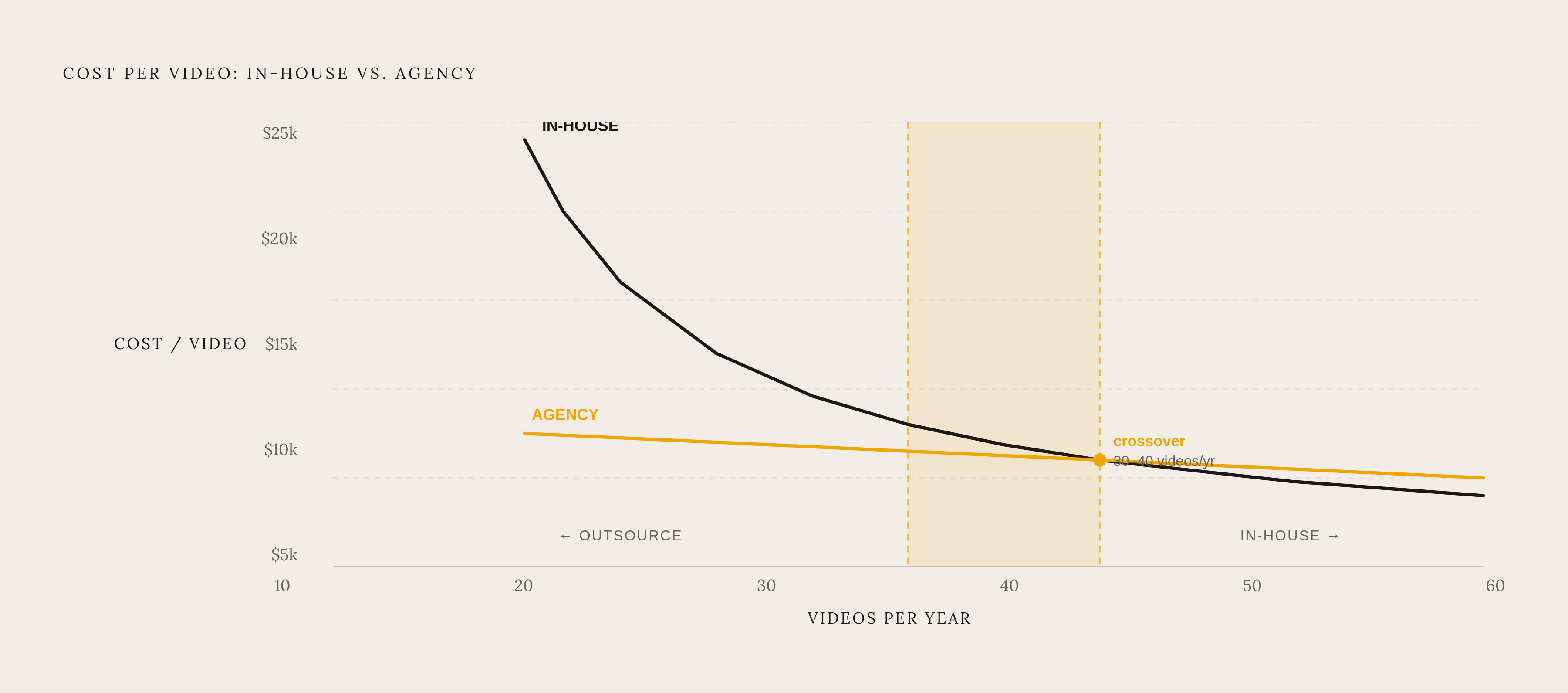
Run the math on a company making 12 videos a year with a full in-house team. Amortize the salaries and gear across that output and you're often paying $20,000 to $25,000 per video. An agency would've charged $5,000 to $8,000 for the same thing. In-house only gets cheaper past a certain volume threshold, and that threshold is the whole next section.
I once sat with a client who insisted their in-house setup was "basically free" since they already owned the cameras. I asked what the editor's salary was, and there was a long pause. Turns out "basically free" cost well over six figures a year.
When In-House Volume Justifies the Cost
In-house tends to become the cheaper option once you're consistently producing 30 to 40-plus videos a year, roughly 8 to 12 a month. Below that, agencies cost about 60% less than building and staffing a team, based on production cost comparisons across the industry. For a company making 10 to 25 videos a year, it isn't even close.
Volume isn't just a total, though, it's a rhythm. A company that spikes to 15 videos around a launch and then goes quiet for four months still pays full salaries during the quiet period. That's the expensive kind of demand. It's the one you rarely account for when you're excited about hiring your first videographer. Hiring a full-time crew for uneven demand means carrying full overhead through months with little to no output.
Storyblocks Creative Director Kaitlyn Rossi said it plainly: the real pivot point is volume and pace. Four videos a year, get a freelancer. Weekly or monthly output, now you're having the in-house conversation for real. But volume by itself doesn't tell you whether your team can actually execute the work. That's variable two.
How Complexity Determines Who Should Own Production
Complexity is really a question about how specialized the skill set is. Can one generalist carry a project start to finish, or does some piece of it need a dedicated specialist?
Low-complexity, high-volume formats belong in-house: social clips, internal comms, FAQ explainers, recurring training updates. These reward knowing the company over owning better gear, and a generalist who's been there two years will outperform a stranger with a RED camera on brand-familiar content every time.
High-complexity work is a different calculation entirely. Brand films, homepage launch videos, 2D or 3D animation, keynote-style executive pieces, and multi-language versions are the formats that typically fall into this category. These need equipment and specialists most companies have no business owning outright. A RED Digital Cinema rig runs about $50,000. Buying one to shoot two videos a year means carrying significant capital cost against minimal utilization. Agencies bring people who specialize exclusively in lighting, color, or motion graphics, and that depth doesn't exist on a three-person internal roster, no matter how talented they are.
The real trap is needing high volume and high complexity at the same time. No single hire fixes that. That's exactly the moment the hybrid model stops being an option and becomes the only one that works.
When Control Overrides Volume and Complexity
Control isn't abstract. It shows up as how fast you can update something, how consistent the brand looks across fifty different assets, and how carefully sensitive internal messaging gets handled by whoever's editing it.
In-house wins on control when content changes constantly, think training material or product updates, when brand standards can't bend across a high volume of formats, or when the material is internal and sensitive enough that routing it outside creates genuine risk. Outsourcing wins on control when the deliverable is scoped and built to last. A polished brand film doesn't need monthly tweaks, so handing it to a specialist costs you almost nothing in terms of brand consistency.
Here's the assumption that may be tripping you up: that outsourcing means surrendering control. A well-briefed agency working from a locked creative template often produces more consistent brand output than a stretched-thin internal team improvising before a deadline. The actual question is who owns the brief and the brand standards versus who executes them. Those don't have to be the same people, and assuming they must be is where a lot of budgets quietly go to die.
Reading All Three Variables to Pick a Model
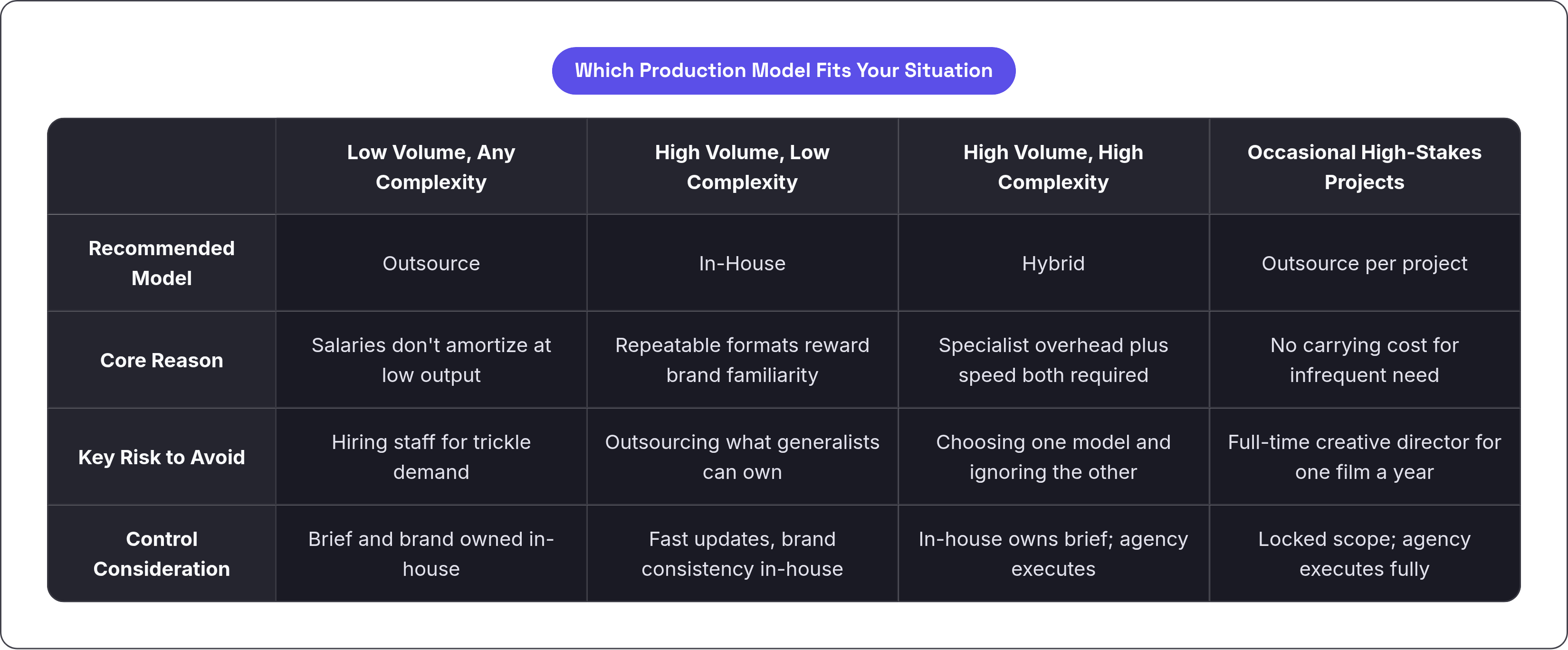
Line the three variables up together and the scenarios sort themselves.
Low volume, any complexity: outsource. Salaries don't amortize against a trickle of output. 55% of marketers still produce video in-house, and inadequate bandwidth is the most commonly cited barrier to keeping output consistent. If you're a low-volume team, you'll feel that pressure first and worst.
High volume, low complexity, frequent updates: build it in-house. Repeatable formats, brand-familiar content, fast turnarounds. This is the exact shape an in-house team exists to fill.
High volume, high complexity, uneven demand: hybrid. Keep every launch video in-house and you're carrying specialist overhead most months don't use. Outsource everything instead and you lose the speed and institutional knowledge only an internal team has.
Occasional high-stakes projects: outsource per project, one at a time. One polished brand film every 18 months doesn't justify a full-time creative director on payroll between projects. An agency handles it with no ongoing carrying cost.
None of this is permanent. Volume grows and formats shift. A setup that made sense at 15 videos a year can be the wrong call by the time you hit 40.
How a Hybrid Model Works in Practice
The hybrid structure splits ownership cleanly. A small in-house function owns brand standards, briefs, fast-turn social content, and internal comms. An agency or subscription partner absorbs the overflow: launch spikes, specialist animation, multi-language versions, and anything where production value needs to hold up under serious scrutiny.
The division that matters most: in-house owns the brief and the brand, the outside partner owns execution for anything past the team's skill ceiling or bandwidth. A common setup has an outside team build the first strong template, covering script tone, scene style, motion patterns, caption rules, and export sizes. The internal team then runs all follow-up content off that template without reinventing anything from scratch.
Cost-wise, a hybrid setup with one or two internal hires plus an agency relationship for the harder work typically lands well below a fully staffed in-house team. A fully in-house team costs $180,000 or more. Fully outsourced at similar output runs significantly less. The risk hybrid actually manages isn't just cost, it's continuity. One resignation can stall the entire pipeline. A two-person in-house team has no built-in backup, while an agency relationship does, by design.
What AI Tools Change and What They Don't
AI-augmented editing is cutting turnaround time and reducing outsourced production costs significantly, without adding headcount.
That shifts the math at the low-to-mid volume end. Agency capacity is getting cheaper and faster simultaneously, so the volume threshold where in-house becomes the smarter economic choice is probably creeping upward. But AI's reach stops at complexity and control. It lowers the floor for routine, repeatable formats. It doesn't give a generalist the judgment of a professional colorist or the timing instincts of a motion designer. And it doesn't close the brand familiarity gap an outside team starts with on day one.
Wistia's 2025 State of Video Report found that AI use in video production more than doubled over the last year. That's baseline infrastructure now, not an experiment. If you're pressure-testing these numbers in 2025, check them against current AI-augmented agency rates, not whatever a spreadsheet from 2022 still says.
Four Questions That Reveal the Right Model
Four questions, ranked roughly in order of how much they'll hurt to answer honestly, are what you'll need to ask yourself:
How many videos are you actually producing per month, consistently, as a floor and not a peak?Below 8 to 12 a month, full in-house rarely pencils out, no matter how strong the team is.
What share of your formats could a skilled generalist handle start to finish, and how much needs a specialist you'd be paying full-time to use only occasionally?
Which content types genuinely need fast updates, brand intimacy, or internal sensitivity that an outside partner can't replicate no matter how good the brief is?
Is your volume steady enough to keep an in-house team consistently busy, or do you have peaks that will require outside help regardless of how the org chart looks?
For most mid-sized B2B teams, those four questions land in the same place: hybrid. Own the brief, the brand, and the fast-turn formats. Outsource the complex, the high-stakes, and the peaks. Revisit the arrangement when volume crosses a new threshold, when a new format emerges, or when a key person leaves. That last one will reveal exactly what your team was actually dependent on.