Building a Repeatable Video Content Calendar
Document your video production once, then let the system run without weekly scrambling.

Summary
Document your video production once, then let the system run without weekly scrambling.
93% of businesses use video as a marketing tool now, per HubSpot's State of Marketing Report. That's basically every company you can name, so the real question is whether you can keep making it past February without the whole thing collapsing.
That's what this piece covers: a calendar built to survive an actual busy quarter, not the fantasy quarter where nothing goes wrong. Fixed rhythms, a defined job for every video, and rules that make the small decisions ahead of time so nobody's guessing at 4pm on a Thursday.
82% of businesses say video increased their web traffic, and 85% say it generated leads. Fine numbers, and probably true, but they measure adoption, not survival. They tell you video works when somebody makes it. They say nothing about whether your team still makes it six months from now, after the person who edited everything quietly leaves and nobody wrote down how the intro graphic gets built.
That gap between "we use video" and "we produce video reliably" is where most teams fall apart. Usually it's a slow fade into silence, then a panicked binge of five videos crammed into one week to make up for it. That binge, it turns out, is often worse than posting nothing.
What "documented strategy" actually means in practice and why it beats scrambling every week
Marketers with a documented content strategy are 538% more likely to report success, and structured calendars improve engagement by 36%. Big numbers for something embarrassingly basic: write it down.
That's really the whole trick. Documented means the decisions live somewhere other than one person's head, or a Slack thread from October that's since been buried under nine hundred other messages, rather than in a 40-page brand bible with a color-coded org chart nobody reads. Ownership, cadence, format rules: written down, visible, not tribal knowledge that walks out the door the moment someone takes a new job.
Reactive posting fails in a few predictable ways. There's topic drift, where nobody checks last week's lineup and you accidentally publish the same idea twice. There's an uneven format mix, five product demos in a row because that's what was easiest to film that month. And there are orphaned deadlines, where a video is "someone's" job, which in practice means nobody's. Responsibility without a name attached just evaporates, and that's just how teams work.
Moving from reactive to structured means planning fewer decisions rather than planning more content. Front-load the judgment calls once, then let the system run without you.
The four structural pieces a video calendar needs before it can repeat itself
A calendar isn't a date grid with clever titles typed into boxes. Treat it that way and you'll be ambushed weekly by problems you absolutely should've seen coming. A real calendar is a production control system, answering what gets made, when it ships, where it lives, and who's actually on the hook.
Start with the fields: publication date, title, content category, format, production status, target platform, assigned owner. Skip "assigned owner" and watch a video sit in limbo for three weeks because everyone assumed somebody else was editing it. That happens more than anyone wants to admit.
Then content pillars, usually three to five themes tied to what your audience needs and how you want to be known. Every video maps to one. Skip this and you'll look up one day to find you've posted nothing but customer testimonials for a month, purely by accident, because testimonials were the easy thing to schedule.
Ownership gets named per stage: who scripts it, who shoots it, who edits it, who posts it, not just a general sense of who's making the video. Ambiguous ownership is the fastest route to a missed deadline there is.
Keep a rolling window of four to eight videos ahead, far enough out you're not scrambling Monday morning, close enough you can slot in a trending topic without wrecking two months of planning.
Build tracking columns right into the calendar itself: views, engagement, conversion, reviewed monthly on a fixed schedule. The calendar works as a feedback loop this way, alongside its job as a to-do list.
Picking a posting cadence your production team can actually keep up
76% of companies produce at least one video a month. That's the floor, and it's a sturdy one. The harder question is raising that floor without the structure buckling under its own ambition.
Different platforms want different things, and baking these in as defaults saves you from relitigating cadence every single week. YouTube long-form does well at 2 to 3 videos weekly, while Shorts want 3 to 5. Your long-form habits affect how well Shorts distribute, so treating them as unrelated tracks costs you reach on both.
TikTok rewards 2 to 5 posts a week; Buffer's analysis of 11 million TikTok posts found creators in that range saw up to 17% more views per post than sporadic posters. LinkedIn does best at 2 to 5 weekly, engagement peaking around 2 posts for most B2B accounts. Instagram's a reasonable starting point at 2 Reels weekly plus daily Stories. Organizations posting twice weekly on Facebook saw the highest engagement rate, at 2.08%.
Post more than 5 times a week on most platforms and you hit diminishing returns fast. Push quality down chasing a frequency number and you damage your own distribution, beyond just wasting an afternoon of editing.
So pick a cadence you can sustain (even if that's once a week) and don't budge. Algorithms and audiences both punish stop-start posting harder than they punish a modest, steady rhythm. Most calendars need to work inside a real budget, not an aspirational one, and cadence has to reflect that math.
Giving each format an actual job so the calendar isn't just noise
Short-form video, under a minute, leads on ROI: 49% of marketers cite it as a top ROI-driving format, with long-form at 29% and live-streaming at 25%, per the HubSpot State of Marketing Report. But ROI isn't a job description. Short-form's role is discovery, since it sits top-of-funnel and gets new eyeballs on you, and it stops there. It won't close a deal by itself.
Long-form earns its keep differently, through depth and trust and actual conversion. Short-form finds people, while long-form keeps them around long enough to care — each format doing a different job in the same funnel.
Educational videos, product videos, social videos, and webinars get the most consistent investment industry-wide right now. Each slots naturally into a pillar, which means your format mix and your topic mix get designed together instead of as two separate headaches.
Customer testimonials deserve a specific callout, because the growth curve on them is steep, jumping from a niche tactic a few years back to something close to standard practice now. They're worth a dedicated slot, especially in B2B. Podcast video is the newer entrant worth watching, particularly if you've already got audio content sitting around doing nothing for you.
The practical move: give each pillar a default format. Do that and the mix stays varied on its own, without anyone sitting down to decide format for every single video, one at a time, forever.
The repurposing engine that multiplies output without multiplying the work
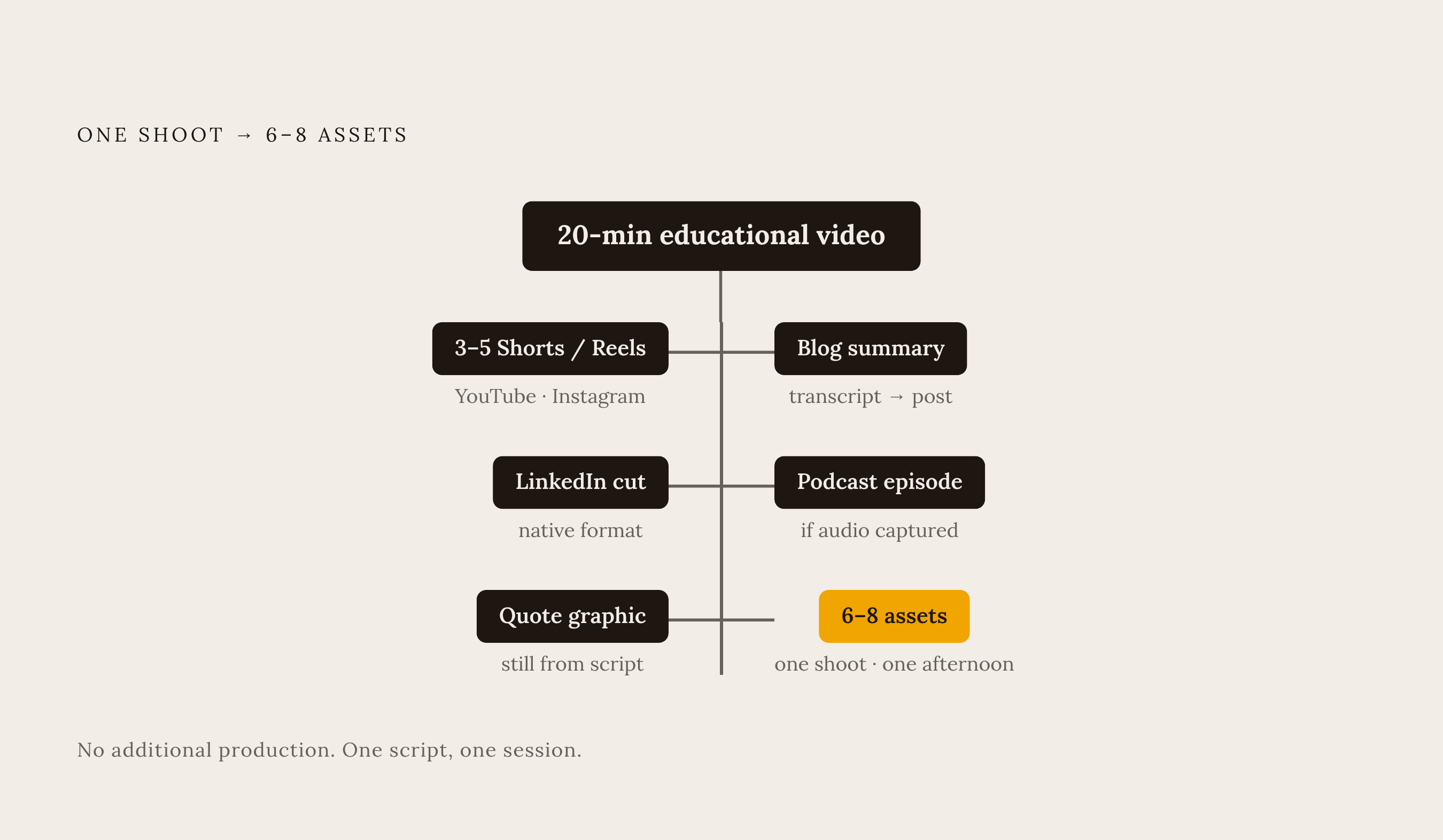
Here's the model, and it's simpler than it sounds. One big source video, the pillar, becomes the single source of truth for a topic. Everything else, clips, Reels, Shorts, quote cards, blog summaries, traces back to it. You're making one thing and putting it in six different outfits, rather than making six separate things from scratch.
Repurposing content across platforms lets you put ideas in front of different audiences without rebuilding from scratch, because the core material has already been tested before it goes anywhere else. That's just using evidence you already paid for.
Creators who seem to be everywhere, on every platform, every single day, aren't secretly running thirty production lines. They're running one, shooting once and distributing thirty ways. Teams that build this into the calendar grow faster than teams treating every platform like its own separate job, its own separate meeting, its own separate headache.
A typical repurpose tree: a 20-minute educational video turns into a handful of Shorts or Reels, a LinkedIn native cut, a quote graphic, a blog summary, and a podcast episode if you happened to capture audio. Six to eight assets from one shoot, one script, one afternoon.
Schedule the pillar video first and let everything else generate from it, rather than planning each piece as its own idea from a blank page. Built this way, the calendar mostly runs itself. And for the roughly 40% of teams working under $5,000 a year, this approach is often the only way a multi-platform presence is financially possible at all.
The decision rules and review rhythm that keep it running without you hovering
A system with no decision rules demands constant judgment calls, and the same judgment call gets exhausting fast when you're making it every single week. Write the rules down once, and your production meeting becomes a status check instead of a debate.
Three rules worth locking in. A pillar earning real traffic doesn't get dropped because someone's bored of it; it gets updated or extended. A trending topic only earns a slot if it maps to an existing pillar, otherwise you're chasing shiny objects instead of building anything that compounds. Format mix gets reviewed monthly against actual numbers, not adjusted week to week on a hunch.
The monthly review is where the system gets smarter. Pull views, engagement, and any conversion signal for everything published that month, figure out which pillar and format are actually earning their keep, then adjust the next rolling window. That's the whole loop, and it only works because the tracking columns were built in from the start.
Zeros need investigating, not shrugging off. A video with no views could mean a broken distribution step, a format-platform mismatch, or a genuine miss on the topic itself. Three different problems, three different fixes, and you can't tell them apart without the data sitting right there in front of you.
Social engagement as a success metric has grown fast as a share of how companies measure video's worth. Treat it as a real outcome in your review process, alongside traffic and lead numbers rather than as an afterthought bolted onto them.
In practice: three meetings, three different jobs. A weekly standup checks status against the rolling window, a monthly review adjusts the mix, and a quarterly audit retires pillars that aren't working and promotes the ones that are. Fixed agenda, fixed horizon, every time, no exceptions made because someone's busy that week.
Here's the actual test of whether any of this works: can the calendar run for two weeks if the person who normally manages it is out sick, or on vacation, or just needs a break? If the answer's no, too many decisions are still living in someone's head instead of on paper. A system that only works when a hero's holding it together is really just a person, tired, pretending to be one.