Video Production Budget Benchmarks for Startups
Understand what different price points actually deliver before your first vendor call.

Summary
Understand what different price points actually deliver before your first vendor call.
Video production costs for startups can feel arbitrary until you understand what drives them. A $2,000 quote and a $20,000 quote are not the same product at different prices; they represent entirely different crews solving entirely different problems. Vidico's 2026 State of Creative in Tech report found that budget constraints outrank measurement gaps, approval bottlenecks, and headcount shortages as the top challenge video marketers face, meaning money is the primary obstacle before anyone picks up a camera. This guide breaks down what each price tier realistically buys, which formats belong at each level, how your production model shapes actual value, and where AI tooling has genuinely changed the cost floor so you can make an informed decision before you are on a call with a vendor nodding along to jargon.
How much budget should go to video
Seed-stage budgets are lean because they have to be. You are proving the product works, not scaling it yet, and every dollar answers to a founder who remembers exactly what it cost to raise. Series A loosens the belt considerably because the question shifts from whether this works to how fast you can grow it.
Video's share of marketing budget varies more than most people expect. Wyzowl found that about a quarter of companies cap video spend at ten percent of marketing budget or less, while others push it toward half, within the same category of company. A practical starting point for early B2B is allocating 25 to 35 percent of marketing spend toward video, weighted toward whatever job is immediately in front of you rather than the job you anticipate having after your next raise.
Vidico's 2024 State of Video Marketing Report found most companies spend very little on video in absolute terms, but median behavior is not a target. The right number depends on your stage and the video's specific job, not a percentage lifted from a survey.
What a minimal budget actually produces
A minimal budget buys a single-camera founder story, a basic product demo, an AI-assisted explainer, or a screen capture with light editing. That is the ceiling at this tier, worth stating plainly so expectations are set before production begins.
AI tools have meaningfully changed what is possible here. Demo and training content now runs through platforms priced under $200 a month, and a screen recording with basic editing can produce a clean onboarding walkthrough in under an hour.
The real value of a minimal budget is the test it buys you. Spending the minimum at this stage lets you confirm whether your story actually lands before you invest in making it visually polished. The most common and costly mistake at this tier is paying for production quality before the underlying positioning is confirmed. A well-produced video with the wrong message is not a better outcome than a rough video with the wrong message; it is just more expensive.
What a minimal budget will not provide: branded motion graphics, multiple properly lit interview setups, professional voiceover, or a production crew larger than one or two people handling every role simultaneously.
Mid-range formats and what they unlock
This is the workhorse tier for seed-stage SaaS companies. Professional explainer videos anchor it, running $2,000 to $12,000 in 2026, which places the entire format squarely within this range.
What changes from the tier below is production structure. You get a dedicated editor, sometimes a small crew, with revisions built into the process upfront rather than negotiated after delivery. Branded motion graphics move from a stretch goal to a standard deliverable.
A common and efficient approach at this level is a single-day essentials shoot: one location, a two-person crew, and you leave with an explainer, a couple of testimonials, and vertical cutdowns for social, all produced within one shoot day.
At the lower end of this range, subscription editing services increasingly compete with project-based quotes. For a startup publishing content on a regular schedule, a recurring monthly fee for ongoing editing across formats often produces a lower per-asset cost than paying a fresh project fee each time.
One use case delivers outsized return at this tier: investor pitch videos. A skilled freelance videographer-editor can produce something genuinely credible, and startups that included a pitch video in their data room saw meaningfully higher conversion from initial intro to a scheduled meeting.
Review the fine print carefully. Revision overages, voiceover licensing fees, and source file ownership clauses can all add a significant premium to a quote that appeared straightforward. Building in a ten to fifteen percent contingency is standard practice, and unlimited revisions rarely means what the sales page implies.
When premium budgets are justified
At this level you are buying a campaign built around a video, not a single standalone asset. A hero brand film with social cuts branching from it. A launch package built from one coordinated shoot and distributed across six different formats. The crew size, shoot days, and post-production hours required to produce this level of work do not exist at a lower price point.
The conditions that justify this investment are specific. Your messaging must be validated, not still being tested in user interviews. You need a proven distribution channel so the video reaches an audience rather than sitting in a shared folder. And the content needs a shelf life long enough to recover its production cost. Skipping any one of those conditions means paying premium rates for an asset that expires before it generates returns.
Pitch videos with animated product demos and investor-grade brand films belong at the top of this range, and that positioning makes sense: they are appropriate for late seed or Series A companies raising on a story they have already proven.
The approach that makes this tier cost-efficient is deliberate repurposing. One well-planned shoot can produce a homepage video, several social cuts, and a sales enablement clip, which reduces the effective per-unit cost substantially. That only works if pre-production receives the same rigor as the shoot itself. Scripting, shot lists, and storyboarding are where budget discipline actually happens, because problems identified in planning are far cheaper to fix than problems discovered in the edit.
Freelancer, agency, or in-house production
Research finds roughly half of marketers produce video entirely in-house, a significant portion run hybrid models, and a smaller share outsource everything. There is no universal answer, only the right answer for what you are trying to produce this quarter.
Freelancers offer lower day rates and often strong technical ability, but you absorb the coordination work, and output quality can vary from project to project. They are best suited to a clearly defined, one-off deliverable with a detailed brief. A vague brief produces a vague video regardless of the freelancer's skill level.
Agencies cost more, and a meaningful portion of that premium buys process infrastructure you would otherwise have to build yourself: a structured pre-production workflow, a defined revision path, and a delivery timeline with accountability attached. That structure reduces the time you spend managing the production, which has its own value.
Subscription and retainer models are growing in adoption among seed-to-Series-A companies that need a consistent volume of edited content rather than one large asset per quarter. Per-asset cost decreases when you stop paying a new project setup fee each time.
In-house production carries costs that are easy to undercount. Equipment, software licenses, and editor compensation are fixed expenses that only make financial sense above a certain volume of video work. Below that threshold, you are paying for full-time capacity while using it part-time.
AI tools add complexity to this comparison. Platforms now handle scripting, voiceover, and rough video generation at a fraction of traditional production cost. But someone still needs to review the output and evaluate whether it accurately represents your brand, and that person is typically a human editor with direct control over the final cut.
Where AI changes costs and where it doesn't
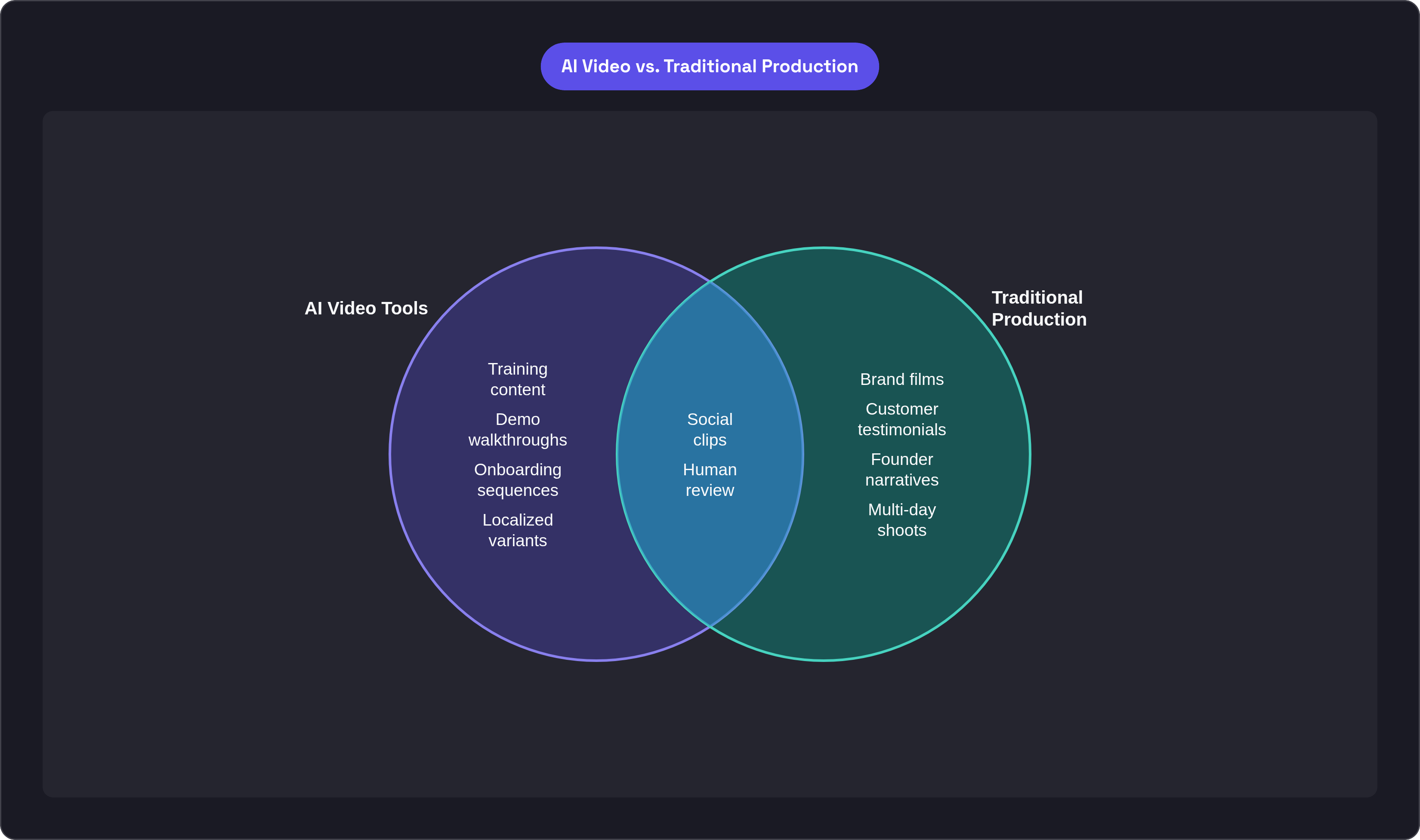
AI video platforms now run on subscription or credit pricing, with entry plans accessible to nearly any startup at the seed stage. The cost compression in specific formats is real and continuing. AI tooling has pushed median production costs down substantially for training content, demo walkthroughs, and social-first clips, and that is where the productivity gains are most defensible.
Repetitive content is where the economics shift most dramatically. Product update videos, onboarding sequences, and localized variants for different markets previously required reshooting from scratch each time something changed. AI-assisted production now handles these formats at a fraction of the original cost, on timelines measured in hours rather than weeks.
AI has not produced comparable results for brand films, customer testimonials, or founder narratives, because these formats depend on a real person's credibility and presence on camera. A human face carries a trust signal that generated video has not replicated, and until that changes, those formats still require an actual person in front of a camera.
The AI video generator market is already substantial and growing, which cuts both ways. The tools improve continuously, but so does the volume of AI-generated video competing for the same viewer attention. The quality threshold for standing out rises even as the cost of producing something technically adequate continues to fall.
The practical result: AI makes the sub-$5,000 validation approach faster and cheaper than it has ever been, and the case for a real production budget still holds once the stakes are high enough to justify one. They are different tools for different jobs.
Four questions before your first vendor call
Before speaking with any video vendor, work through four questions that will determine which tier and model applies to your situation.
What job is this video actually doing? Validating a message, supporting a sales conversation, persuading an investor, and building broad brand awareness are four distinct objectives, each pointing to a different production tier and format. Skipping this question is how budgets get allocated to the wrong problem.
Is the positioning confirmed, or only assumed? If it is not fully validated, the sub-$5,000 validation approach is the correct starting point regardless of available budget. Confirmed positioning is not optional before moving into a higher tier; it is the prerequisite.
Is this a single asset or an ongoing program? A one-off hero piece and a recurring content engine require entirely different pricing structures. Applying a project-based quote to an ongoing need, or a retainer to a one-time deliverable, means overpaying in either direction.
Where does this video live, and for how long? A video anchoring a landing page for six months justifies a larger budget than a social clip with a two-week shelf life. The spend should be proportional to the duration and scale of the distribution opportunity.
Before signing anything, verify the following: how many revision rounds are included, who holds the voiceover rights, who owns the source files, what rush delivery costs if your timeline changes, and whether a contingency buffer is built into the quote.
The principle that holds across every tier and every vendor conversation: spend the minimum required to be credible in the exact context where the video will be seen, rather than the maximum the budget technically allows.