Measuring ROI of Startup Video Content
Measure video ROI separately by funnel stage or lose your actual returns to misleading averages.

Summary
Measure video ROI separately by funnel stage or lose your actual returns to misleading averages.
Video has become one of the most widely used marketing tools available, but most teams still have no reliable system for knowing whether it's actually generating returns. 91% of businesses use video as a marketing tool now, yet almost none of them can tell you if it's working. Most are staring at a views counter and calling it a day, and views tell you exactly nothing about whether the video made money. Startups feel this worse than anyone, because when you've got twelve months of runway, you can't defend a metric that doesn't connect to revenue.
The problem isn't that video is hard to measure in principle. It's that most teams apply a single measurement framework across video types that are doing completely different jobs. A brand awareness clip running on social media, a product demo embedded on a landing page, an onboarding walkthrough sent to new customers, and a case study video shared by a sales rep in a late-stage deal each serve a distinct purpose, sit at a different stage of the buyer journey, and should be evaluated against entirely different success criteria. Collapsing all of them into one "video ROI" number produces a figure that's either misleadingly good or misleadingly bad, depending on which video happened to perform that quarter.
This post breaks down how to measure video ROI at each stage of the funnel, what metrics actually matter and why, how attribution typically breaks and how to work around it, and where AI-sourced visibility is creating a blind spot that most video dashboards still don't account for. The goal is to give startup marketing teams a practical framework they can apply to their existing video programs, not a theoretical overview of what good measurement looks like.
There's no single ROI number for video. Asking "what's our video ROI" depends entirely on which metric, for which video, at which stage of the funnel. Getting that wrong means you either kill a program that's working or keep funding one that isn't.
ROI depends on funnel stage
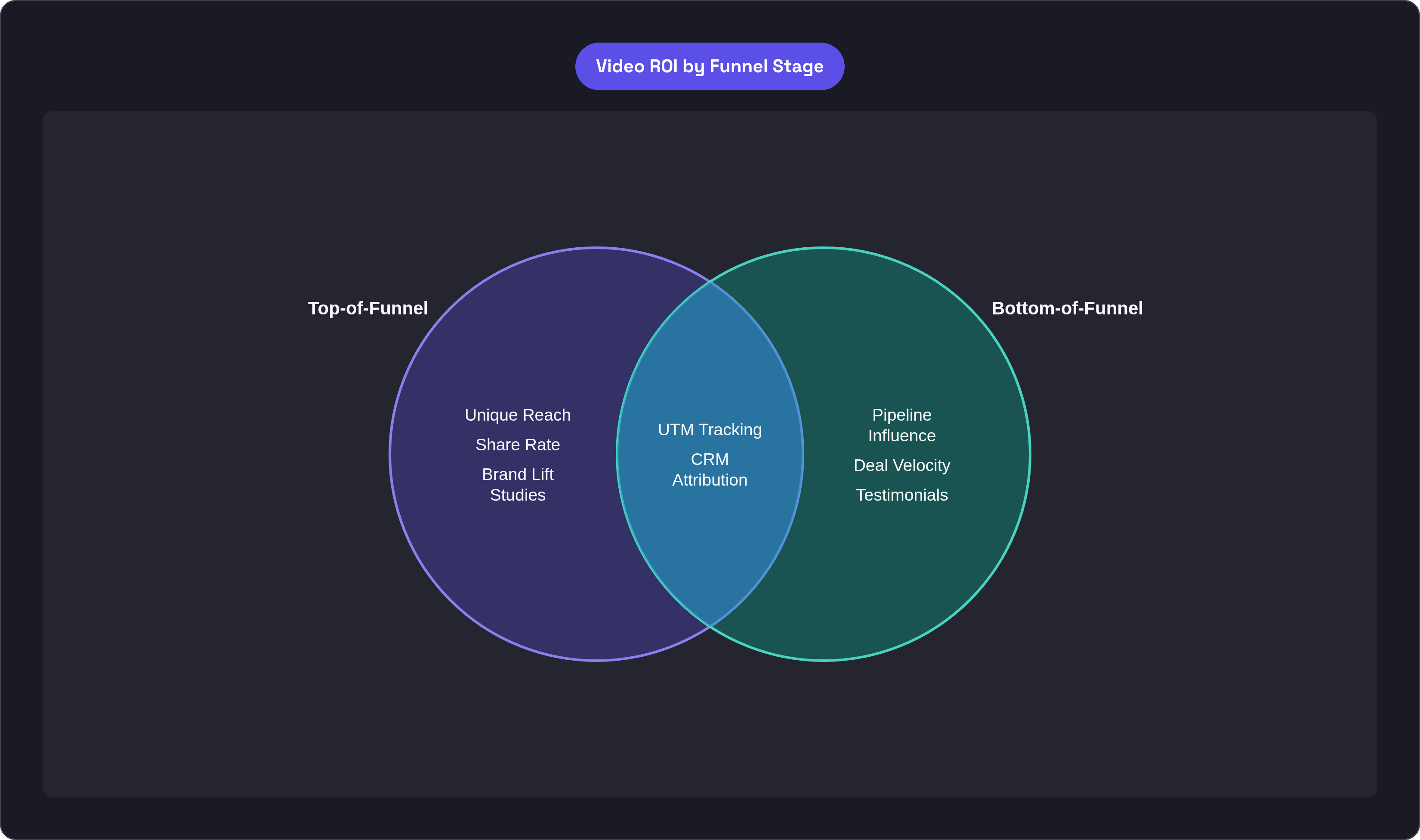
A brand awareness spot, a product demo, an onboarding walkthrough, and a customer testimonial are four different jobs. Judging all four by the same yardstick doesn't make sense, and yet most teams do it constantly.
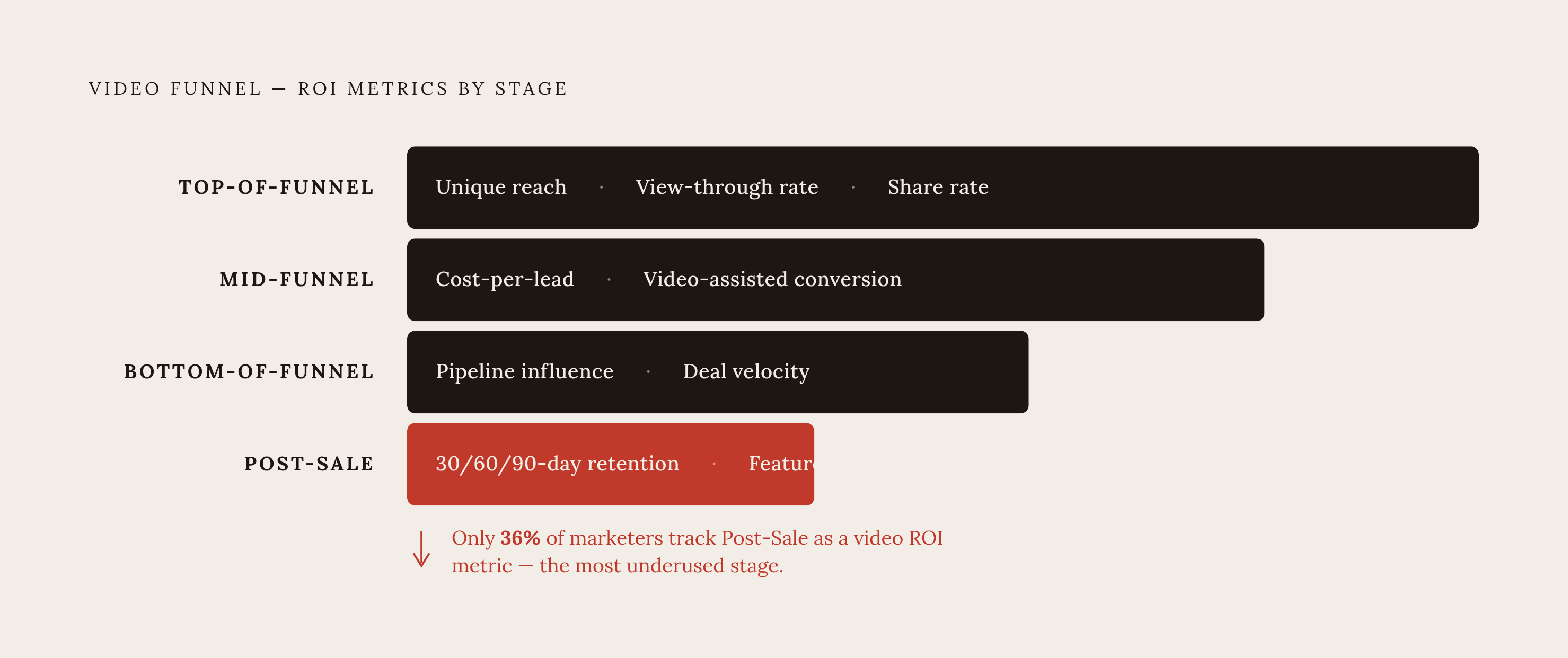
Top-of-funnel gets judged on reach and attention. Mid-funnel gets judged on engagement depth and lead conversion. Bottom-funnel gets judged on pipeline influence and deal velocity. Post-sale gets judged on retention and expansion. A startup that runs a brand video and then panics because it didn't generate demo requests is measuring the wrong outcome for that format. Running a detailed product explainer and celebrating a pile of impressions is the same mistake in reverse.
52% of B2B marketers say video is their highest-ROI content type. That finding only becomes actionable once you break it apart by stage and format.
Top-of-funnel: measure reach and attention
At the awareness stage, video has one job: get your company into someone's head before they're ready to buy. The metrics that matter are reach-based: unique reach, view-through rate, average watch time as an indicator of whether the message landed, and share rate as a signal that people cared enough to pass it on.
74% of companies measure video ROI using engagement metrics like views and watch time. These numbers are easy to grab, but they were never built to answer whether video drove revenue. Watch time tells you someone watched, and nothing more. It says nothing about whether they'll buy, or remember your name next week.
A brand lift study gets you closer to the truth: survey people before and after exposure, and check whether unaided recall or category association actually moved. For seed and Series A startups, awareness spend is exactly what a board member questions first, because "we got attention" is a much weaker claim than "we got leads." That's what makes mid-funnel metrics worth understanding carefully.
Mid-funnel video: track watch time to conversion
Mid-funnel video does the work of moving someone who already knows you exist toward filling out a form. Product explainers, demo walkthroughs, webinar recordings, and comparison pages all belong here.
Landing pages with embedded video consistently convert at higher rates than text-only pages. That lift is testable: run both versions side by side and measure the split directly.
Track cost-per-lead by dividing production and distribution cost by leads sourced from that specific video. Track video-assisted conversion rate. Track click-through on the CTA inside the video itself, not the button floating somewhere else on the page.
85% of businesses report video generated leads, but that figure is missing a video type, a placement, and a tracked path. It earns a spot in your budget deck only once you can name which video, on which page, drove which leads. Explainer videos are used by 73% of businesses, and for SaaS products they reduce the cognitive load a buyer carries when trying to understand what a product does, which is typically where mid-funnel drop-off occurs.
What belongs on your tracking sheet: UTM tags on every CTA inside the video, form completions attributed to pages where video is the primary content element, and A/B results comparing video pages against no-video pages.
Bottom-funnel video justifies the budget conversation
Once a deal is close to closing, video's job is to eliminate objections through customer testimonials, detailed case studies, security walkthroughs, and sales videos built for specific accounts.
Research consistently puts customer success stories among the most convincing proof formats for B2B buyers, with concrete outcomes ranking as the most persuasive proof type. Buyers respond more to another buyer describing what actually happened than to a product description.
Two metrics carry the weight here. Pipeline influence tracks how many closed-won deals had a video touchpoint anywhere in the buyer journey, which most CRMs can surface once view data is integrated. Deal velocity compares sales cycle length for prospects who watched a key video against those who didn't. That gap, once measured, becomes a cost argument you can bring into a budget meeting with confidence.
A significant share of B2B buyers say they rely on video when making purchase decisions. Bottom-funnel video that isn't tracked has invisible ROI, not zero ROI, and those require two very different fixes. 83% of businesses report video directly boosted sales, but that's self-reported and says nothing about how anyone measured it. The actual work is building tracking infrastructure so you can make the same claim about your own funnel and back it up with data.
Post-sale video drives retention startups ignore
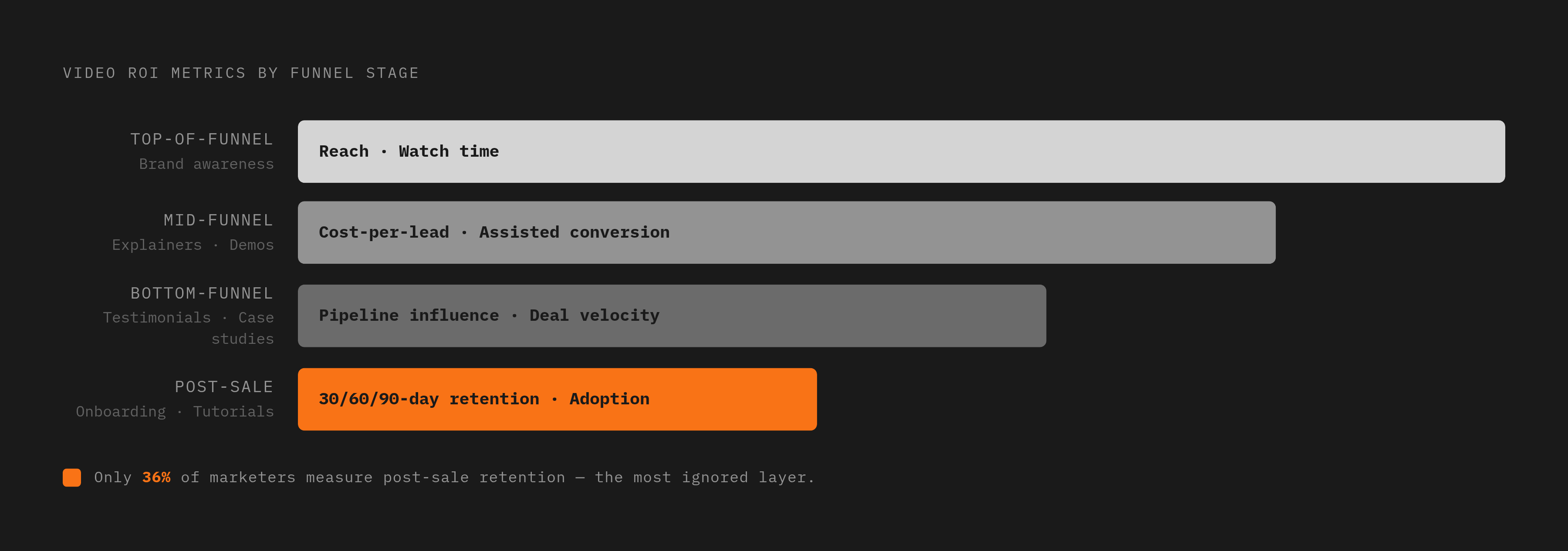
Onboarding videos, feature tutorials, and customer success content are almost never measured, and they may carry the highest financial upside per dollar spent of anything in a startup's video program. Video in this category shortens time-to-value, and time-to-value predicts renewal about as well as any metric in SaaS.
Only 36% of marketers count retention and engagement as a video ROI metric. Most startups are sitting on a lever they've never pulled or measured.
The measurement is straightforward. Compare 30, 60, and 90-day retention between customers who completed onboarding video sequences and those who didn't. Track feature adoption against tutorial completion. Then calculate what that retention gap is actually worth: a 5-point improvement in retention moves lifetime value harder than an equivalent bump in conversion rate does for most SaaS businesses.
There's a secondary savings line that almost nobody claims: tutorial video that answers a question before a customer opens a support ticket produces fewer tickets, fewer refunds, and real dollars saved, none of it visible on any dashboard until someone connects the data.
Fix attribution before it breaks your analysis
Only 36% of marketers say they can accurately measure content ROI, and 47% point to multi-channel attribution as the primary cause. This is an infrastructure problem, not a measurement philosophy problem.
A common failure: someone watches your brand video on LinkedIn, goes quiet for three weeks, resurfaces through organic search, and converts after a sales rep emails them. Last-click attribution assigns all the credit to the email and zero to the video that initiated the relationship. Top-of-funnel video gets shortchanged by last-click models, and even many multi-touch setups still underweight early touchpoints. Companies that move to more precise attribution platforms often discover their content was influencing far more conversions than their previous dashboard ever recorded.
Video shared over Slack, forwarded by email, or sent directly between colleagues represents real influence that is completely invisible to standard tracking tools.
For startups without a dedicated data team, three approaches are realistic. First-touch attribution works for awareness campaigns. Multi-touch attribution suits mid-funnel sequences where the buyer journey has enough steps to track meaningfully. Incrementality testing using holdout groups makes sense for bottom-funnel video where deal size justifies the additional setup.
What you can implement today: tag every video CTA with UTMs, feed video view data into the CRM so it lives on the contact record alongside other touchpoints, and add one question to every signup or demo form asking how the person heard about you. It won't capture every dark-funnel touchpoint, but it's often the only place one will surface at all.
Realistic production costs for startup video budgets
Many startups produce video on lean budgets, and that matters because it removes the assumption that quality video requires a large agency retainer. AI-assisted production tools have pushed per-minute production costs lower, and that trend continues as adoption grows among video marketing teams.
The right way to frame cost for an ROI calculation is to add production, distribution, and internal team time, then divide by pipeline generated or leads sourced. That produces a cost-per-outcome figure you can defend in front of a founder or board.
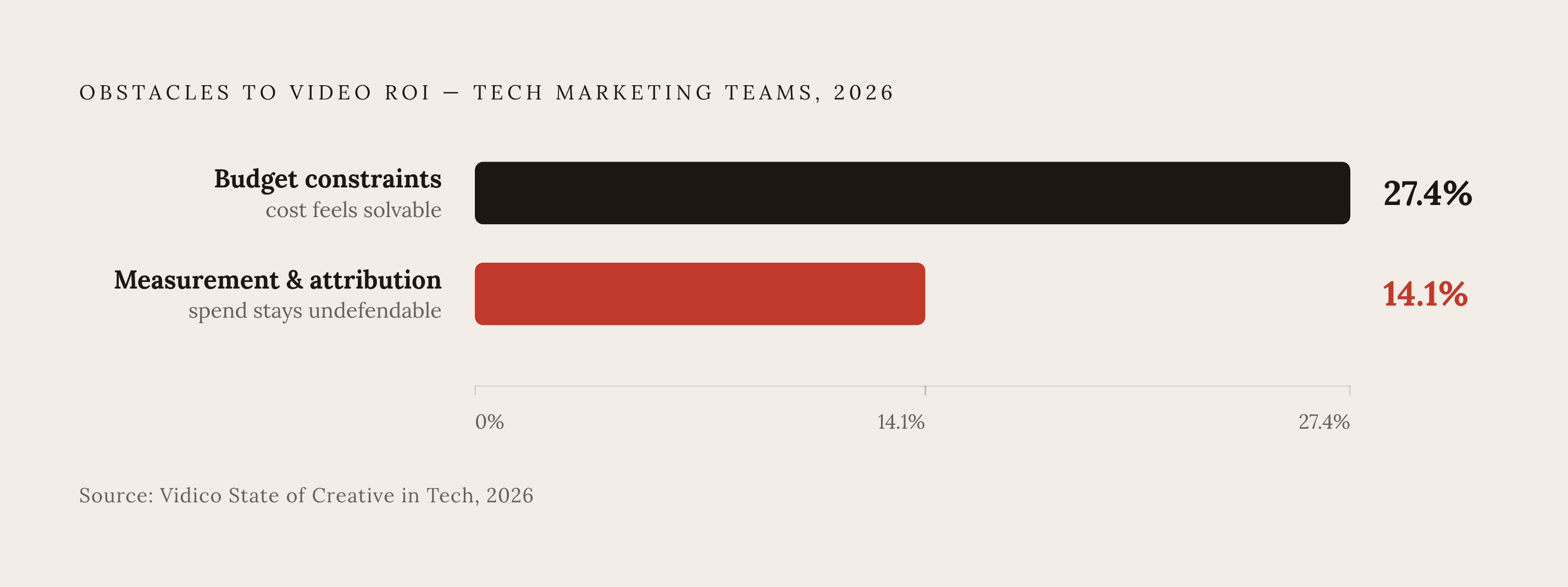
Budget remains the biggest obstacle to video programs, cited by 27.4% of tech marketing teams per Vidico's 2026 State of Creative in Tech report, with measurement and attribution close behind at 14.1%. Solving the cost problem without solving the measurement problem only addresses the smaller issue. You can produce video inexpensively and still have no idea whether it's working. Connecting spend to traceable outcomes is where the real leverage sits.
Format choice affects both sides of the equation. Short-form is cheaper and easier to A/B test, which is why it dominates top-of-funnel. Long-form costs more, takes longer, earns more SEO value, and holds attention longer, but it also demands more tracking infrastructure to demonstrate any of that actually happened.
Track search visibility and AI citation together
Your video content, especially explainers, case studies, and thought leadership, increasingly shapes what AI answer engines surface when someone asks a question about your category. Standard video dashboards track clicks, impressions, and conversions, but none of that tells you whether an AI model is reading your content, citing it, or naming your company in response to a relevant query.
If AI-sourced demand isn't tracked deliberately, it gets misattributed as direct traffic or credited to whatever channel touched the buyer last. This is the same attribution problem described earlier, applied to a channel that didn't exist a few years ago.
This is the layer Letterbrace treats as a first-class metric alongside traditional search authority. Every number appears as a rate with its confidence interval attached, not a bare count, so a zero means something specific: either a real visibility gap or broken tracking. Knowing which problem you're facing changes what you do about it.
Two questions now belong in any video ROI framework. First, is the content structured so an AI model can parse it clearly, with specific claims, named outcomes, and evidence tied to real results? Second, is anyone measuring AI mentions of your brand, or just assuming they don't exist because no one checked? A complete measurement system needs the funnel metrics covered above plus an AI-visibility layer running alongside them. Without the second part, you're measuring how last decade's buyer researched decisions while missing a growing share of research that happens where your current dashboard has never looked.

