Video in the Startup Sales Cycle
Matching video format to each sales stage boosts reply rates and shortens cycles.

Summary
Matching video format to each sales stage boosts reply rates and shortens cycles.
Video is everywhere in B2B sales now: 91% of businesses use it as a marketing tool this year, and 87% of B2B marketers have it baked into their strategy, according to the Content Marketing Institute. That means using video is no longer a differentiator. Knowing which video goes where in the sales cycle, and when to deploy it, is what actually moves revenue.
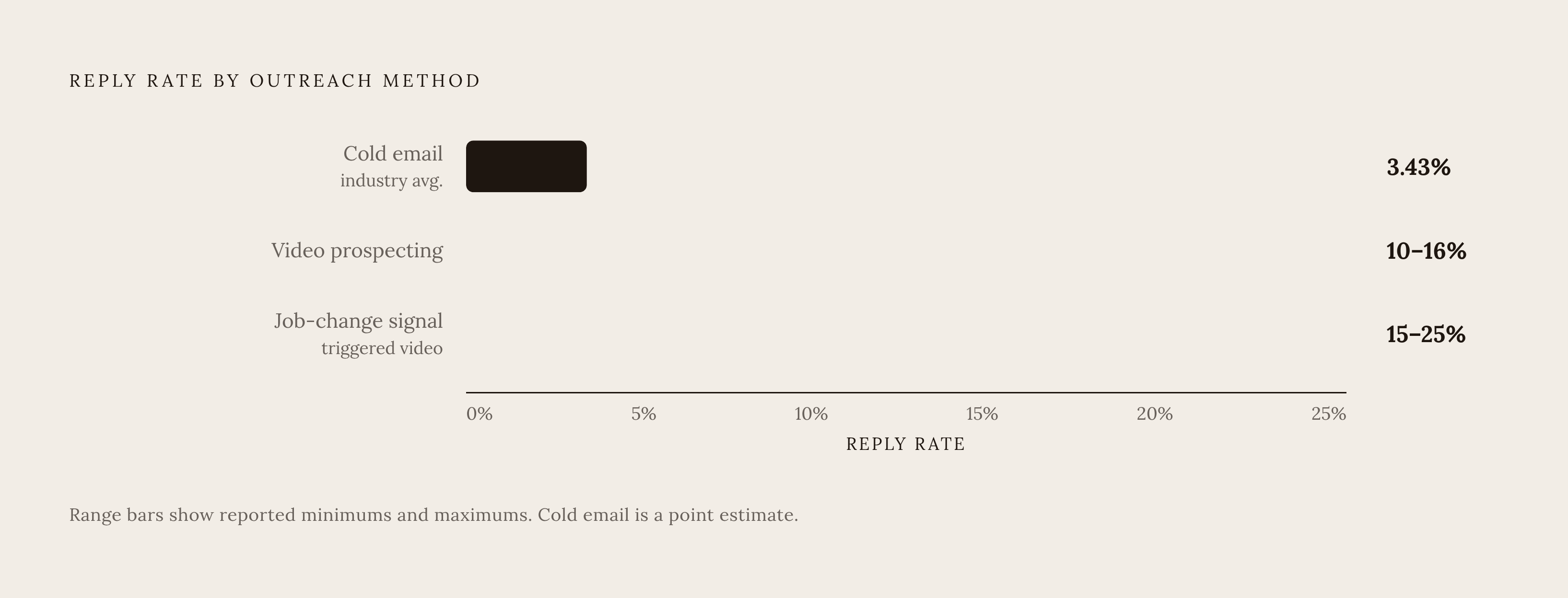
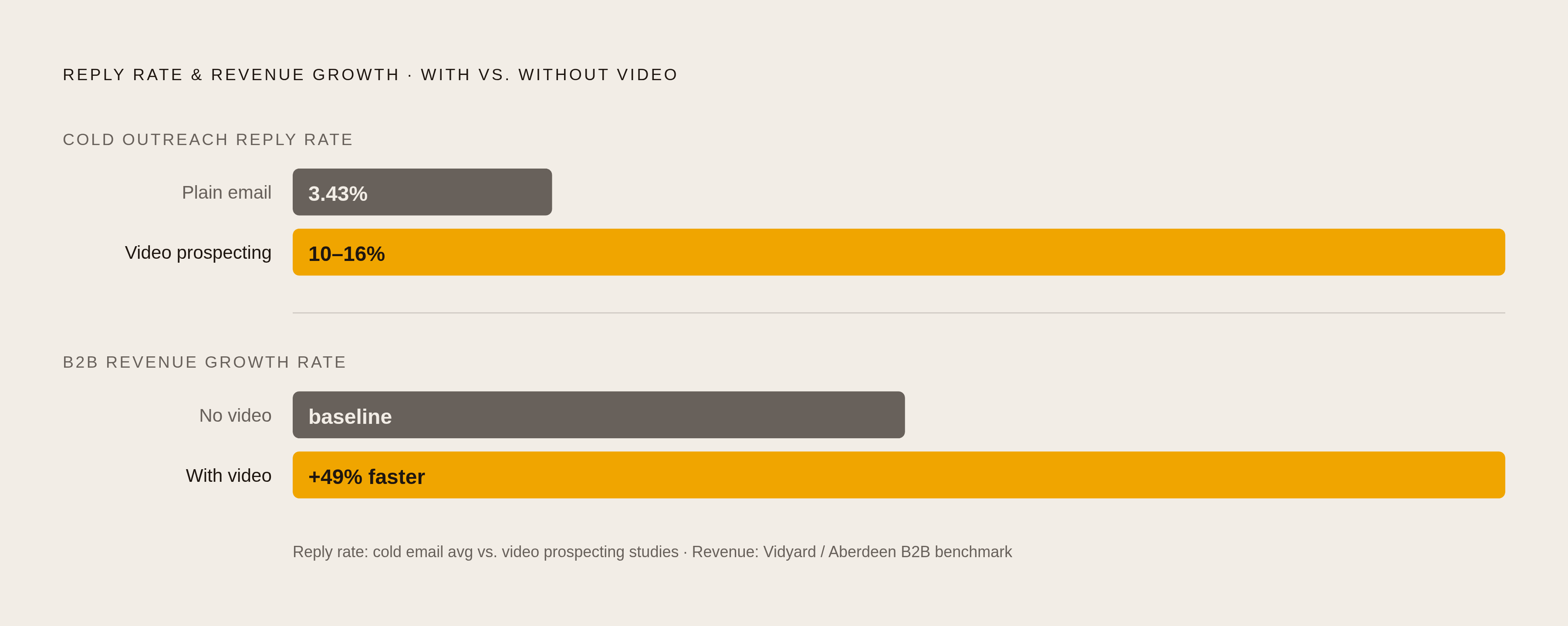
The numbers back up why this matters so much right now. Video marketers report direct sales impact 84% of the time, and B2B companies using video see revenue grow 49% faster than the ones that don't. Cold email reply rates sit at an industry average of 3.43%, while video prospecting pulls 10% to 16% reply rates. B2B video also shortens the sales cycle by 23% on average, which on a 10-month cycle means compressing the timeline by roughly two months.
The differentiation isn't whether you use video. It's whether you're using the right format at the right moment, for the right buyer, at the right stage of their decision process.
Why Stage-Matched Video Format Drives Results
A buyer at the top of the funnel hasn't yet established trust and has limited attention available. A buyer mid-evaluation is comparing multiple vendors across dozens of resources. A buyer at the closing stage is managing committee pressure and risk aversion. A buyer post-sale is focused on change management and product adoption.
Video that ignores which of these stages the buyer is in either asks too much of someone who isn't ready, or undersells at the moment they need conviction. This failure is rarely visible because the lead simply stops responding.
This matters more now because reps have less room to correct a bad format choice in real time. Gartner's 2025 research found B2B buyers spend only 17% of their total buying time actually meeting with vendors. Video is doing the selling in the other 83%, whether you've planned for that or not. And 6sense's 2025 B2B Buyer Experience Report found that 85% to 95% of eventual purchases come from whatever shortlist the buyer built on day one. Stage-matched video is there to earn a shortlist spot before the buyer ever contacts a vendor.
The framework has four stages: awareness, consideration, closing, and expansion. Each has its own logic, length, and job to do.
Top-of-Funnel Video That Earns a Response
Cold outreach video should run 30 to 60 seconds. Follow-up video, once context has been established, can stretch to 60 or 90 seconds before watch-through rates drop significantly. Length isn't the primary lever, though. Personalization is. A 1:1 personalized video gets a 16 times higher click-to-open rate than a generic one, according to DashClicks' 2025 data. A thumbnail that visibly signals the video was made for a specific recipient is the single biggest driver of click-through before anyone hits play.
Including the word "video" in a subject line lifts open rates by 7% to 13%. SalesLoft data shows video prospecting drives a 26% bump in replies over plain text outreach. Signal-triggered video tied to events like job changes, funding rounds, or product launches outperforms cold sequences by a wide margin. Job-change signals alone produce response rates in the 15% to 25% range.
Animated explainers and short social clips handle awareness at scale. Companies using video report 27% higher marketing-qualified lead rates than those that don't. One finding from B2B Decision Labs is worth noting: a group that received a short video followed by a short written summary accounted for 64% of all prospect meetings booked, even though that group replied to outreach less often than others. Fewer replies produced more meetings because the video-plus-summary format drove higher-quality engagement.
Mid-Funnel Video for Independent Buyer Evaluation
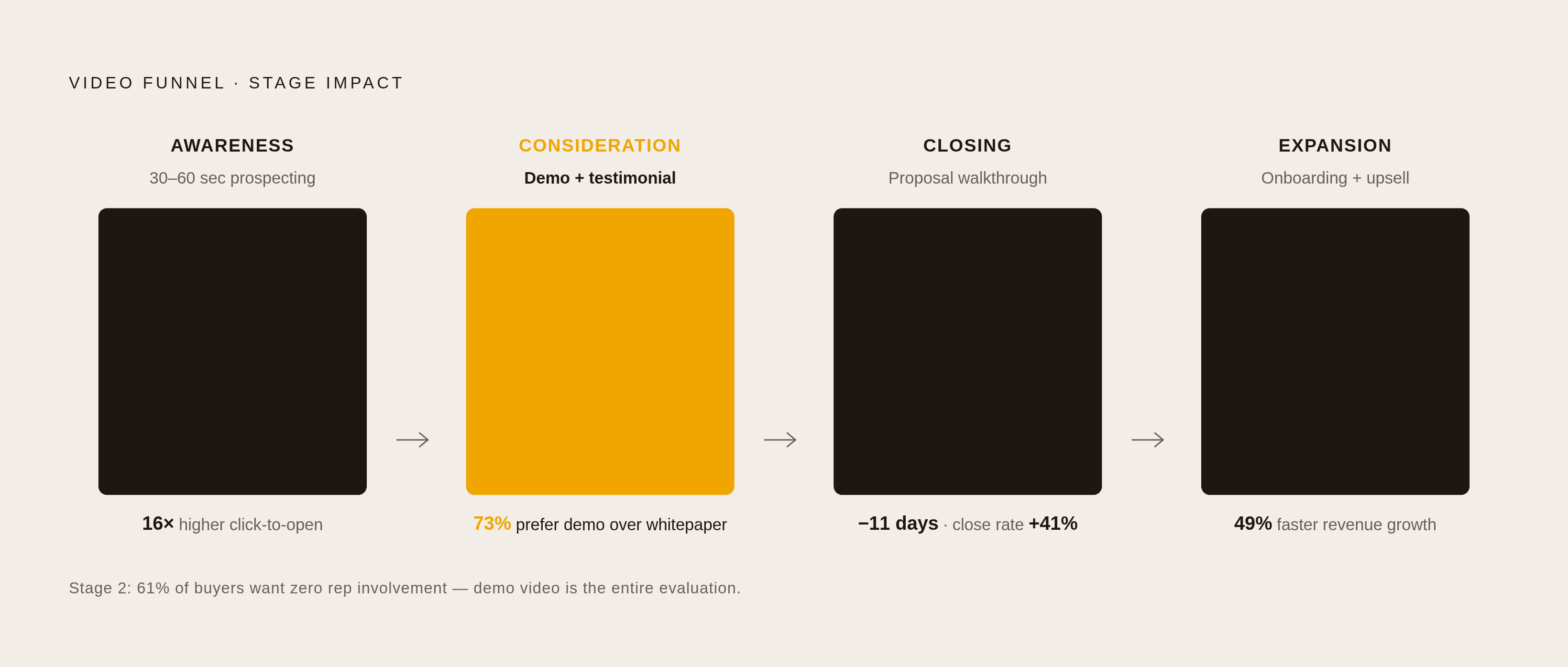
73% of B2B decision-makers prefer watching a demo video over reading a whitepaper. 61% say video helped them understand a complex product, versus 35% who say the same about written material. This stage is where most startups underinvest, and it's arguably the most consequential one.
Gartner's 2025 sales survey found 61% of B2B buyers now prefer a buying experience with zero rep involvement. The demo video isn't a preliminary step before a live call anymore. For a majority of buyers, it is the evaluation. If your demo video is ineffective, there may never be a live call to recover the opportunity.
72% of buyers say vendor video shapes their shortlist decision, and since 85% to 95% of purchases trace back to that day-one shortlist, missing this window typically means losing the deal before vendor contact begins.
The average B2B deal now involves 6.8 decision-makers. A rep can speak with one person at a time; a video can reach all 6.8 simultaneously, on their own schedule. Buyers are 44% more likely to forward a product video to a colleague than a brochure, which only gets shared 18% of the time.
The mid-funnel format mix should include detailed feature demos, customer testimonial video (which sees 31% higher engagement than standard product video, per Zebracat), and FAQ or objection-handling videos that address concerns proactively. Decision-stage videos built around ROI and pricing pull 39% higher engagement than generic sales video. That gap reflects a straightforward principle: specificity drives engagement, not production value.
Interactive demos are becoming the standard at this stage. Platforms offering them report a 32% average lift in conversions when interactive formats replace or supplement the standard demo video.
Closing-Stage Video That Moves Committees
Gong analyzed over 121,000 web-based sales meetings and found that closed deals involved webcam use 41% more often than lost deals. A visible face on screen, even in a recording, correlates with higher trust than audio alone.
Video proposals are underused at this stage. Gong Labs' 2025 data shows walking a prospect through numbers and terms on screen shortens the decision cycle by an average of 11 days. Video in proposals boosts close rates by up to 41%, according to Gong data cited by Vidyard. A committee reviewing a static PDF without the rep present to clarify the content will frequently generate objections that a video walkthrough would have preempted.
This is the committee dynamic appearing again, later in the process. A video proposal carries the rep's framing and context as it moves through an organization. A PDF forwarded through multiple stakeholders loses that context at each step.
Landing page video also plays a closing role, particularly for self-serve or product-led motions. Video on landing pages lifts conversions above text-only pages, with the largest effect for complex B2B SaaS products where the cognitive load of evaluation is high.
Keep bottom-of-funnel video under two minutes, specific to the prospect's actual situation, and paired with a clear next step.
Post-Sale Video That Drives Expansion Revenue
This is the stage most startups overlook, and it has a direct cost. B2B marketers using video see 49% faster revenue growth overall, and a large majority of B2B organizations now include video in onboarding, according to Zebracat. The customer who fully adopts your product is the same customer who buys the next tier up. Onboarding video is structurally the top of your expansion funnel, and treating it as an afterthought delays or eliminates the second sale.
Vidyard's State of Virtual Selling Report found a substantial majority of the job roles studied reported success using custom-recorded video across demo, onboarding, upsell, and renewal moments. The same format that drives initial deals works equally well for keeping accounts healthy after close.
Specific formats worth building include feature walkthrough videos triggered by in-product behavior, QBR recap videos, upsell pitches personalized around actual usage data, and renewal walkthroughs that mirror the proposal format used at closing. Startups that build video into post-sale touchpoints reduce the time between product adoption and readiness to expand, applying the same cycle-compression mechanics inside accounts they already own.
AI Tools Cut Video Production Time Significantly
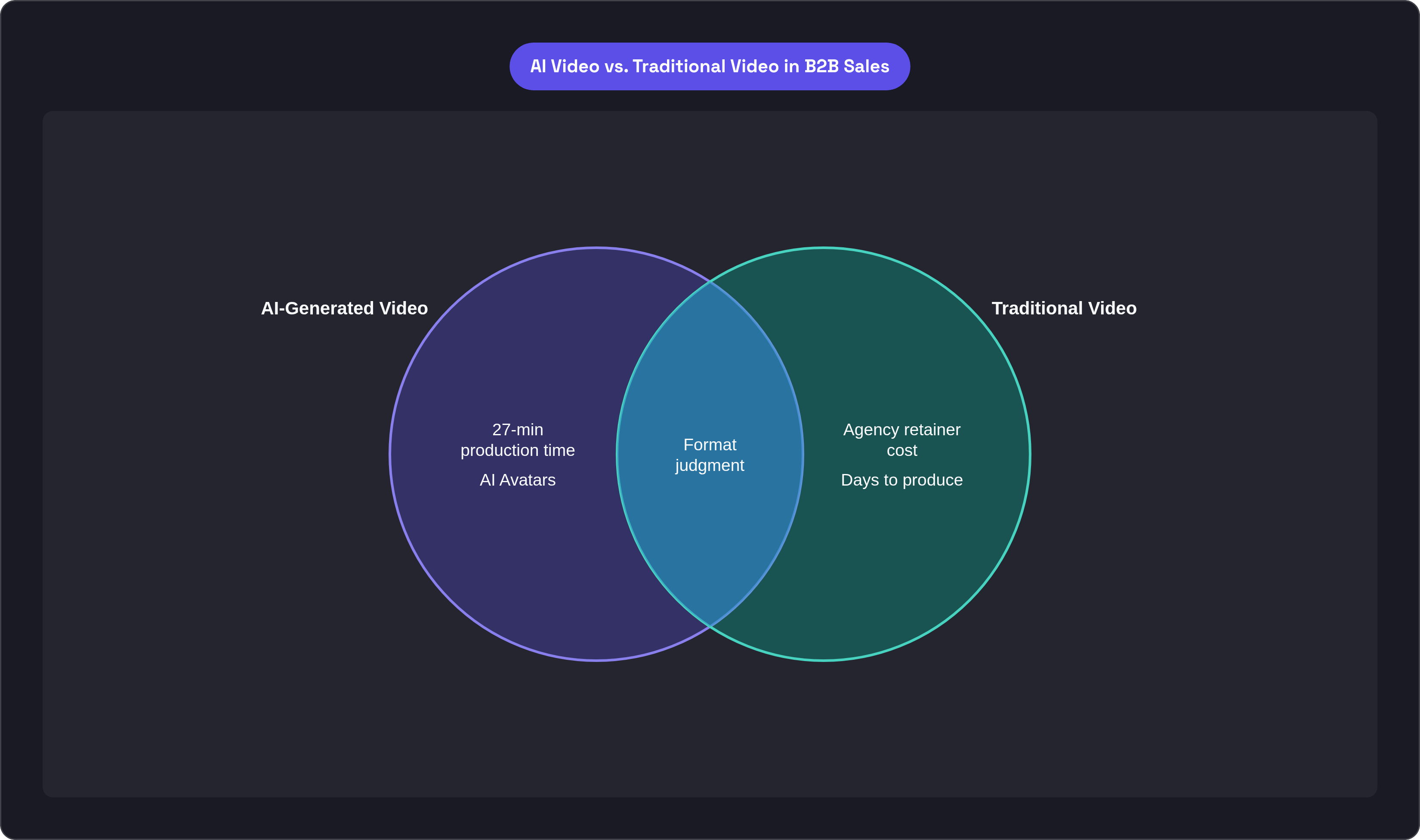
AI-powered editing, scripting, voiceover, and generation tools have cut production time dramatically. GenMediaLab data puts a 60-second marketing video at roughly 27 minutes to produce now, compared to what previously required days. Teams are producing significantly more video on the same budget. Vidyard launched AI Avatars in April 2024, and by December adoption had jumped 12x. A growing majority of video marketers say they've used AI tools to create or edit video, up significantly from the prior year, per Vidico.
A two-person content team can now maintain a full stage-matched library, including awareness clips, demo recordings, proposal walkthroughs, and onboarding tutorials, that previously required an agency retainer. However, AI lowers the cost of making video without improving judgment about what that video should say or to whom. AI-generated video that ignores stage fit fails for the same reasons poorly planned human-made video fails: wrong length, wrong format, wrong level of specificity for the buyer's actual stage.
A Video Plan Startups Can Actually Execute
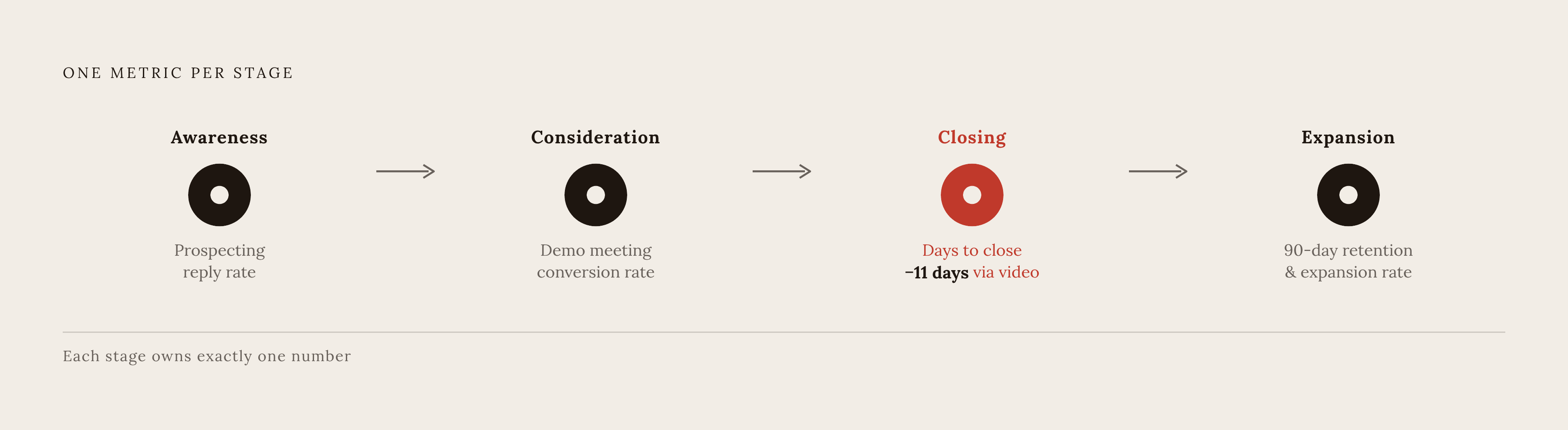
Start narrow. Build one strong mid-funnel demo video, which has the highest buyer preference and the easiest ROI to measure, and one personalized prospecting format. Get those two producing measurable results before adding closing and onboarding video on top. Building all four stages simultaneously with a small team typically produces four incomplete libraries instead of one that works.
Each video type needs one primary metric:
Prospecting videos: reply rate
Demo videos: meeting conversion rate
Proposal videos: days to close
Onboarding videos: 90-day retention or expansion rate
The most common mistake is building a large library for one stage, usually awareness, while leaving mid-funnel and post-sale video underdeveloped. Buyers who can't evaluate the product independently, or onboard themselves after purchase, exit cycles that the right video would have retained.
Buyers now arrive roughly 61% through their own evaluation before contacting a vendor. If your awareness video doesn't link directly to a demo they can watch independently, you lose them at the handoff point when they were ready to engage further.
Stage-matched video also compounds over time. A testimonial captured at renewal becomes mid-funnel proof for a new prospect six months later. A demo video refined across 50 prospect viewings becomes a more accurate and persuasive version of your pitch than any live improvisation. For most teams starting from zero, the constraint is not budget. AI tools have largely removed that barrier. The real constraint is having a clear answer to what job each video is doing, for which buyer, at which exact stage of the cycle.