Founder-Led Video Content as a Growth Channel
Founders outperform brand accounts on video because credibility can't be faked or delegated.

Summary
Founders outperform brand accounts on video because credibility can't be faked or delegated.
91% of businesses now run video as a marketing tool, and three years ago that number sat at 86%. Video isn't the edge anymore — it's the price of admission, and founders who treat it like a shortcut are going to get lapped by founders who treat it like a channel.
Here's the thing nobody wants to say out loud: the format arms race is over, and everybody won. Short-form video has topped the ROI charts for three years running, and ninety-three percent of marketers report positive returns. Seventy-eight percent of buyers would rather watch a 90-second video than read a paragraph (only 9% prefer text, which, sorry copywriters, is rough). When adoption gets that close to universal, the format itself stops telling you anything. Polish has stopped being the differentiator, and now it's about who's talking.
What founders actually bring to video that a brand account cannot replicate
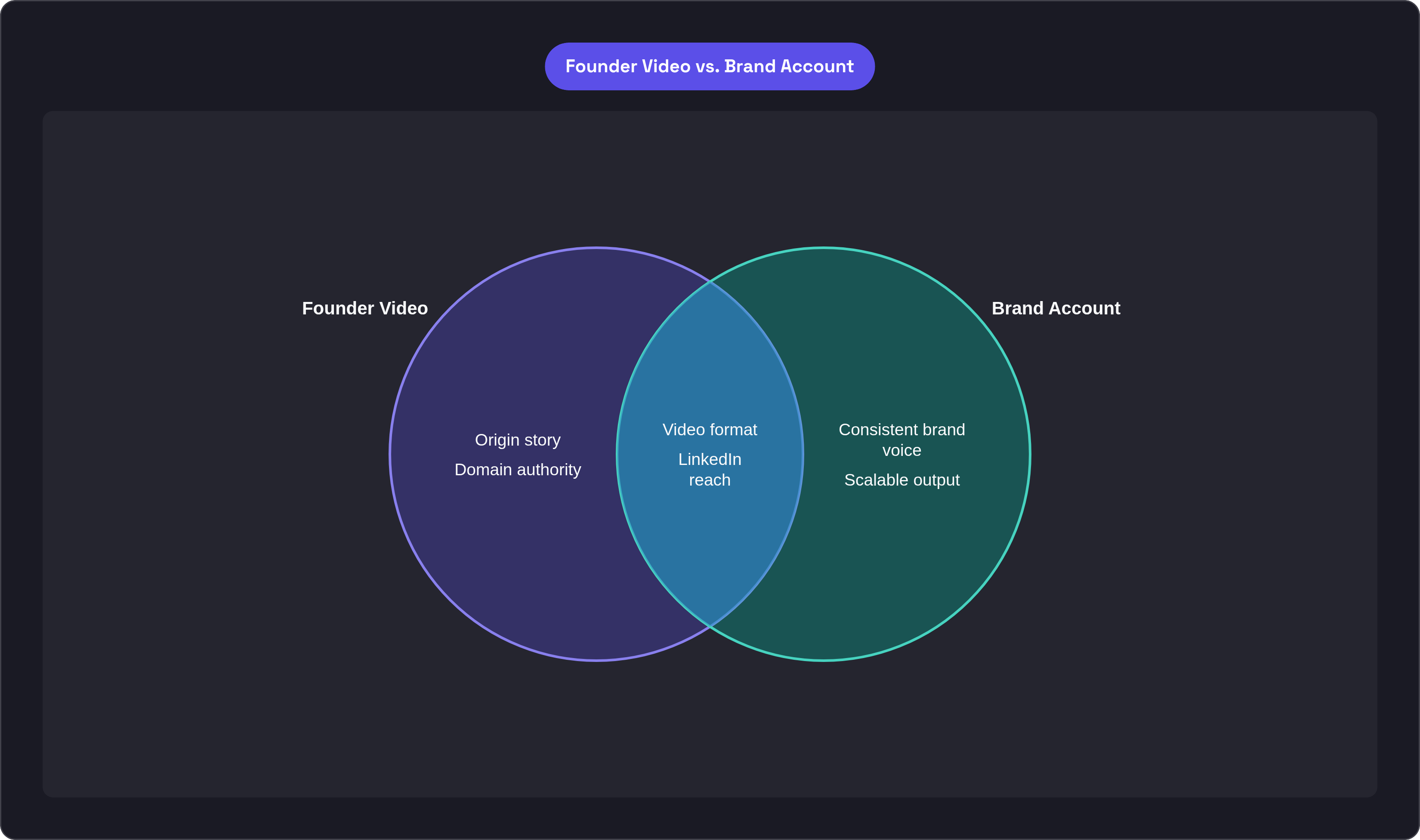
A brand account can post video all day, but it cannot bleed for the product, and that gap is the whole game.
Founders bring three things a logo never will. Domain authority: they built the thing, broke it twice, and fixed it at 2 a.m., so when they talk about the problem, it doesn't sound like it came from a briefing doc. Origin story: nobody can hand you a founding myth in a content brief, because it either happened to you or it didn't. And unscripted conviction: an actual opinion, stated by someone with real professional skin in the game, not a hedge sanded down by seven rounds of legal review.
The numbers back this up in ways that should make any marketing team sit up. People are 82% more likely to trust a company when its senior leaders show up on social media, and on LinkedIn specifically, posts from a founder or CEO get 3x more engagement than the same message from a company page. Same platform, same audience, wildly different outcome, because the source changed, not the content.
This isn't just a vanity metric dressed up as a vibe. Executives themselves estimate that 44% of their company's market value traces back to CEO reputation, according to Weber Shandwick research. That's balance-sheet adjacent, and meanwhile 67% of Americans say they'd spend more with a company whose founder's values line up with their own, per Brand Builders Group. Value alignment, it turns out, travels faster through a face than through a mission statement.
So let's kill the myth up front: authenticity isn't the mechanism here, it's the byproduct. The actual mechanism is credibility, and credibility is something a founder holds that a brand page simply cannot fake. A marketing team can write "we care about customer success" a thousand different ways, but it cannot fake the founder knowing exactly which part of the onboarding flow breaks, because they built it, and they were the ones fielding the angry email about it.
Where founder video actually performs — the platform picture for B2B
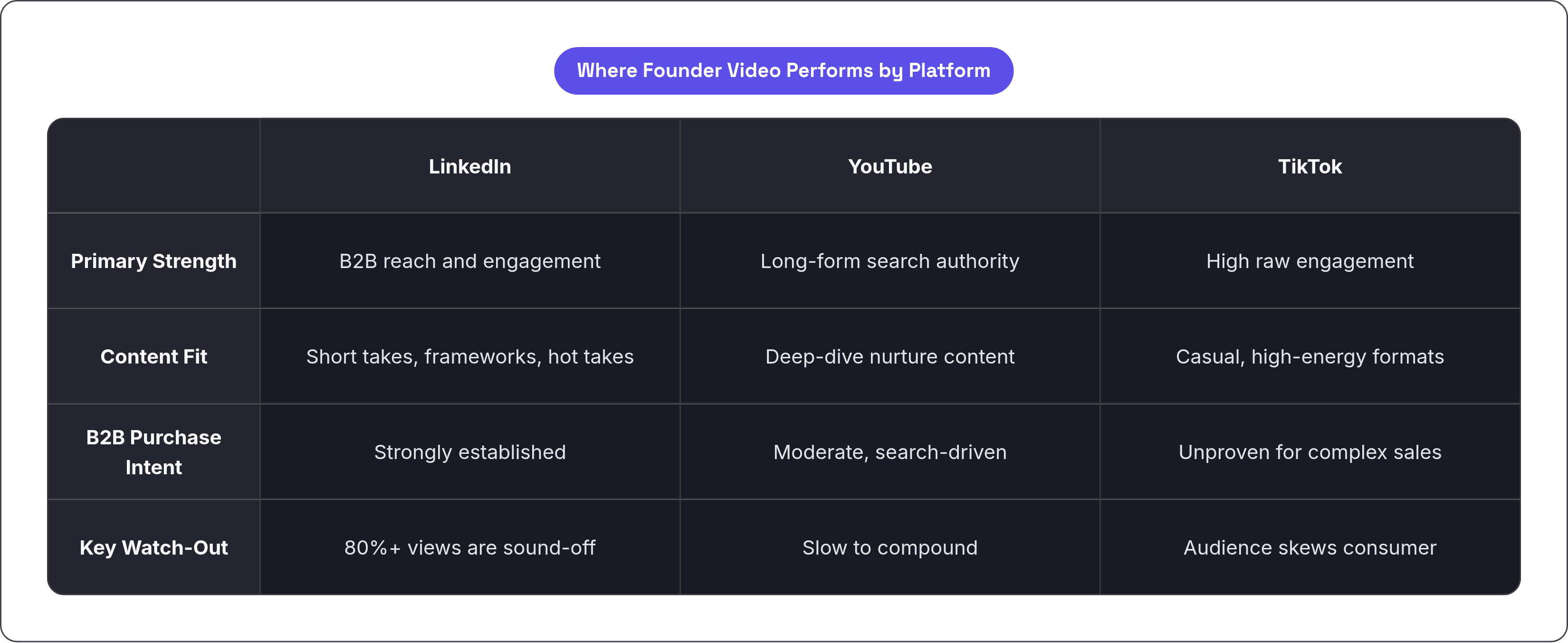
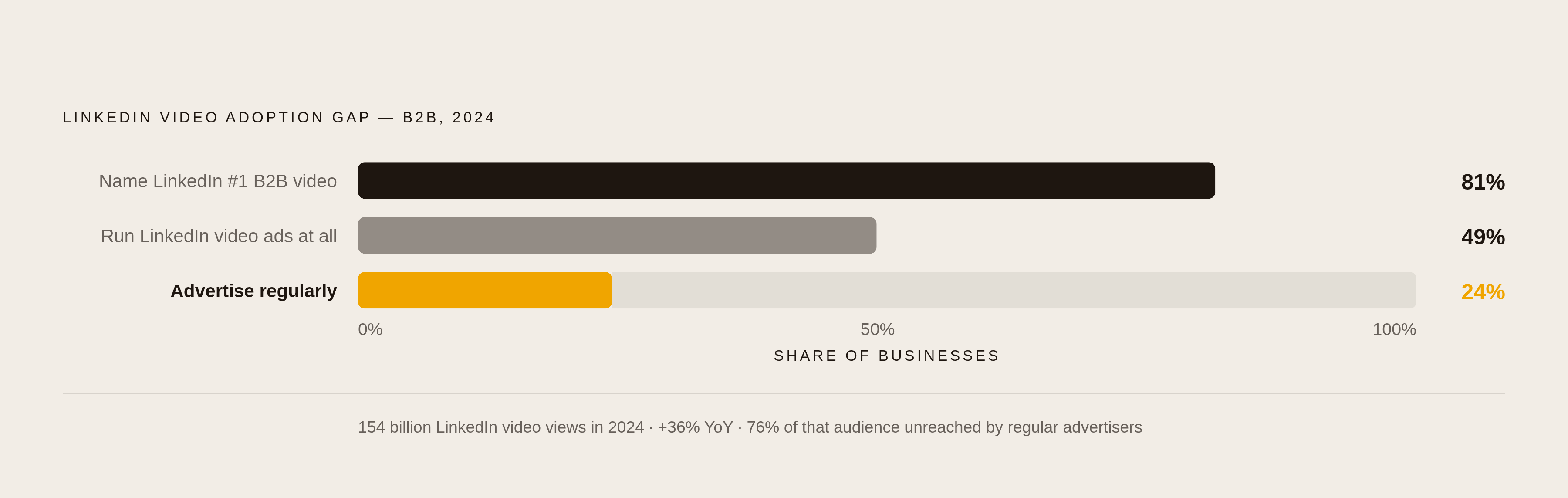
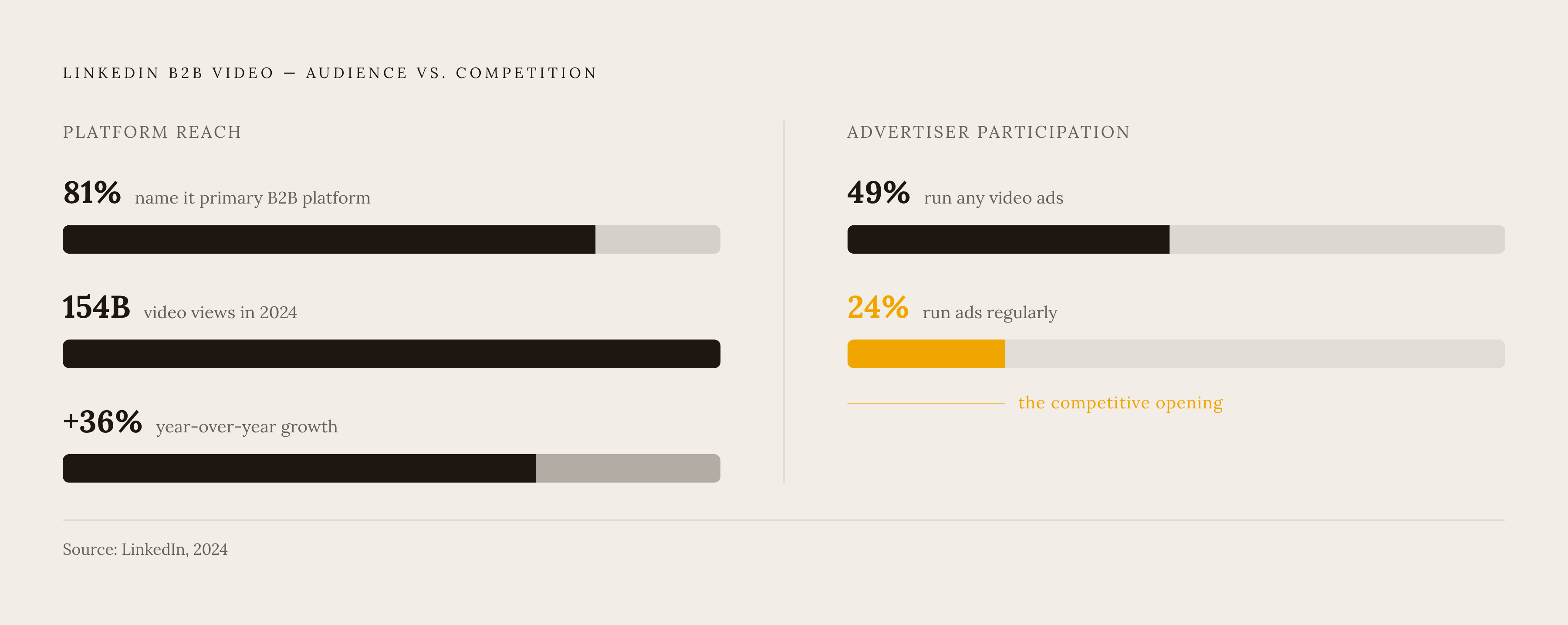
If you're a B2B founder wondering where to actually put your energy, the data has already made the decision for you. LinkedIn passed YouTube as the top B2B video platform, with 81% of businesses now naming it their primary channel, according to Wistia's 2026 State of Video Report. That's the allocation signal, so stop debating it.
The scale of what's happening there is genuinely wild. LinkedIn logged 154 billion video views in 2024, up 36% year over year, while video impressions climbed nearly 73% and views climbed over 52%. The audience is growing faster than the content that's supposed to fill it, which is the kind of gap that doesn't stay open forever. CEO video posts are already up 52% over two years, so the window is closing, not opening.
Here's the part that should actually get founders moving: only 49% of businesses run LinkedIn video ads at all, and just 24% do it regularly. Translation: most of the audience is sitting there, reachable, with almost nobody competing for it — an empty room with the lights on.
YouTube still matters, but it's a different job entirely. It's built for long-form nurture and search-indexed authority, the kind of content someone finds eight months after you published it because they searched a specific phrase. TikTok has real engagement numbers too, higher than most platforms, but the audience skew leans consumer, and for enterprise or complex-sale B2B, the purchase intent just isn't proven yet. Fine for DTC, less fine if you're selling six-figure software to a procurement committee.
One production detail changes everything: over 80% of LinkedIn video views happen with the sound off on mobile. That's a structural requirement, not an accessibility footnote, and if your opening three seconds depend on audio, you've already lost the scroll.
The creative signals that separate founder videos that build pipeline from those that get ignored
LinkedIn's Creative Labs team ran machine learning across thousands of B2B video ads and over half a million individual frames. That's a big enough dataset to describe structural patterns, not anecdotes cherry-picked from a few viral posts.
The headline finding: named subject-matter experts speaking conversationally drove a 40% lift in engagement over generic, formal delivery. Forty percent isn't a rounding error, and it's something any founder can act on tomorrow without hiring a single new person.
Two creative approaches came out on top in the research: "Expert Takes," where a credentialed person states an actual position, and "Human Touch," where there's a visible, unscripted moment on camera. Both of those are things a founder does naturally and a brand account can't fake with a stock photo and a caption.
Timing matters too, and it's brutal. On TikTok, a strong majority of videos that surface the key message in the first three seconds get higher click-through, and that principle travels across platforms. Founders who spend the first fifteen seconds thanking everyone for watching and setting the scene are burying the one thing that made someone stop scrolling in the first place.
A few formats keep showing up as reliable performers for founders on LinkedIn: the 60-second hot take on something happening in the industry right now, the two-to-three-minute framework breakdown that walks through a structured idea, and the conversational problem-solution video that just talks through a buyer's actual pain. None of these require a production crew.
That brings up the thing worth saying plainly: production quality is not the lever. The research doesn't show polish moving the needle, it shows framing, message structure, and visible expertise doing the heavy lifting. The conviction piece is real: a founder stating an opinion, including one some prospects will disagree with, outperforms a founder reciting brand-safe talking points. The willingness to be wrong in public is, weirdly, what makes people trust you're right about the rest.
Turning a founder's natural output into a repeatable content format strategy
Most founder video efforts don't die from a lack of ideas. They die from too many ideas and zero constraint, because when every video could be about anything, nothing gets made — "what should this be about" is a much harder question to answer at 6 a.m. than "what goes in this week's hot take."
Format constraint fixes that. Pick two or three repeatable structures, say one hot take a week and one framework breakdown a month, and the only decision left is what content fills the slot. That's a much smaller, much less exhausting problem.
This shift is already happening at scale. Nearly three out of four small business owners are stepping into something like a creator identity now, according to a Constant Contact survey of over 5,000 people, and 47% personally manage their own company's social accounts. That's real, but it's also a warning sign, since managing it personally without a system doesn't scale, it just burns you out faster.
The logistics matter more than people admit. A founder's week is already full of raw material: customer calls, internal arguments about roadmap, live problem-solving on a support ticket. The job isn't creating new content occasions, it's capturing the ones already happening without adding meetings to the calendar.
LinkedIn's own data shows short-form video is growing twice as fast as any other post format on the platform right now. The platform is rewarding volume and consistency over sporadic polish, which is good news for a founder who'd rather film something on their phone between calls than storyboard a campaign.
Distribution compounds in a way founders underestimate, too. Ninety percent of employees agree that an active leadership presence improves how the company is perceived, and when the team reshares a founder's video, that's an audience multiplier no paid campaign can buy for an early-stage company. Credibility doesn't reset between videos either; each one trains the audience to expect a specific kind of value, and that expectation is exactly how channel trust turns into pipeline over time.
How to measure whether founder video is actually building a growth channel
Different metrics answer different questions, and mixing them up is how founders convince themselves a channel is dead when it's actually just slow. Impressions and views tell you distribution worked, engagement rate tells you the message actually landed, and DMs, demo requests, and inbound mentions tell you it's turning into pipeline.
For calibration, Socialinsider's 2025 LinkedIn Benchmarks, built from a million posts published across 2024, found video posts averaging a 5.60% engagement rate by impressions, versus 5.20% platform-wide. Use that as a reference point, not a finish line.
Here's where it gets slippery: 82% of B2B decision-makers say creator content on LinkedIn shapes their purchasing decisions. Yet that influence doesn't show up neatly attached to a single video — it surfaces weeks or months later, in a sales call where someone says "yeah, I've been following your stuff." Judge founder video on a 30-day window and you'll systematically underrate it, then kill the channel right before it was about to pay off.
Better to track leading indicators instead: growth in followers who actually match your ideal customer profile, DM volume from buyers rather than just peers being nice, mentions of a specific video showing up in sales conversations, and shares and links coming from people in your industry rather than your mom. These show up before the pipeline does, which is the whole point of a leading indicator.
A video with zero engagement isn't proof the channel is broken, it's a diagnostic. It's either a distribution problem (wrong audience saw it), a creative problem (no credible signal in the first three seconds), or a format problem (doesn't match how the platform's algorithm treats native content). Figuring out which one it is matters more than moping about the number itself.
One more wrinkle worth naming: buyers are increasingly asking AI tools who they should talk to about a given problem. A founder's consistent video presence, especially when it gets cited in written recaps or show notes or articles, becomes something those AI systems can actually read and surface. Whether a founder gets named in an AI-generated answer is still a young metric, but it's becoming a real part of what content authority looks like.
What a sustainable founder video program looks like in practice
The minimum viable version of this is almost insultingly simple: one format, one platform, one cadence. Consistency on a single axis beats a scattered presence across five platforms almost every time, especially early on.
Budget-wise, 57% of marketing teams now carry a dedicated line item for short-form video. Founders without a marketing team don't need that budget line, they need the equivalent: protected calendar time and a capture workflow simple enough to survive a bad week. That's the actual resource commitment, not a camera or a lighting kit.
Brands that pair video with a genuine influence strategy, meaning a real person building real trust, end up more than twice as likely to be seen as trustworthy and nearly twice as likely to be well known. That compounding effect is real, but it only shows up with sustained presence, since one good video does not a channel make.
At some point, scale forces a question: does founder video have to stay entirely founder-operated forever? The shift from founder-as-only-voice to founder-as-anchor, backed by a broader content system, needs to be a decision someone makes on purpose. Left alone, it drifts into brand-speak, and brand-speak is exactly the thing that got you here in the first place.
This is also where video and written content need to stop being treated as separate departments. Video earns the trust and gets the scroll to stop, while written content — the articles, the newsletters, the pages that get indexed and cited by AI systems — is what catches that attention and turns it into something durable. A founder who nails the video but has nowhere for that trust to land afterward is leaving pipeline sitting on the table. This is the exact gap Letterbrace is built to close: a system for publishing editorially credible written content alongside a founder's video presence, tracking both traditional search visibility and AI citation, so the trust earned on camera has somewhere durable to go once the video ends.
The real test of whether founder video has become a channel, rather than a hobby with good intentions, is whether it produces inbound reliably enough that you can plan around it. Getting there takes format discipline, honest measurement, and knowing your audience well enough to stop guessing. Volume alone was never going to get you there.

