Video Content Goals for Early Stage Startups
Focus on explainers and demos first to build understanding before chasing vanity metrics.

Summary
Focus on explainers and demos first to build understanding before chasing vanity metrics.
Generic video marketing goals look like: increase awareness, grow reach, improve engagement. Those are fine goals. For companies with existing audiences. That is not you.
At the early stage, you're still figuring out who your best customer actually is. Your messaging is shifting. The product itself is probably shifting. Setting goals around reach and engagement before those fundamentals are locked means you're optimizing for distribution before you've figured out what you're distributing. That's not a strategic problem. It's a money problem.
The specific failure mode plays out the same way every time. Teams invest in polished, feature-heavy product videos before the product or the customer profile is stable. Then the product changes. The video is outdated. The footage cost more than it ever earned back. I've watched this happen to smart founders who knew better and did it anyway because the video looked good in the moment.
VSC Studio, a firm that works with venture-backed startups, has a framing I keep coming back to: seed-stage brands need one product video, Series A brands need three, and the count grows as the business matures and has more stable things to say. That's not a content calendar. That's a discipline.
One principle worth holding onto: when the product is still evolving, invest in videos that explain your perspective and the problem you're solving. Features change. The problem you're solving usually doesn't.
Making Strangers Understand What You Built: The Explainer and Demo as First Priorities
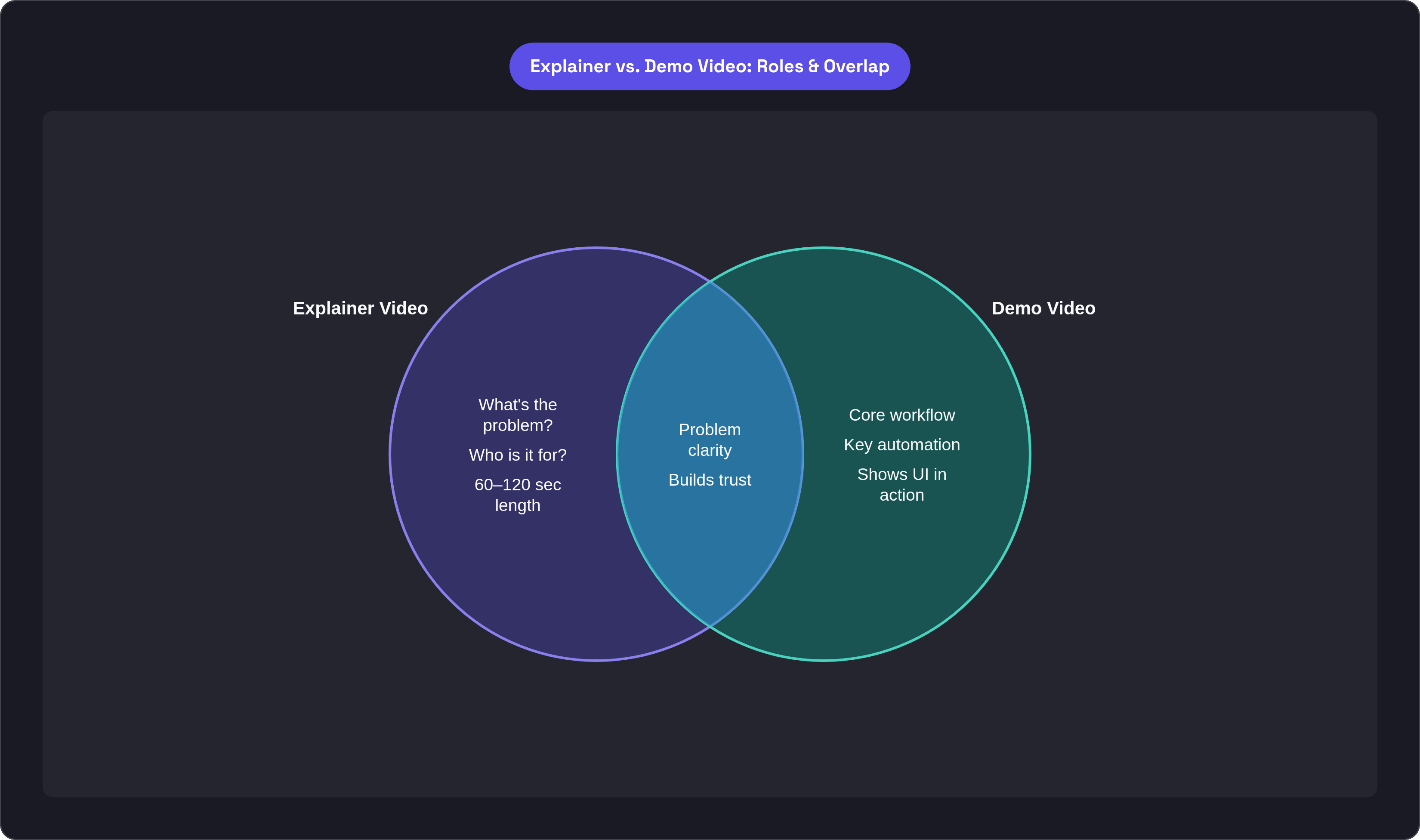
Before anyone trusts you or buys from you, they have to understand you. For novel products and new categories, that understanding is not guaranteed. People will not work hard to figure out what you do. That is your actual first job.
Explainer videos exist for exactly this. Three questions, answered in plain language:
- What's the problem?
- What's your solution?
- Who is it for?
No assumed knowledge. No jargon. Just clarity.
Demo videos have a related but different job. A demo should show the core workflow and the moment where it clicks for the viewer. Not the exhaustive feature tour. Not a UI walkthrough of every screen. Just: here's the problem, here's how we solve it, here's what that actually looks like in practice.
I've seen a B2B analytics startup swap a static screenshot on their landing page for a 75-second product demo showing the onboarding flow and a single key automation. Conversions went up 18% in four weeks. No massive production budget. Just showing the right moment, clearly.
On length: 60 to 120 seconds is the target for explainers. Most research lands on the same window. Stay in it.
What to avoid is equally specific. Don't lead with company history. Don't open with the founding team. Don't front-load a feature list before the viewer understands why they should care. Nobody cares about features until they care about the problem. This is not a stylistic preference. It's just how attention works.
Building Purchase Confidence Before You Have a Track Record
Trust is the scarcest resource a new company has. Established brands accumulate it through years of familiarity and word of mouth. You don't have that yet. Video is one of the few shortcuts that actually works, and I mean that literally, not as a motivational claim.
The research backs it up: 87% of consumers feel more confident purchasing a product after watching a video about it (Wyzowl, 2025). For early-stage companies specifically, that number is doing a lot of work. Confidence is exactly what you need to manufacture before your reputation can do it for you.
Founder-led video is the most underused format here. It humanizes the company. It puts a real face and voice behind the claim. About 70% of consumers say they're more likely to buy from a brand where the founder personally shares the company's story. You have something established brands genuinely cannot buy: the authentic origin story, told by the person who lived it. Use it before you've convinced yourself it's not "professional" enough.
Dollar Shave Club made a $4,500 founder video and generated 12,000 orders in 48 hours. What drove results wasn't lighting or editing. It was a real person talking directly to the camera in plain language, explaining why they built the thing and who it was for. That example is old now. It still holds.
Customer testimonials work the same way when you have them. Social proof from a real user is more credible than anything you say about yourself. At the earliest stage, even one honest testimonial from one real customer is worth producing.
Converting Site Visitors Who Already Understand and Are Interested
Landing pages are where comprehension and trust either translate into action or don't. This is a different video goal from the explainer. It assumes the viewer already understands the category. They're not asking "what is this?" They're asking "is this right for me?"
Landing pages with embedded video convert at significantly higher rates than text-only equivalents. For B2B SaaS, explainer videos on landing pages have produced conversion lifts exceeding 100% in controlled testing. Those are not marginal improvements. They're advantages you're leaving on the table if you skip this.
The conversion video has a different job than the awareness video. It needs to show proof, reduce risk, and answer objections. Re-explaining the basics is a different task for a different video. If you mix the two, you end up with a video that does neither job well.
Formats that work here:
- Demo videos showing the product solving a recognizable, specific problem
- Customer testimonials from people who match your ideal customer profile
- How-to content that targets keywords your ideal customer is actively searching
The conversion video assumes a warmer viewer. Meet them at that stage. Don't drag them back to the beginning.
Using Video to Reach Investors Before You Have Traction to Speak for Itself
Investors are a parallel audience with their own comprehension and trust problem. They see hundreds of pitches. They need to quickly understand what you do and decide whether you're worth more of their time. A video gives you a repeatable asset that carries your presence, your energy, and your clarity into every conversation before it starts.
Y Combinator now requires a one-minute video where founders introduce themselves and explain what they're building. That format has become standard across accelerator applications and crowdfunding platforms. If YC is requiring it, the signal is pretty clear.
A video in a cold outreach email is one of the few things that can make a pitch feel less cold. Accelerant, an insurance technology company, used explainer video as a core part of its investor communications on a trajectory that led to over $1 billion raised and a $6.4 billion IPO valuation in 2025. The asset wasn't decorative. It was functional.
A minimum investor video kit, practically speaking:
- Elevator pitch (60 to 90 seconds): who you are, what you do, and why now
- Problem-solution explainer: the market gap and your answer
- Traction or product demo: show it working, or show the numbers if you have them
- Team or founder story: credibility through origin, not credentials alone
Here's the thing most founders miss: investors care more about team, market size, and momentum than about feature demonstrations. That's different from what your customers care about. Know which audience you're making the video for before you script a single line.
Sequencing These Goals When You Can't Pursue All of Them at Once
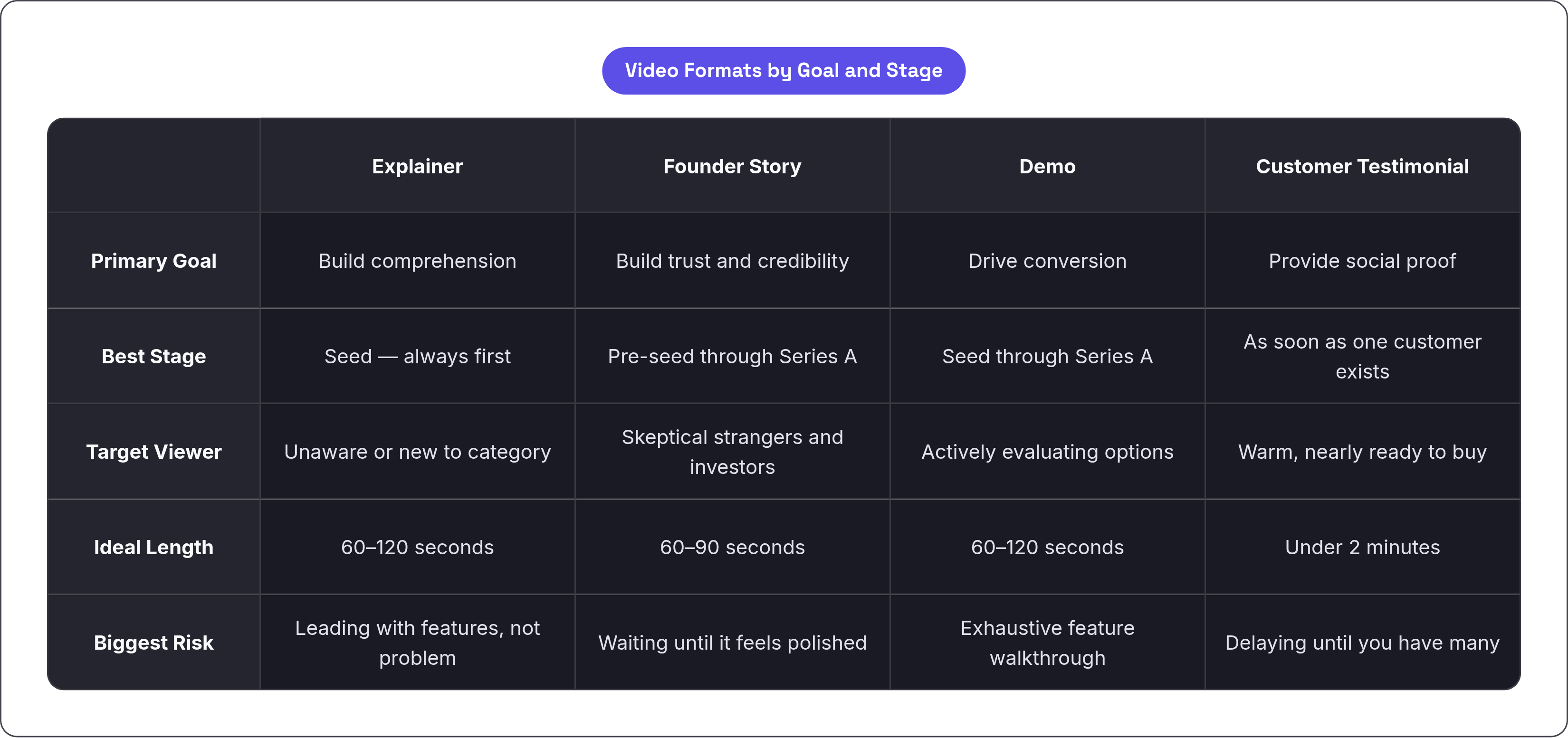
You can't do all of this at once. A small team that tries to pursue every video goal simultaneously ends up with mediocre content across the board. Pick a lane before you pick a camera.
Think in four tracks:
- Demand generation (awareness, new audience)
- Conversion (demos, signups, sales)
- Retention (onboarding, product adoption)
- Founder brand (credibility, recruiting, partnerships)
Pick one and go deep before splitting your attention.
A quick diagnostic: where does your target viewer actually sit right now? Are they unaware of the problem? Aware of the problem but not your category? Do they know your category but not you? Are they actively evaluating? Most startups discover they've produced too much top-of-funnel content and too little conversion content. The awareness video exists but the landing page video doesn't. That's a common and fixable mismatch.
The VSC Studio ladder applies here: one video at seed stage, more as things stabilize. Don't build a content matrix before the foundation is solid.
Channel discipline matters just as much as format discipline. Start with two or three channels. LinkedIn plus YouTube. Short-form social plus your landing page. Spreading production resources across six platforms trying to be everywhere at once is how you end up with nothing that works anywhere.
Repurposing is your best force multiplier. One longer video becomes multiple short clips, newsletter content, and social posts. One hour of filming can generate weeks of distributed content if you plan for it from the start. Most teams don't plan for it from the start.
How Short-Form Video Fits into an Early Startup's Goals Without Becoming a Distraction
Short-form video under 60 seconds was the most popular content format among marketers in 2025, ahead of long-form video and blog posts. For B2B specifically, 81% of B2B teams now share video on LinkedIn, making it the top distribution platform for B2B content, ahead of YouTube for the first time.
That's all real. It's also a trap.
The trap is chasing engagement metrics that aren't connected to outcomes that actually move the business. Views and likes are vanity metrics. Comprehension, trust, and conversion are the metrics that keep the lights on. If you go viral on short-form and see zero movement on signups, you've wasted a budget you didn't have. This happens more than founders talk about publicly.
Short-form works as a complement, not a foundation. A 30-second clip that surfaces a specific pain point and drives traffic to a landing page with a longer explainer is a coherent strategy. Posting short clips hoping one lands is not a strategy. It's a lottery ticket with worse odds.
The hook principle matters especially here. Most startup videos fail because they open with the company instead of the problem. Viewers care about their own pain first. Short-form gives you almost no time to recover from a weak opening. Start with the problem. Every time.
What Realistic Production Investment Looks Like and Where to Spend It
Here's what nobody tells you early enough: production cost is not the barrier it used to be. Wyzowl data shows 42% of marketers spent $500 or less on an average video. The majority of brands spend well under $5,000 per video. AI-powered editing, scripting, voiceover, and generation tools have pushed the floor even lower, and roughly half of small businesses have now adopted AI video creation tools in some form.
Dollar Shave Club's $4,500 founder video is still the benchmark, and not because of what it cost. Clarity and authenticity drove trust. Production value was almost beside the point.
Where to spend first:
- Landing page explainer: converts traffic you're already getting
- Founder story video: builds trust at near-zero cost
- Short product demo: handles comprehension and conversion in a single asset
Where to avoid spending first:
- Polished brand films
- Multi-video campaign series
- Heavily produced content tied to product details that will change next quarter
Those are Series B and Series C problems. You don't have Series B and Series C money, and even if you did, the stable product narrative those formats require isn't there yet.
Spend on the video that addresses the most urgent communication gap your startup currently faces. Impressive-looking videos and whatever your competitor just released are secondary concerns. The only video that matters right now is the one that closes the gap between what a stranger understands about you and what they need to understand to take the next step.


