Competitor Video Analysis for Startup Positioning
Watch how competitors explain their value to spot messaging gaps you can own.

Summary
Watch how competitors explain their value to spot messaging gaps you can own.
Competitor video content is the most honest positioning document your competitor will ever publish, and most startups never read it that way. They track pricing pages, release notes, and job postings, which tells you what a competitor built. Video tells you what they believe about the buyer, what they think the buyer's pain sounds like, and what they trust as proof. That's a different, richer kind of intelligence, and it's sitting in public view.
Nobody FOIA'd this content out of a competitor's Slack. It's an authored statement: someone on their team wrote a script, argued over the hook, picked a customer to feature, and shipped it on purpose. Every layer encodes a decision. Given that the overwhelming majority of businesses now use video as a marketing tool, according to Wyzowl, that means nearly every competitor worth watching has a public archive of these decisions stacked up on YouTube, LinkedIn, and their own homepage. This piece is about reading that archive layer by layer, so you can find the gaps your own messaging should live in, rather than simply counting views.
What Competitor Videos Reveal About Their Strategy
A competitor's video library isn't a pile of separate assets. It's a funnel argument, sequenced.
The homepage explainer and the top-of-funnel animated video carry the primary value prop. Are they selling themselves as the innovator, the safe incumbent nobody gets fired for choosing, or the cheapest path to ROI? You can usually tell within the first ten seconds.
The hook is a targeting decision in disguise. A video that opens with "if you're a CTO at a Series A company" is drawing a much narrower circle around the buyer than one that opens with "if you're losing deals to your biggest competitor." Neither is wrong, but they reveal completely different bets about who's watching.
Script language is the clearest signal of all. The specific words a competitor picks for pain, benefit, and outcome are a direct broadcast of how they want to be positioned, and you can map most of it fast by close-reading titles, opening lines, and CTA phrasing. What they leave out matters just as much. A competitor with polished awareness-stage explainers and zero mid-funnel case studies has a credibility hole exactly where a serious buyer starts asking hard questions.
Testimonials tell you who they're trying to clone. Industry, company size, role, and the specific problem named in the story all map to the customer archetype they've decided to chase. Paid video ads, which you can dig up through YouTube's ad transparency tools and Meta's Ad Library, are the most deliberate signal in the whole stack. Nobody spends media budget on a claim they haven't already tested.
How to Pick Competitors and Find Their Videos
Some names in your CRM deserve a deep read more than others. Split your list into two groups: direct competitors (the ones your sales reps hear named in live deals, or the ones showing up in analyst reports) and aspirational competitors (better-funded companies, or adjacent players whose content strategy is running ahead of where the category currently sits).
Keep the working set small. Three to five competitors is the sweet spot, enough to spot real patterns, small enough that you can actually go deep instead of skimming thumbnails. The most useful comparison is often the competitor fighting for the same audience size and buyer intent you're fighting for right now, rather than the market leader with the huge channel.
For where to look: YouTube is the main corpus, since it's the platform the large majority of video marketers actually use, per Goldcast and Wyzowl data. LinkedIn matters heavily for B2B messaging specifically, used by a large share of marketers, and LinkedIn video reportedly pulls five times the engagement of a text post on that platform, which makes it worth checking even when a competitor's YouTube channel looks thin.
Look beyond owned channels, too. Webinar archives, product pages, G2 and Capterra review-page videos, and conference talk recordings are goldmines. People say things in a live talk or an unscripted webinar Q&A that never survive the editing room on an owned channel. Before you analyze a single video, write down each channel's basic shape: video count, content types, and rough posting history over time. That map becomes useful later when you're looking at cadence.
Read Channel Structure Before Watching Anything
The shape of the channel tells you something before you've watched a frame of footage.
Look at whether they separate content into playlists: demos in one bucket, thought leadership in another, customer stories in a third. That kind of separation usually means a team that's thought seriously about funnel stages. An undifferentiated dump of forty videos in no particular order usually means the opposite.
Volume and frequency, taken together, tell you about commitment. A channel that's published steadily for three years has made a different bet than one that dropped fifteen videos in a single month two years ago and then went quiet. Neither is automatically better, but they signal very different resourcing decisions.
Sort by most-viewed. That's what a first-time visitor sees when they search the competitor's name, so it's effectively the competitor's chosen front door. Then compare that to most-recent. If the top-viewed video is three years old and the product has changed since, there's a trust gap sitting right there: the channel has authority it hasn't bothered to refresh.
Pay attention to absence as well. A B2B software company with zero demo videos anywhere on its channel is signaling something, whether that's a lack of confidence in the product under scrutiny or a gap in bottom-funnel content priorities. Either read is strategically useful.
Analyze Each Video by Hook, Script, Proof, CTA
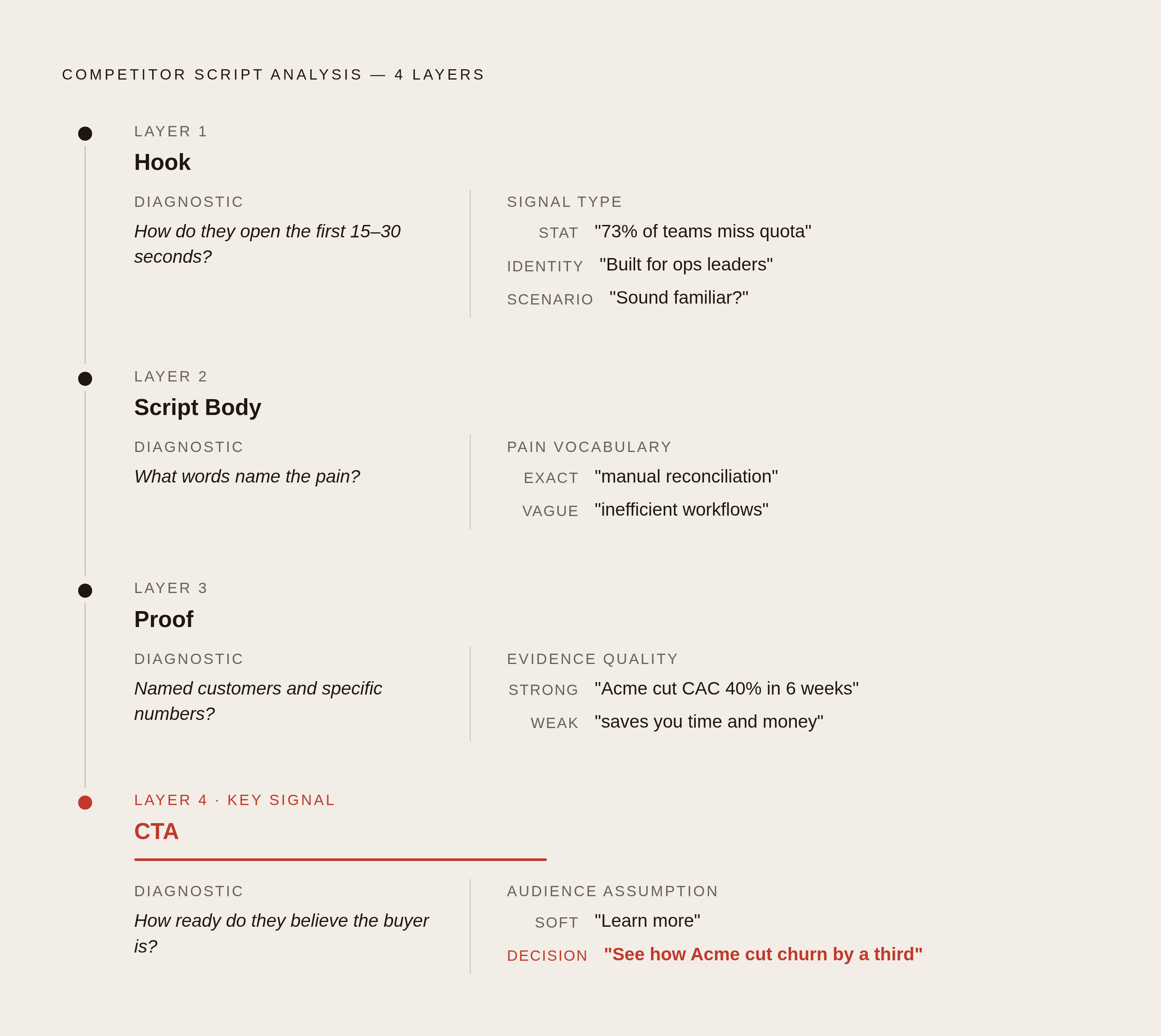
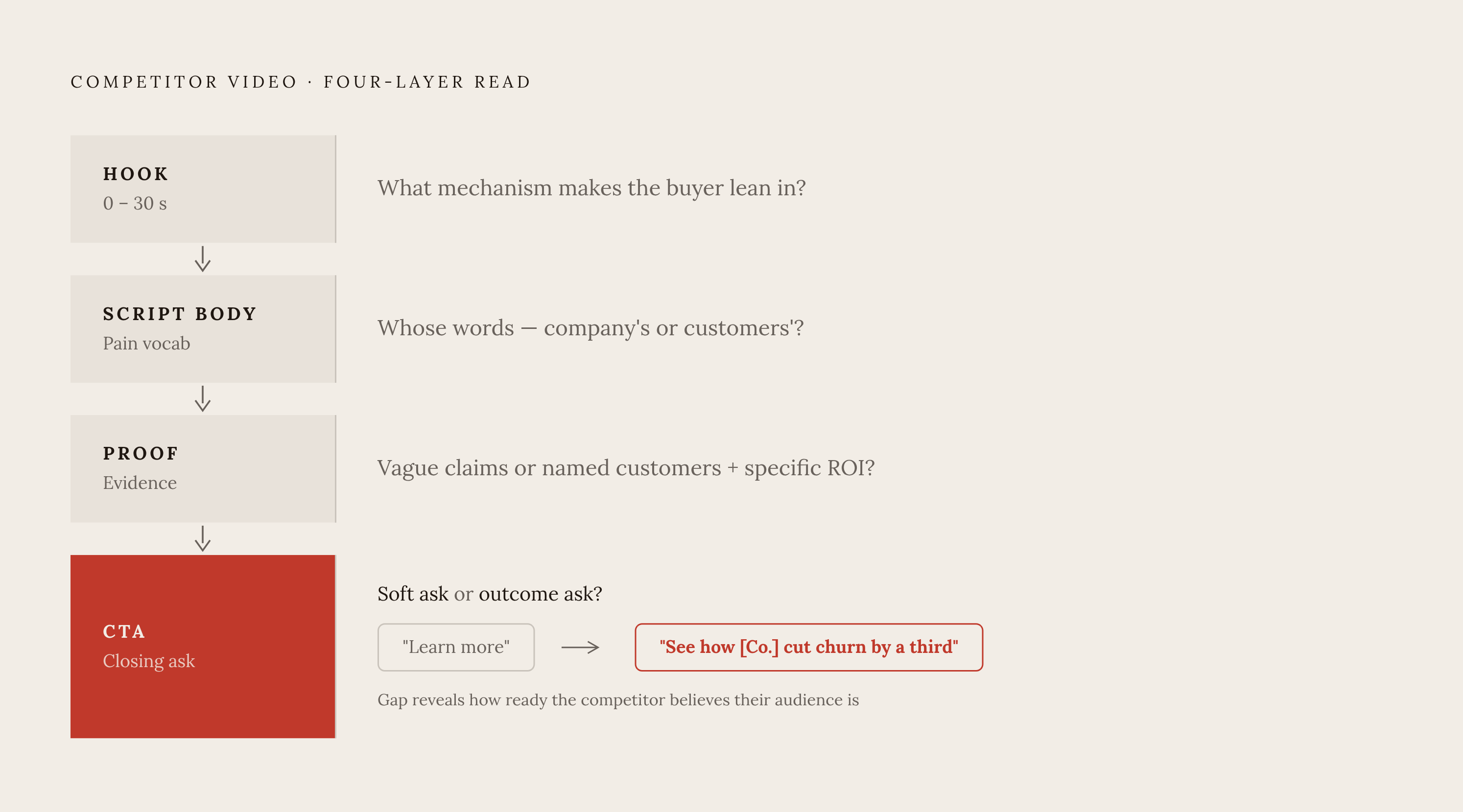
Once you're actually watching, work each video in four layers, always in the same order: hook, script body, proof, and CTA. Consistency here is what makes the notes comparable later.
Hook. What's the exact mechanism in the first 15 to 30 seconds? A jump cut, a surprising stat, a viewer-identity line, a problem scenario acted out. This is never accidental; someone chose it because they believe it's what makes their target buyer lean in.
Script body. Listen for pain vocabulary, the exact words used to describe the problem. These words usually come straight out of customer interviews, so they're a decent proxy for what the competitor's actual buyers say out loud.
Proof. What evidence shows up, and when? A video full of vague claims like "saves you time," with zero case data attached, is an awareness-stage argument dressed up to look bigger than it is. Named customers, specific ROI numbers, and before-and-after comparisons signal a company confident enough to make a mid-funnel case.
CTA. What action does the video actually ask for? "Learn more" is a soft ask aimed at someone early in the journey. "See how [Company] cut churn by a third" is a specific ask aimed at someone much closer to a decision. The gap between those two tells you how ready the competitor believes their audience is.
Given that the overwhelming majority of people report watching an explainer video specifically to learn about a product, per Wyzowl, these videos carry real trust with buyers. However a competitor structures theirs ends up shaping what buyers expect from everyone else in the category too, including you. Take verbatim notes: three to five exact phrases per video. That's your raw material for the comparison work later.
Mine Engagement Signals to Test Positioning Resonance
Engagement rate (likes plus comments, divided by views) is a rough compass, best used to compare videos within the same channel rather than across channels with wildly different subscriber bases.
The real gold is in the comment section, and almost nobody mines it properly. Comments are unfiltered buyer language: unmet expectations, objections the video never addressed, and questions asked in plain words instead of marketing copy.
Read the positive comments for the "why." People responding to clarity, to depth, to feeling understood, or to seeing their exact problem solved on screen reveal which piece of the competitor's positioning is actually sticking versus which piece just sounds good in a script meeting.
Negative comments are arguably more useful. Complaints about pacing, accusations of clickbait, and a string of "but what about X" questions nobody from the company answers each point to a gap. Check whether the competitor's team even replies. Active replies suggest a company treating its audience like a community. Silence on pointed criticism usually means the content operation is a one-way broadcast, one they're not iterating on based on feedback. Track recurring keywords across descriptions and comments over time. That vocabulary is often meaningfully different from the script language the competitor is using, and the difference is the point: it's the gap between what buyers actually care about and what the competitor assumes they care about.
Map Funnel Coverage to Expose Exploitable Gaps
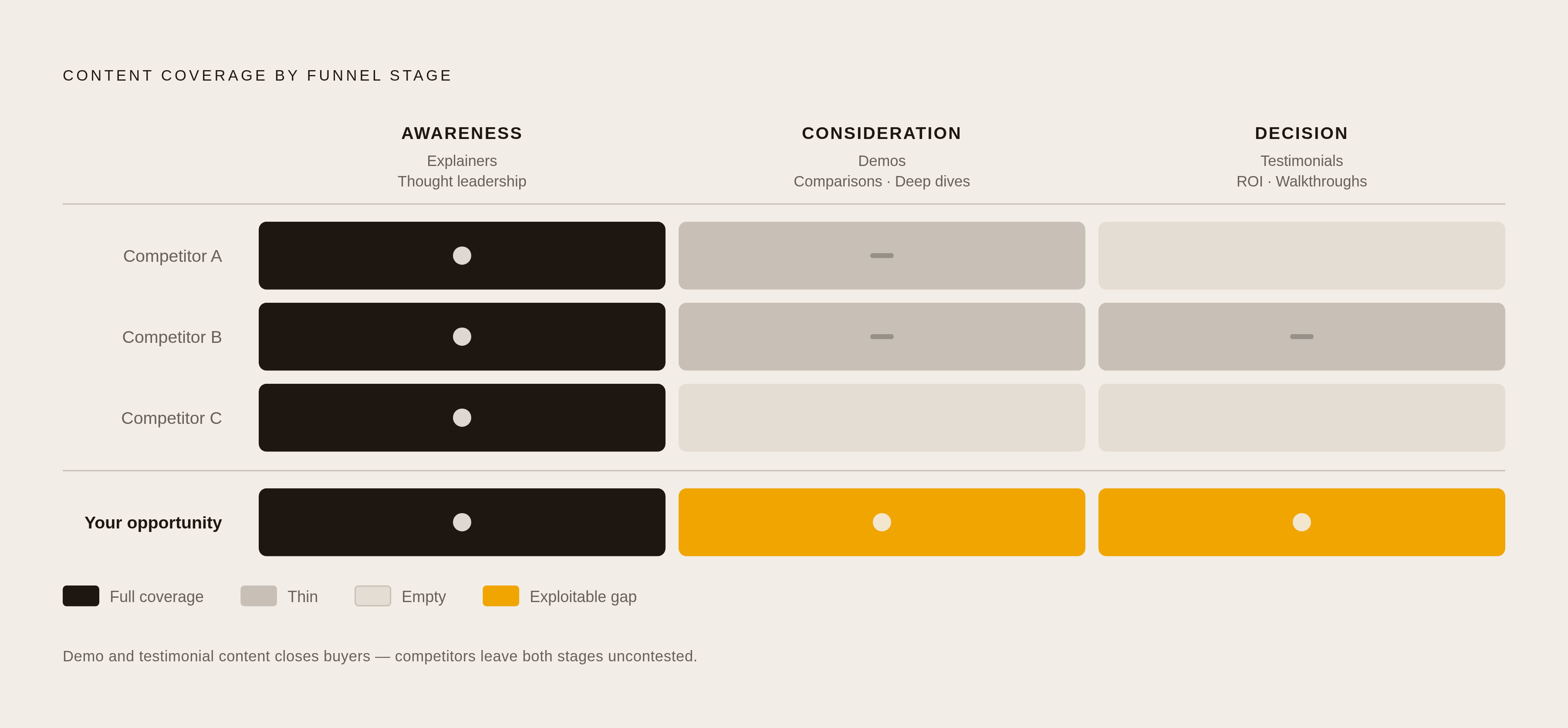
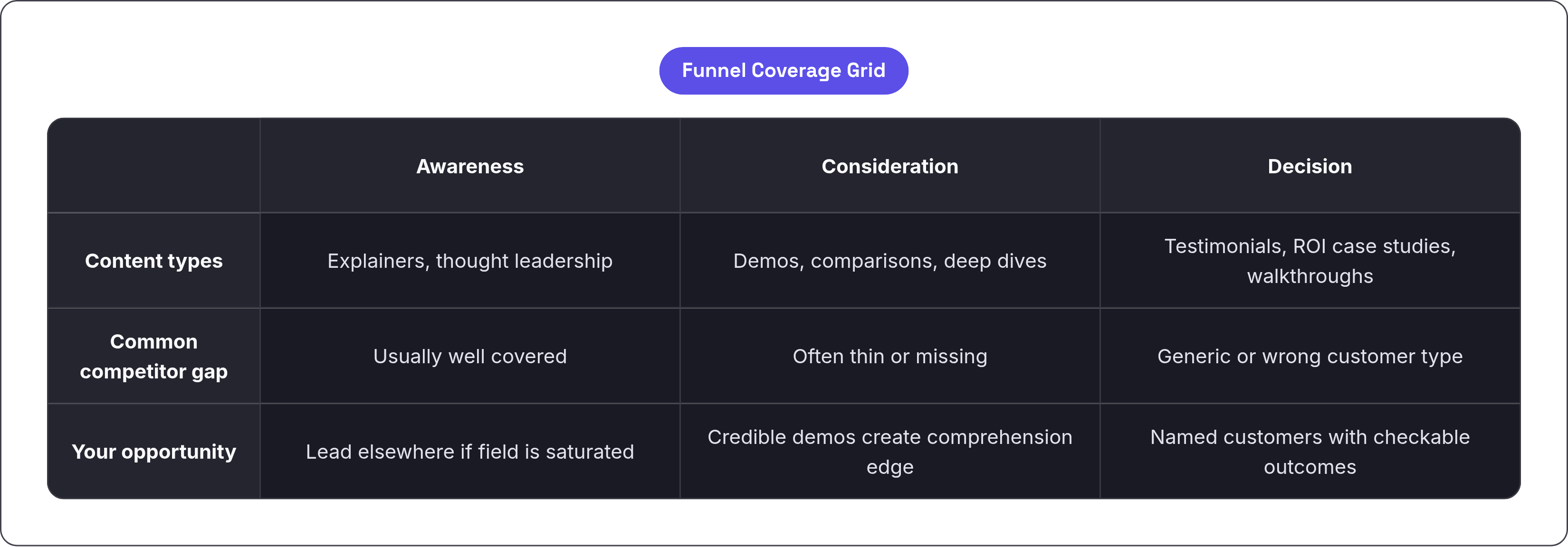
Every competitor's video library covers some funnel stages well and leaves others thin. The job here is mapping coverage, not grading quality.
Build a simple grid with three columns, one for each funnel stage: awareness (explainers, thought leadership), consideration (demos, comparisons, deep dives), and decision (testimonials, ROI case studies, implementation walkthroughs). Mark which cells are full and which are empty or barely populated.
The pattern shows up constantly: a gorgeous top-of-funnel explainer followed by almost nothing credible in the middle. That's a company that can get attention but can't close a buyer who wants receipts. There's real cost to that gap. Demo videos reportedly produce notably better comprehension than text documentation alone, according to Storimatic and Vidyard data, so a competitor skipping credible demos is leaving comprehension on the table, measurably. Testimonial videos are tied to meaningfully higher conversion rates in the same data. A competitor running generic, unattributed testimonials, or featuring the wrong customer type entirely, has a specific and exploitable hole in their credibility.
Watch for asymmetry too. A competitor might cover all three funnel stages beautifully, but only for one buyer persona, leaving every adjacent persona completely unserved. That adjacency is often exactly where you should enter. This step produces a map of where the competitor is thin or absent, and the next step is figuring out what to build from it.
Run the Substitution Test on Competitor Claims
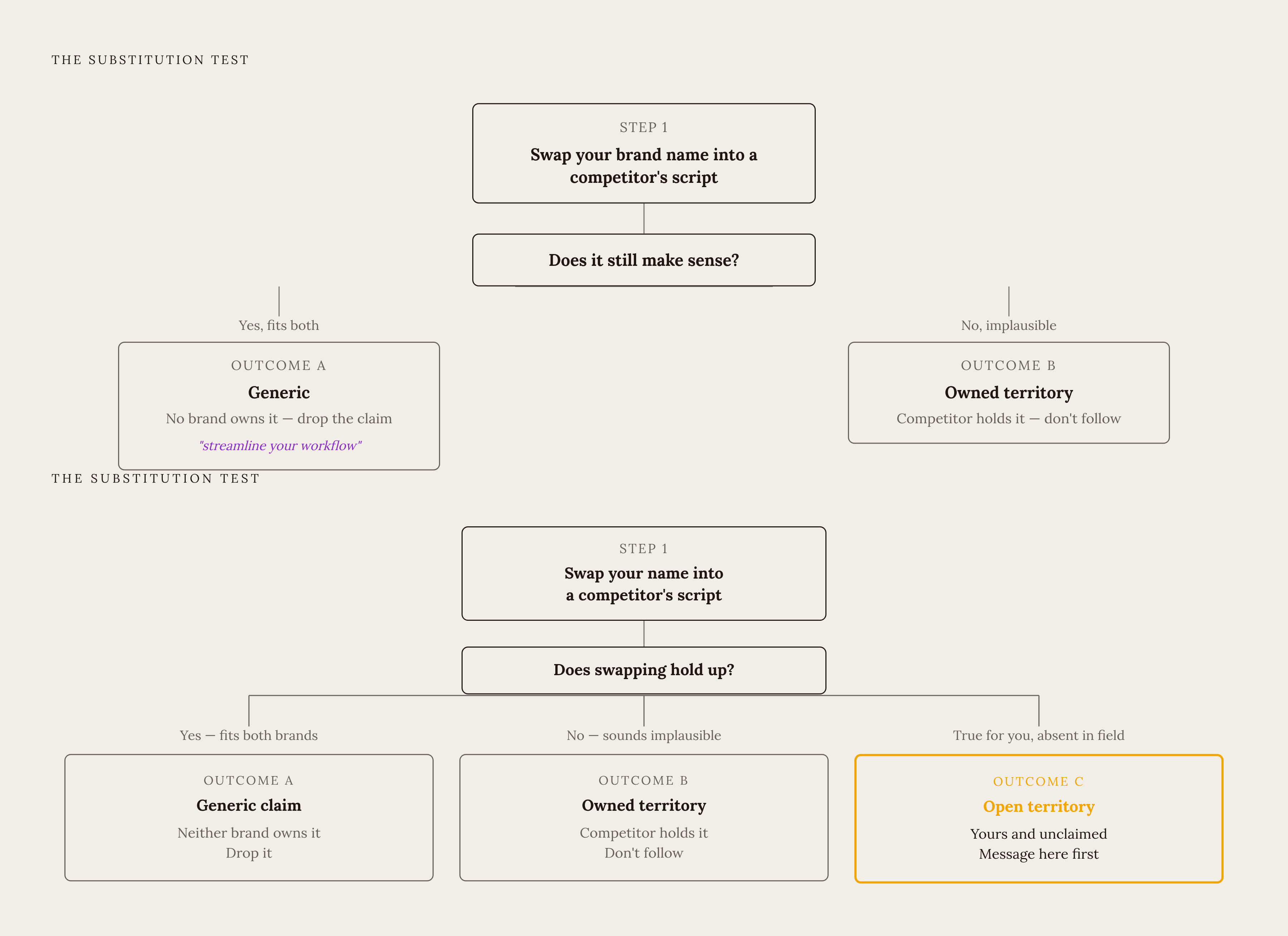
Take a competitor's core script or homepage headline, swap their brand name for yours, and read it back. If it still makes complete sense, neither of you is actually differentiated. You're both just saying the category's default sentence.
Most B2B software video content clusters around the same handful of claims: streamline your workflow, boost productivity, scale with your business. This language is so common inside the category that the teams writing it often don't notice how generic it's become.
Run the substitution test across every competitor in your working set and keep a running list of every claim that survives the swap. Those are the claims nobody owns, because everybody's making them.
Then flip the test around. Look for claims a competitor makes that would sound implausible or flat wrong if you slapped your own name on them. That's genuinely useful. It shows you exactly where their positioning is anchored in something real, and exactly where you have no business trying to follow them. The prize you're hunting for is the overlap: claims that are true about your company and completely absent from the competitive video corpus. That overlap is your open territory. It reframes the whole exercise. You're hunting for the true thing nobody else is saying loudly, not trying to copy what the competition does well.
Turn Your Gap Map Into a Video Messaging Plan
The gap map and the substitution test hand you two inputs. First, which funnel stages the competitive field leaves underserved. Second, which positioning claims are both true and unclaimed. Line those up and prioritize wherever they overlap. That intersection is the highest-leverage ground available, and where your first videos should get built.
If every competitor is leading with slick, product-centric demos and you've got strong customer outcome stories, lead with testimonials. The reasoning matters here. Testimonials aren't magically superior in general, but the gap map showed that's exactly where the field is thin. Match the format to the gap: awareness gaps want explainers, consideration gaps want demos and comparisons, and decision gaps want named customers with specific, checkable outcomes.
Resist the urge to mirror competitor content type for type. If your analysis is doing its job, your output should look like a different shape entirely, rather than a slightly-remixed copy of theirs.
Treat the competitor's own vocabulary as a fence to avoid as much as a template to learn from. If every single competitor leads with "efficiency," leading with something else entirely, such as control, clarity, or confidence, creates distance in the buyer's head even when your underlying product does roughly the same job. Perception moves faster than feature parity ever will.
Write a one-line brief for every planned video: which gap it fills and which specific competitor claim it's built to displace. That keeps this exercise tied to actual production decisions. Otherwise it turns into a slide deck that gets presented once and buried in a shared drive. Widen what you're tracking beyond search rankings, too. Check whether your video content is getting cited or named when buyers, and increasingly AI answer engines, process questions about your category. That's becoming one of the clearest signs of whether your positioning is actually cutting through, or just adding another voice to the pile saying "streamline your workflow."