Video Content Planning for Early Stage Startups
Match your video strategy to your funding stage, not your budget.

Summary
Match your video strategy to your funding stage, not your budget.
Video content strategy for B2B startups is not one-size-fits-all: what works at Series A will waste your budget at pre-seed, and what you need at pre-seed will leave pipeline on the table at seed stage. This guide breaks down exactly which video formats to prioritize at each funding stage, how to split your budget between short-form and long-form content, which distribution channels actually reach B2B buyers, and how to measure whether your videos are generating real business outcomes rather than vanity metrics.
Why startups can't copy mature companies' video
A mature company's video strategy sits on top of messaging that has already been tested, priced, and sold a hundred times over. Early-stage startups don't get that luxury. Your product is still changing shape, your ideal customer is a working theory at best, and your pricing might flip next quarter depending on how one call with a prospect goes. Tie a video too tightly to a single feature or price point, and it has a shelf life measured in weeks, not years.
That matters because there is no spare cash lying around to waste on a video nobody watches. Startups mostly die from lack of traction, not lack of effort, and every hour spent making the wrong video at the wrong time is an hour and a budget line you don't get back. Mature companies use video to reinforce a story they already know is true. Startups use it to find out if the story is true in the first place. Same medium, wildly different job.
The glossy brand anthem, the fully animated explainer, the event highlight reel cut like a car commercial: all of it works great once a company knows who it is, but before that, it is an expensive guess. The better question is what makes a good video for exactly where you stand today, not where you hope to be next year.
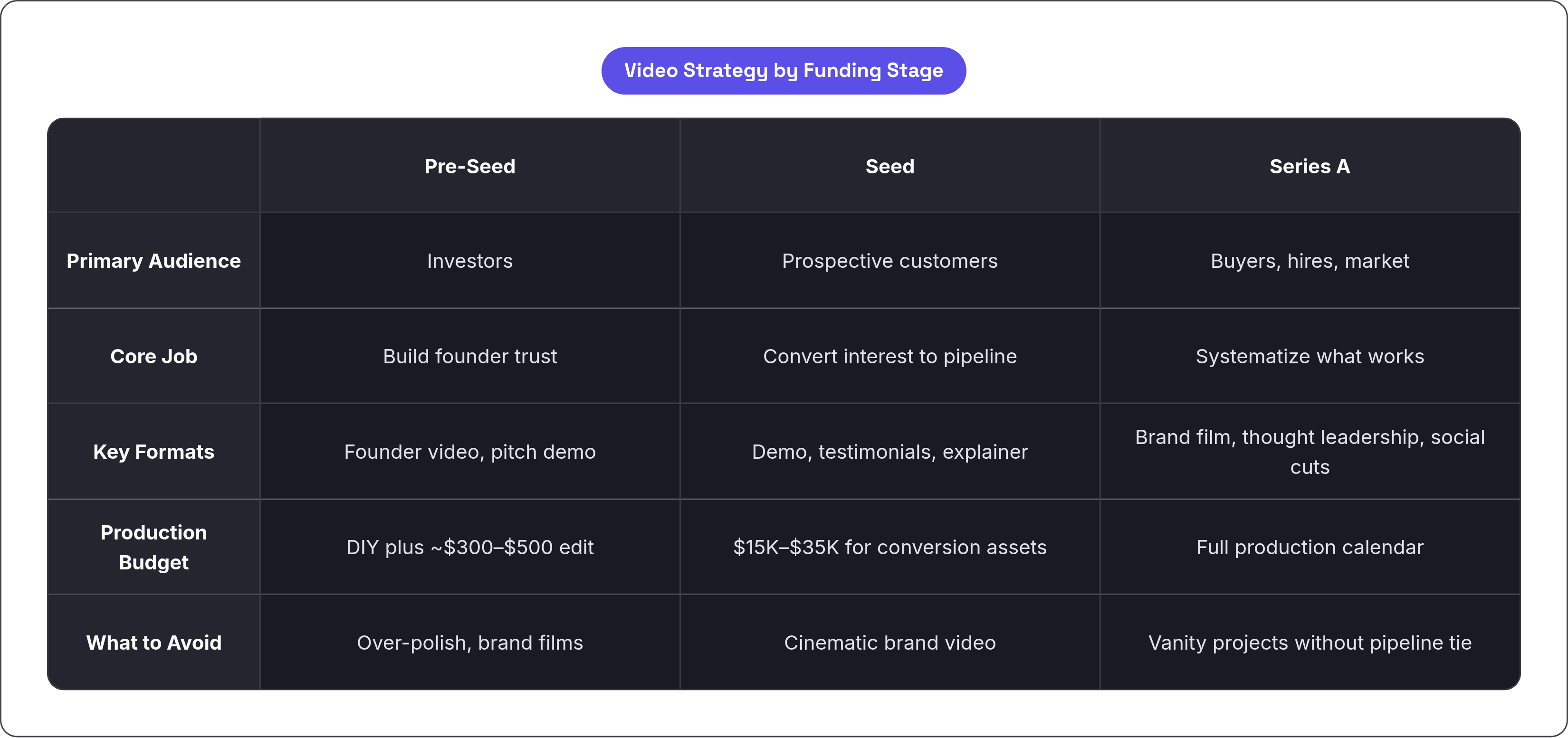
Pre-seed: build founder trust before product exists
At pre-seed, investors aren't evaluating your product. They are evaluating you: can this person execute when almost nothing is certain. A founder video, done right, compresses what would otherwise take three or four meetings into sixty seconds flat.
People commit to founders they trust before they commit to products they understand, and that logic gets stronger once you are talking to investors instead of customers. They are writing a check on trust in a person first, and a well-constructed founder video builds more of that trust per minute than any slide in your deck.
What actually belongs in that minute: the problem framed sharply, why this specific team is the one to solve it, and whatever early traction exists, even if that is five beta users and a waitlist. Run the whole thing on gear you already own: a smartphone or basic mirrorless camera, a lav mic, a $30 ring light, and a free editing tool like CapCut or iMovie. The one place worth paying someone else is the pitch video and product demo, and even there you are in the $300 to $500 range for an editor, not a production company on retainer.
Over-polish is what actually kills pre-seed videos. If your founder video looks like it aired during the Super Bowl, investors start wondering what you are compensating for. They are deciding whether they trust your judgment when things go sideways, and a little rough edge on camera does more for that case than a color grade ever will.
Seed stage: convert early interest into pipeline
Something shifts at seed. The job moves past explaining why the company exists at all, into showing concretely what you solve and who it is for. Your audience widens past investors into actual prospective customers, and customers care far less about your origin story than about whether your product fixes the problem they have today.
Three formats do most of the work here. Demo videos show the product solving a real problem in real time, not a mocked-up screen recording with narration bolted on after. Customer testimonials handle the social proof your sales deck cannot pull off by itself. How-to content gets built around whatever your ideal customer is searching for late at night, trying to fix their own problem before they even know your product exists.
Explainer videos deserve their own mention, since nearly everyone building at this stage ends up leaning on one. Most consumers say they watch an explainer specifically to learn what a product does, which makes it the natural anchor for a seed-stage video plan. Seed is also where a real production line item starts to make sense, often landing somewhere in the $15,000 to $35,000 range for the handful of videos that actually touch conversion. Onboarding videos and product walkthroughs deserve a slice of that budget too, since they reduce support tickets and boost activation without needing to look expensive.
What does not belong yet is the brand film. If your ideal customer, your voice, and your positioning are still shifting, a polished brand video locks in messaging you will be walking back in six months.
Series A: build a repeatable video content system
By Series A, most of the guesswork is behind you. You know which formats convert, which channels your audience actually uses, and which messages land versus which ones go flat mid-demo. The job now is turning what already works into a system rather than running one more experiment to find out.
That usually means real monthly output: social cuts, demos, testimonials, and educational pieces moving through an actual production calendar instead of one shoot every quarter. The bottleneck at this point is usually editing capacity, since teams end up generating more raw material than anyone has hours to cut down.
Educational and thought-leadership video earns its spot here, especially if you sit in a category buyers don't fully understand yet. You cannot sell someone something they don't know they need, so teaching has to come before pitching. Founder-led content that still feels unscripted continues to drive trust even as overall production quality rises, because polish and authenticity serve different jobs and a mature video strategy needs both.
Brand films and animated explainers finally make sense at Series A, since positioning is stable enough to be worth encoding into something permanent. Just watch the trap that comes with a bigger budget: more money does not mean making every video you have ever wanted to make. Every piece needs to tie back to a sale, a hire, or a real market insight, otherwise it is a production expense with no measurable business outcome.
Short-form vs. long-form: allocate without splitting focus
Short-form has topped ROI rankings for several years running, and a growing share of marketing budgets now carve out a dedicated line just for it. Videos under 60 seconds pull in roughly two and a half times the engagement per impression that longer formats get. Completion numbers are blunter still: videos under a minute finish at a high completion rate, while anything over 20 minutes drops sharply as viewers exit before the content reaches its conclusion.
Long-form still earns its place through SEO value, lead generation, and giving a genuinely interested buyer the depth they need to make a purchase decision. Short-form and long-form serve different jobs in the funnel, and treating them as competitors fighting for the same budget line means under-investing in both.
For an early-stage team, the practical split looks like this: lead with short-form for reach, since attention there is cheap and plentiful, and reserve long-form formats like full demos, product walkthroughs, and founder interviews for buyers who are already engaged and actively looking for reasons to convert. Whatever the runtime, front-load the actual point into the first 15 to 30 seconds, since average video viewing time has been shrinking for a decade.
Distribution decisions that determine video performance
A great video with nowhere to live is a great video nobody sees. Channel choice has to follow where your buyers actually spend their attention, not wherever video happens to be trending this quarter.
For B2B startups, LinkedIn carries weight that YouTube and Instagram don't match in a professional context. LinkedIn puts your video in front of someone already in a professional decision-making mindset, and that context changes how the message lands even when the video itself is identical to what you post elsewhere.
Placement on your own site matters more than most early teams recognize. Pages with video convert noticeably better than pages without one, and B2B explainer videos on landing pages have doubled conversion rates in controlled tests. Put video wherever a buyer first meets your product: homepage, landing page, or outbound email sequence.
Distribution decisions need to be made before you shoot, not after the file is exported, because where a video will live shapes its length, its framing, and its call to action. Repurposing is the real force multiplier for teams without a large budget: one long-form founder interview or product demo can be cut into multiple short clips across channels, turning one afternoon of filming into several weeks of content.
Measuring whether video generates real business outcomes
Measurement has to match the job the video was built to do. A founder video meant to earn investor trust does not get judged by the same criteria as a demo built to drive trial signups, and treating them the same means the numbers tell you nothing useful.
Most marketers report that video delivers strong ROI, but that figure only means something if you defined what success looked like before publishing, not after the fact. Metrics worth tracking at the early stage include completion rate, click-through on calls to action, whether the video moves trial signups or demo requests, and for onboarding content specifically, whether inbound support volume decreases afterward. View count carries almost no weight in isolation. A video with tens of thousands of views and zero downstream conversion tells you nothing about whether it moved a single real buyer.
Leave a video alone if it is generating genuine engagement or feeding pipeline, and don't let gut feeling override evidence already sitting in your analytics. There is also a newer signal worth watching: as AI answer engines begin surfacing B2B content in response to buyer questions, tracking whether your video gets cited in those answers belongs alongside search rank and conversion rate in your measurement framework.