Repurposing Video Content Across Channels
One long-form video asset can fuel months of social, email, and blog content.

Summary
One long-form video asset can fuel months of social, email, and blog content.
Most marketing teams produce a video, publish it once, and move on. That's not a content strategy. It's like planting one seed and calling the harvest done. And the wild thing is, video is already the top-performing format for nearly half of marketers. Not blog posts. Not email. Video. Yet most teams still treat it like a one-time event.
I've watched this happen at companies that clearly knew better. They'd spend weeks preparing a webinar, bring in a great speaker, get a solid turnout, and then... post the recording to a landing page and call it done. That's it. The asset just sat there. It drove a third of the value it should have.
Gary Vaynerchuk's team took a single one-hour keynote and pulled 64 pieces of content from it. LinkedIn posts, YouTube uploads, Instagram clips, TikTok cuts, email snippets, and podcast audio. Same source material, wildly different reach. That's not a content marketing hack. It's just a decision made before the camera turned on.
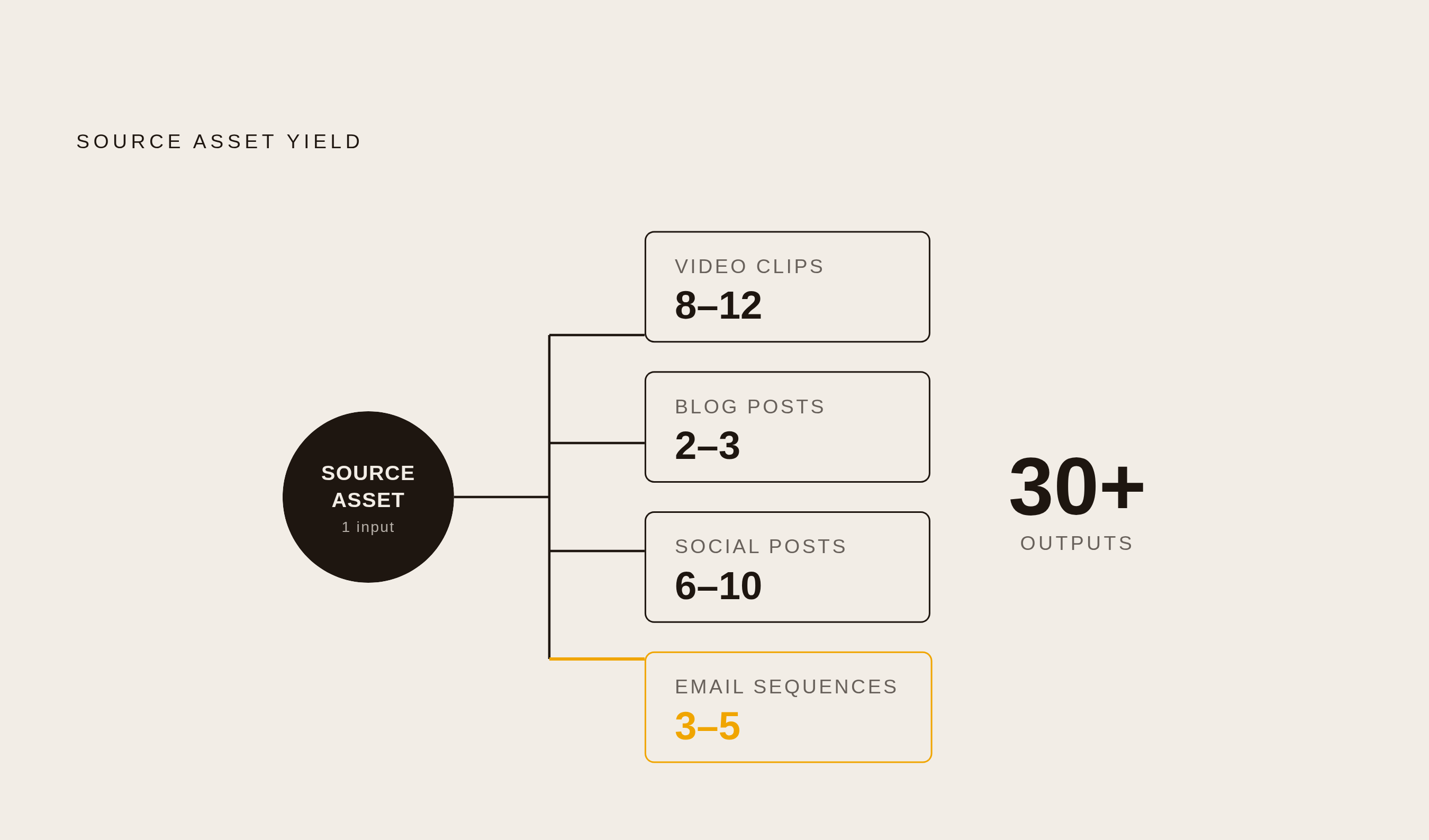
The production decision itself shapes everything. The topic, the depth, who's on camera, how long it runs, all of it should account for what you're going to do with the asset after. A well-planned webinar or long-form interview isn't just a live event or a YouTube upload. It's raw material for a full content campaign. Here's what a single source asset can produce:
2 to 3 blog posts
6 to 10 social posts
3 to 5 email sequences
When you plan the source asset with that list in mind, you film differently. You ask better questions. You structure segments so they clip cleanly. The production cost stays the same. The output multiplies.
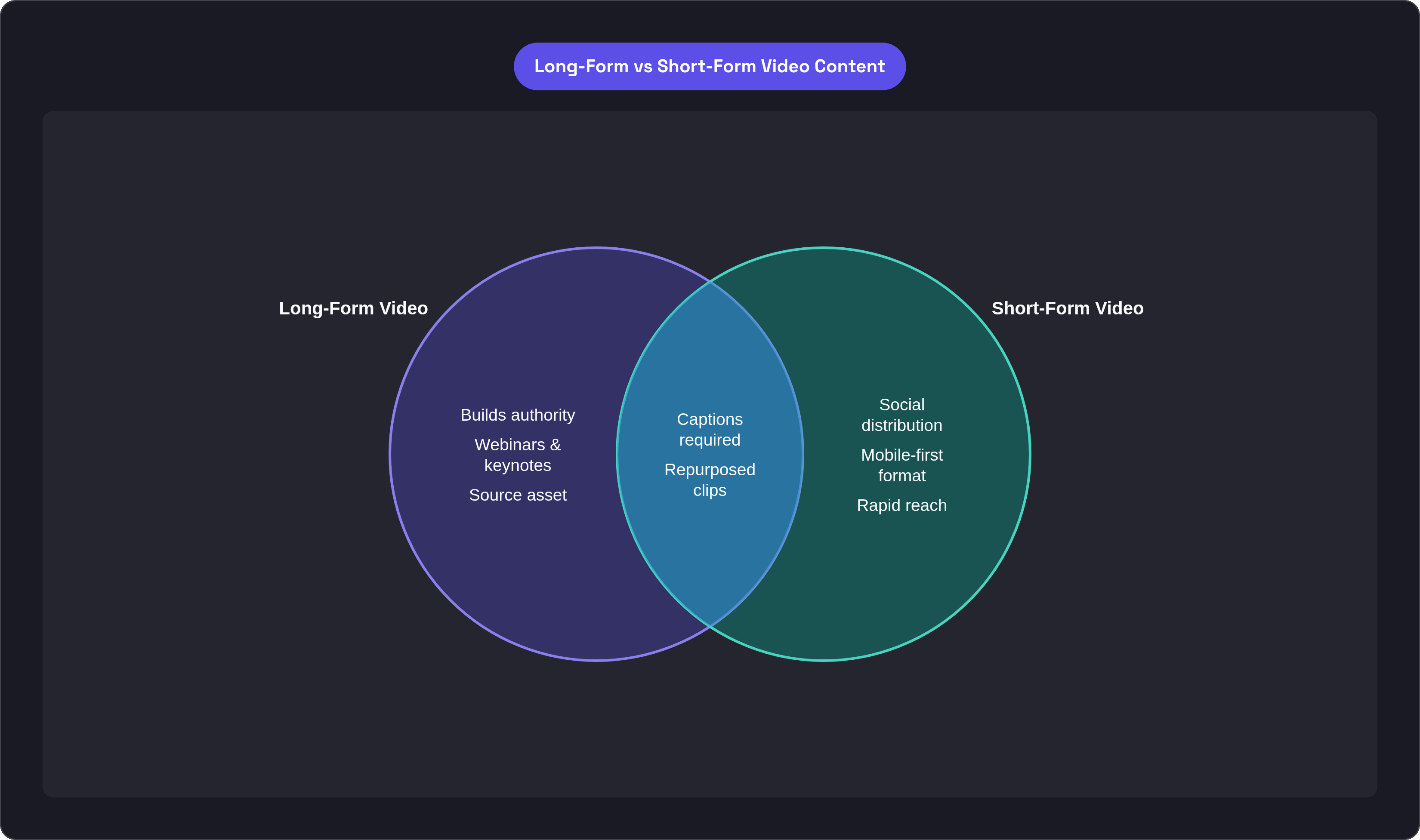
Short-form and long-form video aren't competitors. They do different jobs.
A common assumption holds that short-form has won and everything else is legacy content. That assumption is wrong. It causes teams to make bad calls.
Short-form gets strong engagement on social. That's real. But a 60-plus-minute video still has a 52% play rate. More than half of people who encounter long-form content press play. Webinars do even better because the audience opted in. They showed up to learn something. That's not a dying format. That's a warm audience.
So the answer isn't picking a side. It's understanding what each format is actually for.
Long-form is the source asset. Webinar, interview, course module, or keynote.
Short-form is the distribution layer. The clips you pull from that source and push to social.
One builds authority and depth. The other builds reach. You need both, and one feeds the other.
Three viewer behaviors should drive every clip you make:
Videos under 90 seconds retain roughly half of viewers on average.
About three-quarters of viewers watch short-form on mobile.
Most videos are watched without sound.
These aren't preferences. They're constraints. If your clips aren't made with those three things in mind, they're already underperforming before anyone watches them.
What each platform actually rewards, and how to adapt the same clip accordingly
You don't need a different strategy for every platform. You need the same clip presented the right way on each surface. The underlying content doesn't change. The packaging does. Here's what each major platform actually rewards in practice, and where teams get it wrong.
LinkedIn is now the primary distribution channel for B2B video, and it auto-mutes video in the feed. That second sentence matters a lot. If your clip doesn't work without sound, it doesn't work on LinkedIn. Captions aren't a nice-to-have here. They're the price of admission.
Reels account for half of time spent on the app. The format preference is obvious: vertical crop, captions, hook in the first two seconds. Instagram rewards content that looks native to the feed. A clip filmed elsewhere and cropped after the fact underperforms, even when the content is strong.
YouTube
This is where the full recording lives. Thumbnail and description treatment matter more here than on any other platform because search and suggested video are the primary discovery mechanisms. It's also the platform with the longest shelf life. A well-tagged YouTube video can drive views two years after publishing. Other platforms mostly can't say that.
TikTok
The audience is engaged and the daily time-on-app numbers are genuinely staggering. But competition is rising fast as more marketing teams pile in. Getting there with a consistent presence still matters, even if the algorithm feels unpredictable at first. It rewards consistency more than it rewards any single viral moment.
Facebook isn't glamorous in 2025, but it still accounts for a meaningful share of brand video reach, particularly for audiences that skew slightly older. It's worth the repost. It's rarely worth custom production.
The practical takeaway
Every clip needs at minimum three versions:
Caption-on version for LinkedIn
Vertical crop for Instagram and TikTok
Thumbnail plus description treatment for YouTube
Same content. Different surface presentation. That's the whole job.
The webinar-to-content pipeline as a repeatable production model
If you work in B2B and you're not treating webinars as production assets, you're producing one of the most expensive and effort-intensive content formats and using maybe 10% of what it's worth. That's not a criticism. It's what happens repeatedly at teams that have the right instincts about producing webinars but haven't yet connected production to a downstream workflow.
The Goldcast 2026 B2B Webinar Benchmark Report pulled data from over 26,000 webinars across more than 500 B2B brands. The headline finding: 88% of companies repurpose webinar content. The most common outputs are recordings on landing pages, social clips, and email campaigns. Email and social posts each account for roughly 37% of repurposed assets. That tells you something about where audiences actually spend their time. Audiograms (audio-first clips built for mobile consumption) are growing fast too, which tracks directly with the reality that most video is watched without sound.
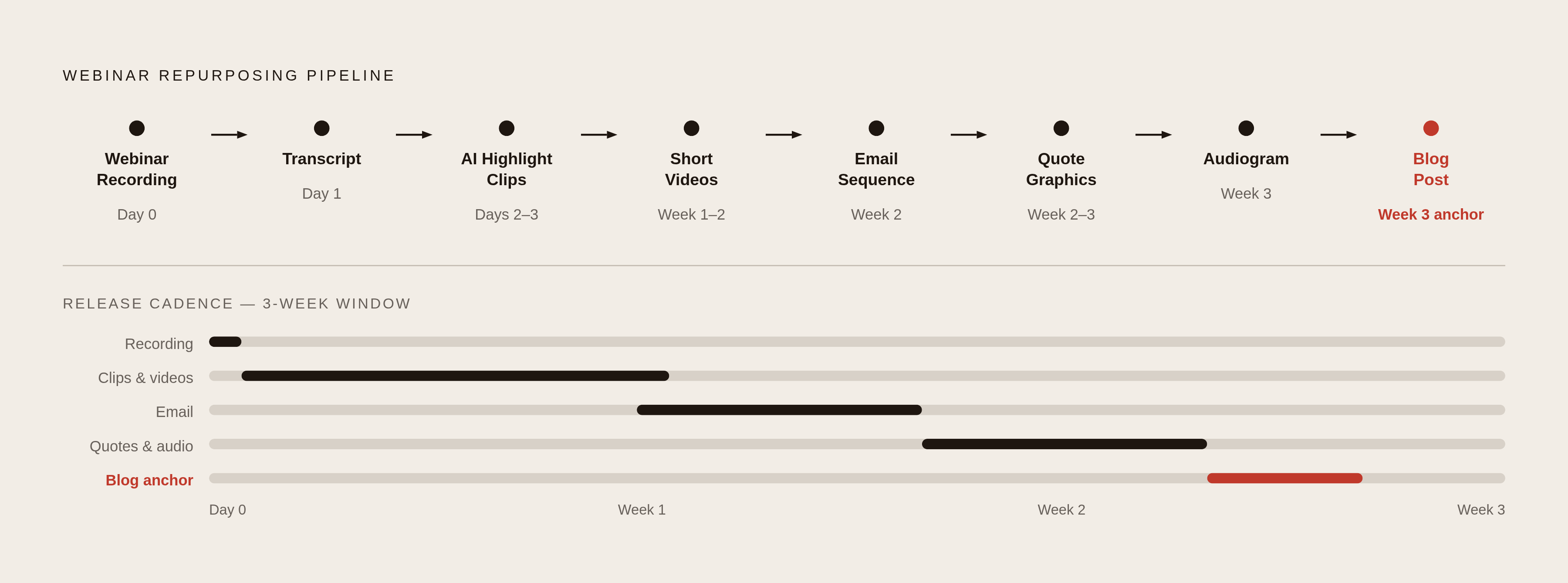
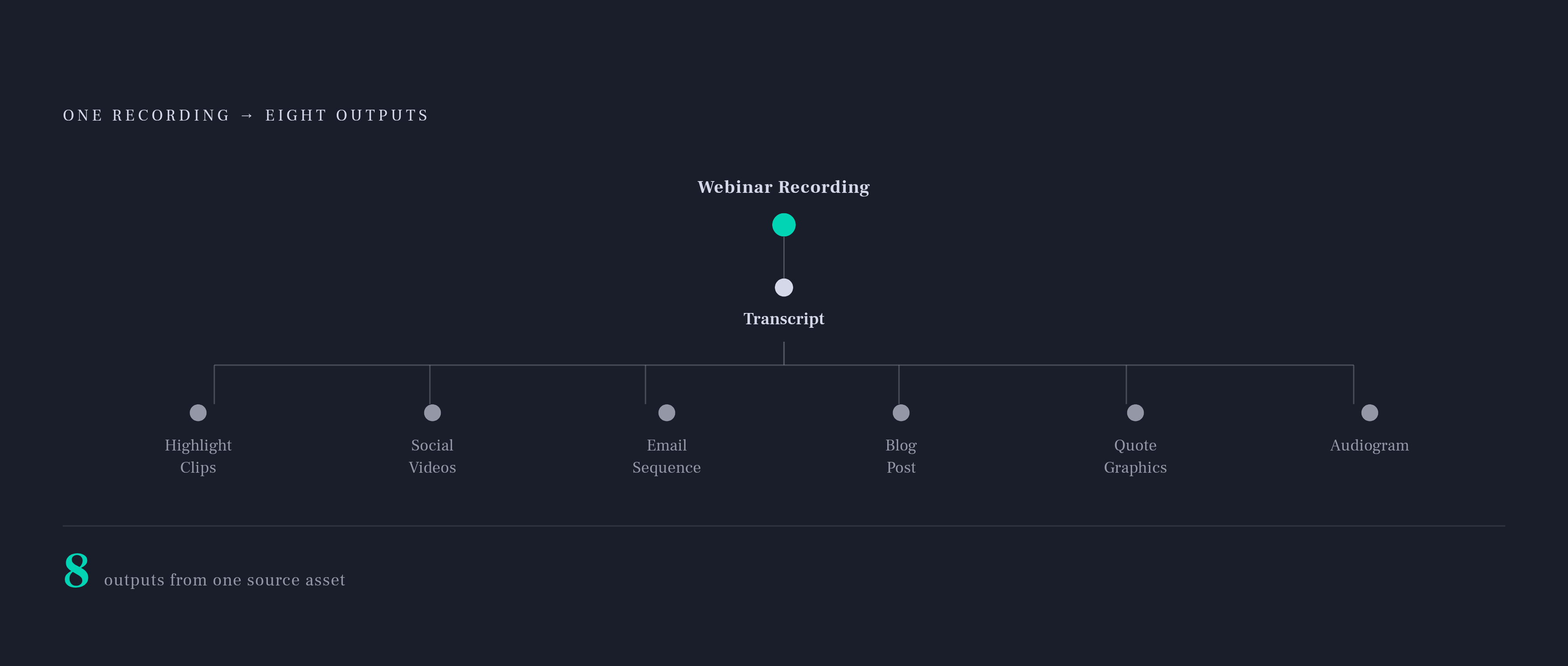
The pipeline in practice looks like this:
Webinar recording
Transcript
AI-selected highlight clips
Social-formatted short videos
Email sequence pulling key moments
Blog post built from the transcript
Quote graphics for organic social
Audiogram for LinkedIn and mobile
The webinar is not an event. It's a production. Budget for it like one, and plan the downstream outputs before you send the calendar invite. That order of operations changes everything about how you run the session itself.
Where AI tools fit in the repurposing workflow and what they actually handle well
AI-powered repurposing has cut manual adaptation time significantly compared to traditional workflows, and adoption among marketing teams has moved quickly. The tools are genuinely useful. But they're useful for a specific slice of the work. If you misunderstand that slice, you'll either over-rely on them or dismiss them entirely.
What AI actually handles well:
Transcription
Highlight detection
Automatic clipping
Caption generation
Aspect-ratio reformatting
Audiogram creation
These are the mechanical, repeatable tasks that used to eat an editor's afternoon for every single output. Goldcast's Content Lab generated a massive volume of AI-produced clips in 2025, and the vast majority of clips created on the platform that year were AI-generated. That's not a pilot program. That's how the workflow runs now.
What AI doesn't replace is editorial judgment. Which moments are actually worth clipping. What tone fits which platform. Which clip goes where and why. A tool can surface ten candidate moments from a 45-minute webinar, but a person still has to decide which three go out and in what order. The AI is often right about surfacing the technically strong moments, the clear sentences, the quotable lines. It's less reliable about surfacing moments that are right for your specific audience or brand voice. That part still requires a human in the loop.
The practical stack for most teams doesn't need to be one product. It usually looks like:
A transcription layer
A clip-selection tool (OpusClip and similar products handle this)
A caption and formatting tool
A scheduling or distribution layer
AI is the mechanism that makes cost savings real at scale. Without AI, the pipeline works. With it, the pipeline scales.
Building a repurposing system that runs without starting from scratch each time
The teams that get the most out of repurposing aren't the ones with the biggest budgets or the most sophisticated tools. They're the ones with a documented process. Ad-hoc decisions kill momentum, slow output, and introduce inconsistency, which then builds up for months. You end up looking back at six months of content and wondering why nothing built on anything else.
Here's how to build one that actually holds up.
Start with the end in mind. Before you produce a long-form video, map the intended outputs. Which clips, which platforms, and which email moments. Structure the source asset so it supports them. This changes how you film, how you segment, and how you wrap up each section.
Build a clip brief template. Platform, intended length, hook format, caption requirement, and CTA. Fill it out the same way for every output. Whoever executes the work should be able to pick it up without a briefing call. If they can't, the template isn't done yet.
Treat the source asset and all derivatives as one campaign. Not separate publications that happen to come from the same recording, but one campaign staggered across two to three weeks. The webinar recording drops first. Clips go out over the following two weeks. Email moments follow the clips. The blog post anchors everything at the end. That sequencing is intentional, and it makes each piece of content feel like it's leading somewhere.
Measure what the repurposed asset actually does. Engagement by platform, email open rates tied to specific clips, landing page replays. Not to justify the workflow retroactively, but so the next production decision is informed by what actually performed. Gut feeling about which clips are good turns out to be unreliable. The data isn't always more reliable, but at least it's honest about what it doesn't know.
One well-produced source asset, planned for repurposing from the start, consistently outperforms multiple smaller efforts that each get published once and forgotten. The produce-and-abandon approach isn't wrong because it lacks ambition. It's wrong because it ignores what you already built.

