Video Strategy for B2B SaaS Startups
Younger B2B buyers research independently and require video at every funnel stage.

Summary
Younger B2B buyers research independently and require video at every funnel stage.
Here's the central fact of modern B2B buying that most startup teams still underestimate: vendors get only a small slice of the buyer's time. The vast majority of research happens before a seller ever enters the picture. Buyers are self-directing their journey. Watching videos, reading comparisons, forming opinions, all before they've booked a demo or talked to anyone on your team.
And who are these buyers now? Millennials and Gen Z make up the majority of B2B purchasing roles. They grew up navigating video natively. They have low tolerance for dense static content. A PDF that should have been a two-minute video isn't just a missed opportunity. It's a friction point someone will bounce from without a second thought.
A few things about how buyers actually behave during a research session:
- They watch multiple videos per session. Not one. Multiple.
- They retain more from video than from a comparable written format, like a datasheet.
- Buying committees routinely include a large number of stakeholders. The CFO, the end user, and the IT lead are all doing their own research, separately, on their own schedules.
That last point is the one that really changes things. When there are six or eight stakeholders involved, you cannot rely on your champion to accurately relay your pitch to everyone else in the room. That game of telephone is where deals go sideways. Video delivers the same message, in the same way, to every person on the committee, whether they're the economic buyer or the person who'll actually use the tool every day.
The implication is simple but easy to miss. A single explainer video on your homepage is not a strategy. It's one node in a journey your buyers are already self-directing. Your job is to build a library that meets them at each step, not one video that tries to be everything.
What Video Actually Moves in the Funnel (and Where the Gains Come From)
This is where a lot of startup teams get vague and then lose budget conversations. So let's be specific.
Video on landing pages produces meaningful lifts in conversion. The effect is strongest for complex products where a visitor needs to quickly grasp something a headline can't carry. If your product solves a non-obvious problem, a short video does the explaining that your copy alone won't.
Email campaigns that reference video see higher open and click-through rates than those without. Part of that is the word "video" in a subject line, which still signals relevance and effort in a way most email content just doesn't.
In the sales process, video is associated with shorter sales cycles. For startups, this matters beyond a metric. Shorter time-to-close directly affects cash burn. Every week shaved off a deal cycle is real money that stays in the business.
At the decision stage, customer testimonial videos significantly outperform generic product videos. And this is a format question more than a production quality question. A slightly shaky, authentic customer testimonial beats a polished product demo reel when someone is deciding whether to trust you. The best testimonial video isn't the one with the nicest lighting. It's the one where you believe what the person is saying.
Two more things that are free to implement and frequently skipped:
- Videos with explicit calls-to-action substantially outperform those without. Tell people what to do next. Don't assume they'll figure it out.
- Subtitles. Add them. (More on this in the distribution section.)
Organizations that treat video as infrastructure rather than one-off content see compounding returns. Lead generation and MQL rates are measurably higher when video is systematic. The gains build on each other over time in a way that sporadic content production never does.
The Funnel-Stage Framework: Matching Video Format to Where the Buyer Actually Is
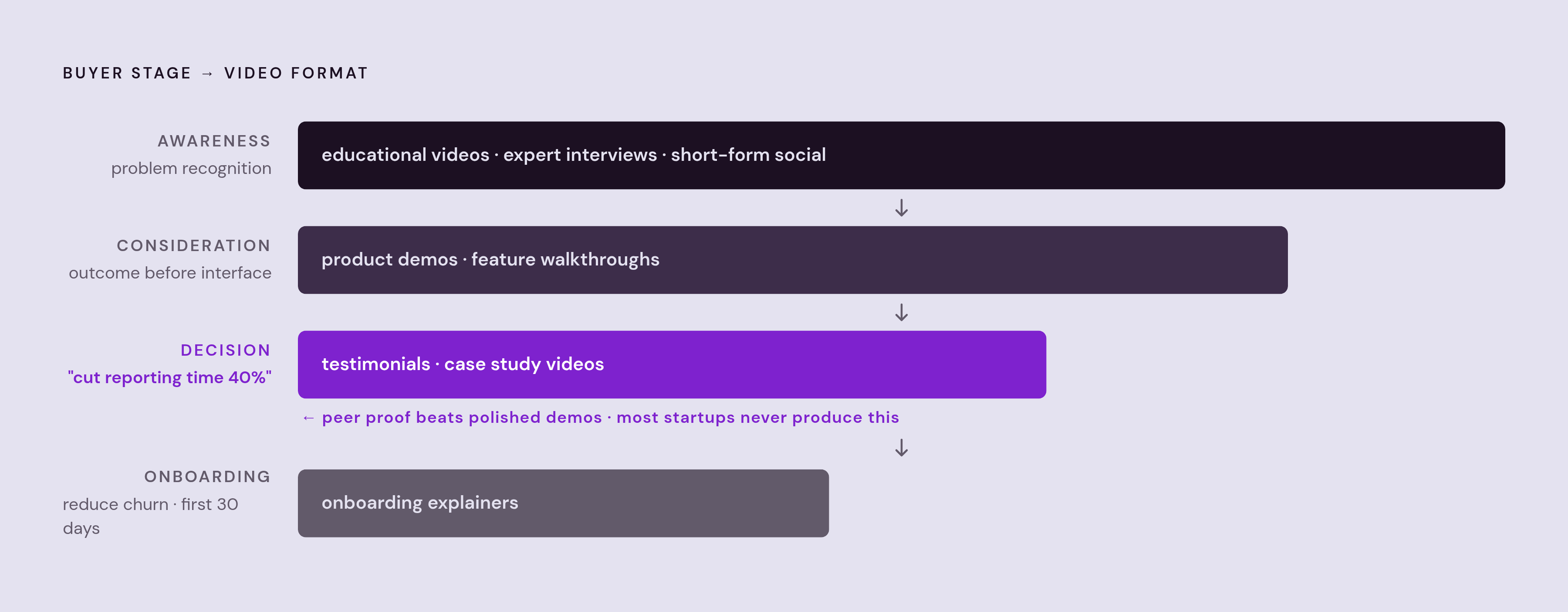
Most startup video strategies get this wrong. They produce one or two assets and try to make them serve every stage. That's like sending the same email to a cold prospect and a customer who's been with you for a year. Technically possible. Almost never effective.
Here's how to think about it by stage:
Awareness. Your buyer feels a problem but has not named it yet. Your job is recognition, not product explanation. Educational videos that frame the problem work here. So do expert interviews and short-form social content. Do not lead with your product at this stage. Lead with the problem, and let them connect the dots.
Consideration. Now they know what they're looking for and they're comparing options. This is where product demos and feature walkthroughs belong. But there's a sequencing rule that most teams violate: lead with the outcome or use case before showing the interface. Buyers need to see themselves in the solution before they care what the login screen looks like. Show them the after before you show them the how.
Decision. This is peer proof territory. Customer testimonial videos and case study videos with specific metrics close the gap that product demos leave open. "Our team cut their reporting time by forty percent" lands differently than "Here's our reporting dashboard." Specifics matter enormously here.
Onboarding and retention. A large share of B2B organizations use video here, and yet most startups treat it as an afterthought. This is a mistake with a measurable cost. Good onboarding video reduces support load, accelerates time-to-value, and keeps customers from getting frustrated in the first thirty days when churn risk is highest.
One thing that applies across all stages: pain-point-targeted videos get substantially higher watch-through rates than generic product videos. A video titled "How [specific role] solves [specific problem]" will find its audience more reliably than "Introducing [Product Name]." Specificity is not just a creative choice. It's a distribution strategy.
How Video Length and Format Interact With ACV and Deal Complexity
Average B2B video length has been shrinking year over year. Your buyers are consuming shorter content even in professional contexts. Completion rates drop sharply as length increases. Videos under a minute achieve strong completion rates. Videos over twenty minutes reach only a fraction of people who start them.
But "shorter is better" is not a universal rule. It depends heavily on your average contract value and deal complexity, and getting this wrong costs you.
Think about it this way:
- Lower-ACV, product-led products can use short-form video aggressively. Drive signups. Drive freemium conversions. The buyer can make the decision fast, so the video should match that pace.
- Higher-ACV, enterprise deals are different. Short-form video works here as a trailer. It creates awareness and drives the buyer toward a longer demo or a webinar. It is not the close. It's the door.
Webinars and on-demand recorded sessions remain effective for complex enterprise buys specifically because they attract buyers who have already self-qualified by committing time. A person who watches a forty-five-minute webinar is not a casual browser. They're in the consideration or decision stage, and they showed up on purpose.
Here's an underrated point about webinar recordings: they continue generating views for many months after the live event. Most teams treat them as one-time live assets and move on. That wastes most of their value. Publish the recording, clip it, index it, and let it keep working.
If you are producing only one video, a runtime somewhere in the ninety-second to five-minute window is the most versatile. Long enough to explain something real. Short enough to hold attention.
Interactive video is also worth knowing about for high-ACV products. Adoption is growing among B2B marketers, and the format lets buyers branch through content based on their role or use case, which simulates a discovery conversation without requiring a sales rep to be on the line. It's not magic, but for the right product and the right buyer, it's genuinely useful.
Where to Distribute B2B Video and How Platform Role Differs From Platform Reach
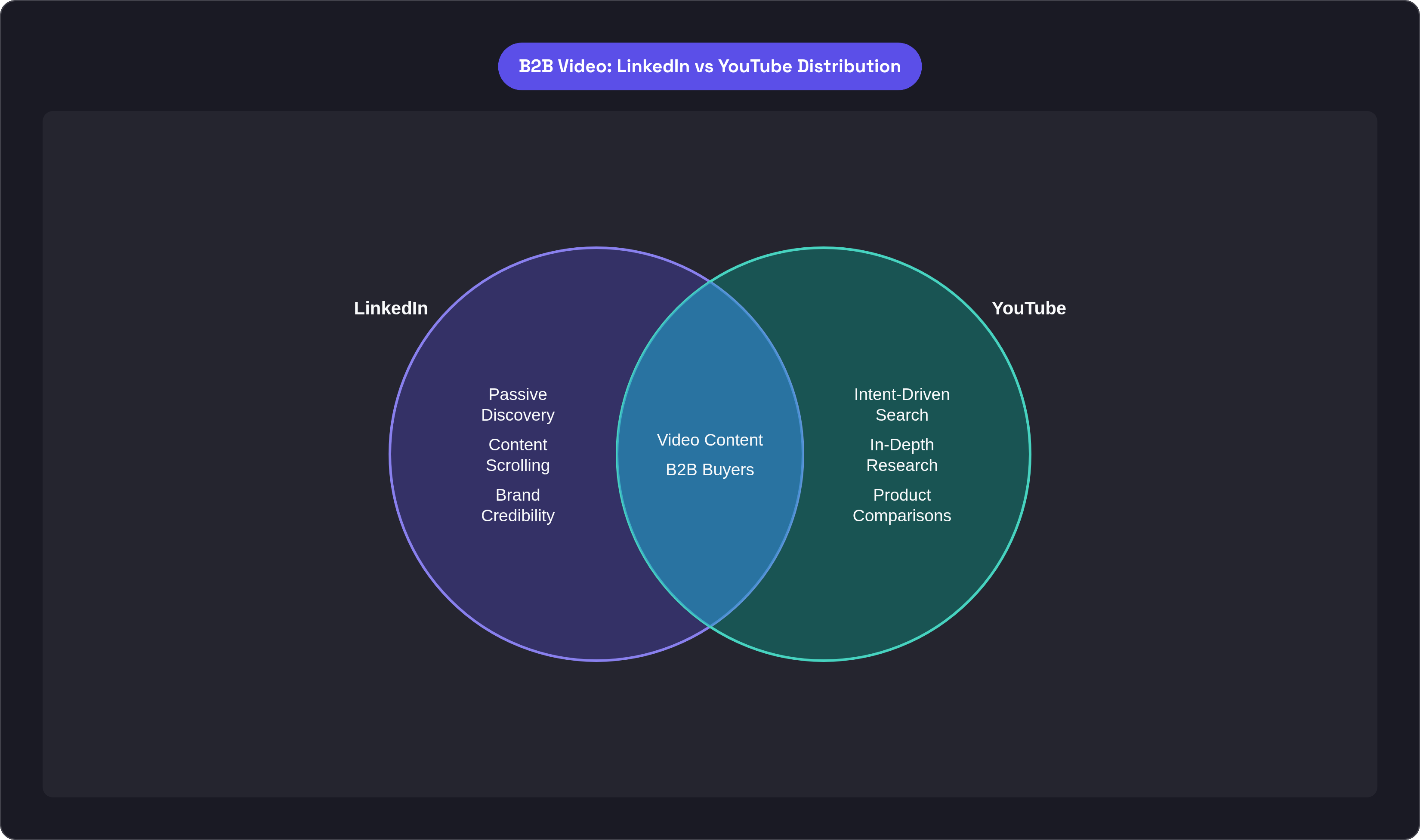
LinkedIn has become the primary channel for B2B video distribution, and video on the platform earns substantially more engagement than other content types. The professional context and the reach align in a way that doesn't happen anywhere else in social. You should treat it as a real channel, not an afterthought.
YouTube plays a completely different role. It's where decision-makers go to research, not where they encounter content passively. The behavior there is intent-driven. Someone searching YouTube for a comparison between two SaaS products is closer to a decision than someone scrolling LinkedIn. These are different moments in the buyer journey, and the platform mechanics reflect that.
To make this concrete:
- LinkedIn is for discovery and credibility. You show up there. Buyers find out you exist and decide you're worth paying attention to.
- YouTube is for intent and depth. Buyers go there when they already know what they're looking for and want to go deeper.
Treating these platforms as interchangeable is a distribution mistake. Repurposing the same video identically on both platforms, without adapting for context or behavior, leaves real results on the table.
Repurposing is standard practice and the right move. Most teams cut social clips from longer assets. But a clip without a destination wastes the click intent it generates. Every clip should have somewhere to send people, and that somewhere should match what they just watched.
A note on mobile: it accounts for a growing share of B2B video views, but desktop still dominates during working hours. Mobile catches buyers during off-hours research and matters especially on LinkedIn where mobile use is high.
On silent-watch design: most video in professional settings is watched without audio, and this matters more than you might realize. This is not an edge case. Subtitles and on-screen text are not accessibility add-ons. They are completion-rate infrastructure. If your video doesn't work on mute, it doesn't fully work.
What Production Actually Costs in 2026 and Where AI Changes the Math for Startups
Traditional agency production is expensive enough to price out most early-stage startups for anything beyond a single hero asset. Freelance rates run from a few thousand dollars per finished minute. Agency work can reach the tens of thousands for a single deliverable. For a seed-stage startup trying to build a full-funnel video library, that math doesn't work and usually doesn't need to.
In-house teams only become cost-effective at high production volume. A two-person team with equipment is justified when the output cadence is consistent. For most early-stage startups, that threshold is a long way off.
AI tools have meaningfully changed the situation here. The median cost per video has dropped significantly. The gap between what a startup can produce and what an enterprise content operation can produce is narrower than it's ever been, and it's narrowing further.
AI adoption in video creation has grown rapidly and is no longer experimental. The key categories for B2B SaaS teams:
- AI avatar and actor platforms (Synthesia, HeyGen, D-ID) for scalable talking-head content. Good for onboarding explainers, enablement videos, and localized content where you need to produce a lot of similar material efficiently.
- Transcript-based editors (Descript) for fast demo and webinar editing. Upload a recording, edit the transcript, export a finished cut. The workflow is genuinely different from traditional video editing.
- Text-to-video tools (Pictory, InVideo) for social clips and enablement content at scale.
The model that works for most B2B SaaS startups: use AI and self-serve tools for high-volume, lower-stakes formats like social clips, onboarding videos, and internal enablement content. Use selective professional production for the assets where authenticity genuinely carries the moment, including your hero video, live customer testimonial shoots, and anything a skeptical CFO will scrutinize.
The most important budget principle is this: production savings should not stay in the video budget. They should flow into distribution and iteration. Publish more. Test formats. Update assets when the product changes. The production quality of a video that nobody sees is completely irrelevant.
Building a Video Strategy That Stays Current as the Product and Market Change
The most common failure mode in your video strategy isn't a bad video. It's a good video suite that quietly decays. Your product ships new features. Your ICP (ideal customer profile) shifts. Your messaging evolves. The videos don't. Six months later, a prospect watches your homepage video and gets a description of a product that no longer quite exists. That's a real problem, and it's almost never intentional.
For your SaaS team, video assets are more like product documentation than brand campaigns. Documentation needs owners. It needs update schedules. It needs someone who notices when something is out of date before a prospect does. Your video needs the same treatment.
A few things that belong in any video strategy for the long term:
- Assign ownership. Someone on your team is responsible for auditing video assets on a regular cadence and flagging what's outdated. If nobody owns it, it decays.
- Tie measurement to funnel stage. Use completion rate and reach for awareness content. Track demo requests and MQL conversion for consideration. Watch sales cycle length and deal close rate for decision-stage assets. Measuring all your videos the same way produces noise, not signal.
- Integrate with account-based marketing (ABM). Personalized video for your target accounts is now achievable at reasonable cost through AI tools. If you're running an enterprise sales motion, test it seriously.
For any video asset, answer these three questions before you publish it. Which stage of the buying journey does it serve? Who is watching it? What should they do next? If you cannot answer all three, the asset doesn't have a job.
If you treat video as a system, where formats are mapped to stages, distribution is matched to platform behavior, and production is scaled to cadence needs, you build on each asset over time. If you treat video as occasional content production, you stay on a treadmill. You work hard, produce something good, and then start from zero. Nothing compounds. That's the real cost of not having a system.


