Data-Driven Storytelling in Startup Video Content
Numbers work only when they prove what viewers already feel in their gut.

Summary
Numbers work only when they prove what viewers already feel in their gut.
Startup videos are drowning in numbers and starving for meaning. Founders load their pitch videos with metrics the way nervous daters load a first conversation with resume details, and the effect is about the same. Nobody is persuaded by a spreadsheet.
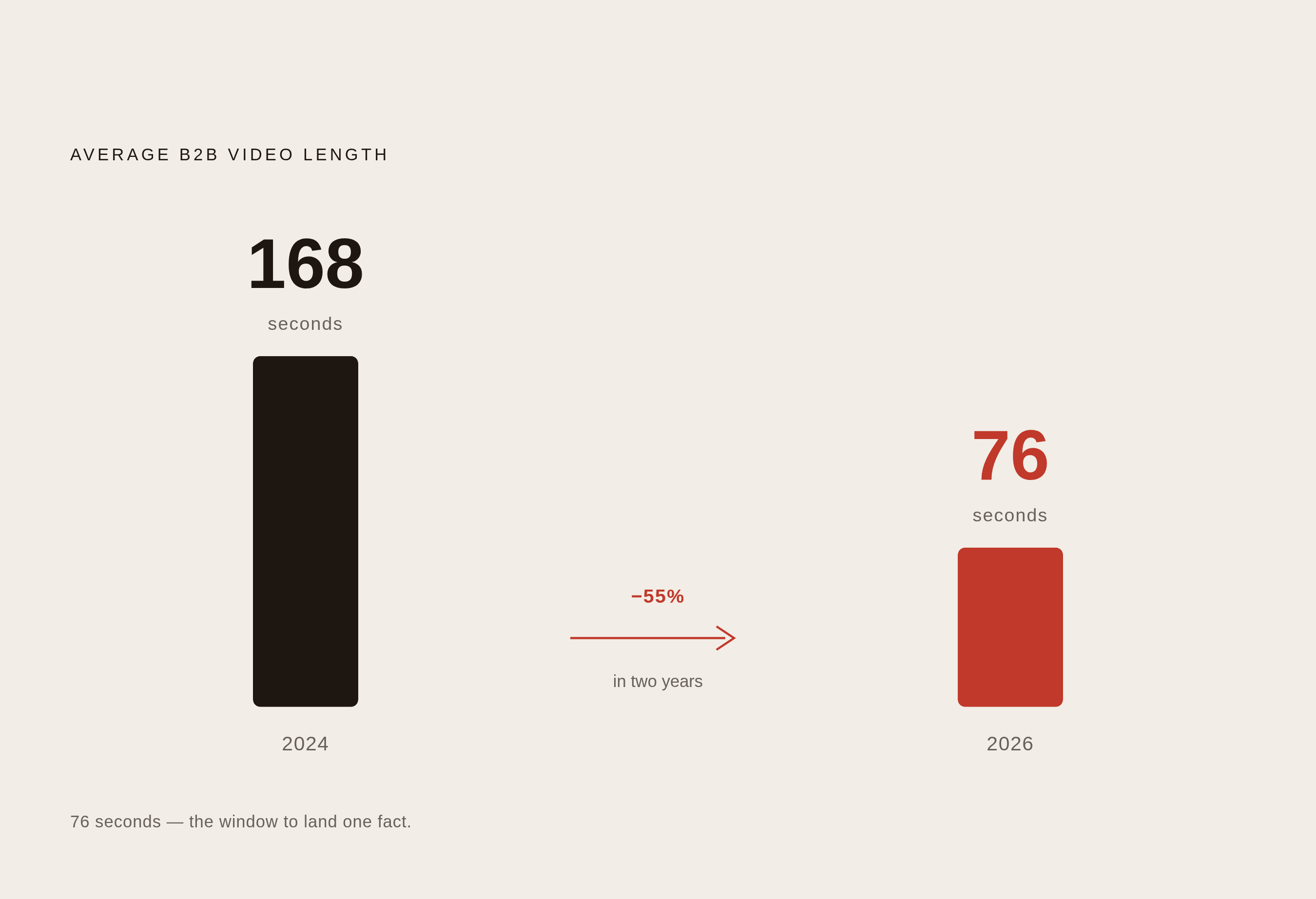
The window to say anything has also gotten brutally short. Average B2B video length dropped from 168 seconds in 2024 to 76 seconds in 2026, which means a founder has roughly the time it takes to read this paragraph out loud to land one fact that actually sticks.
Most startups respond to that pressure by cramming the short window with more metrics, not fewer, adding a growth rate here, a retention number there, and a TAM slide because someone in the deck review insisted on it. That is the wrong instinct. A number without a face attached to it is trivia, and trivia does not move anyone toward a demo call, no matter how impressive it looks on a slide. The failure is a story problem, not a lighting problem or a camera problem, and no amount of production polish fixes a story problem. Video presence stopped being a differentiator once 91% of businesses started using video as a marketing tool, so the content quality inside the video is the only thing left to compete on.
When Data Points Become Emotionally Load-Bearing
Viewers are 22 times more likely to remember a fact when it arrives wrapped in a story than when it gets dropped into a list. A separate measure puts it at 55%, the share of customers who say they are more likely to remember a story than a list of facts. Different studies, same verdict. The number was never the message. The story carrying the number is the message, and the number rides along for credibility.
The real skill is not finding a big number. Every startup has a folder full of those. The skill is finding the turning point in a customer's story, the moment where effort either paid off or it did not, and placing the number there instead of on a slide with an axis and a legend. One number that confirms what the viewer already feels in their gut beats a whole dashboard of numbers that are simply correct. Factual accuracy alone does not convert viewers. Emotional resonance does.
Build the Narrative Arc Around the Data
The customer is the hero, not the product. The data is proof that the hero resolved something, and proof belongs near the end of the conflict, not the beginning.
The structure that follows is not complicated, and most founders skip it anyway. Open with the cost of the problem, leading with a specific number attached to that cost if one exists. Then intensify with the failed attempts, the workarounds that did not work, and the manual processes held together with shared spreadsheets. Only then bring in the solution. Close with the verified outcome, letting the metric land there as proof of resolution rather than the opening line of the pitch. Problem-first narrative frameworks built this way cut buyer cognitive load by 30% and shorten the time it takes to get someone onto a first discovery call.
Zoho's marketing automation video is a clean example of the arc working as designed. The protagonist, Allison, a chief marketer, discovers the product's efficiency as part of her own story, rather than getting handed a feature list up front. Allison has a problem, the video follows her toward the solution, and the features appear as consequences of that journey instead of the reason anyone is supposed to keep watching.
Match Format to Buyer Stage & Data Load
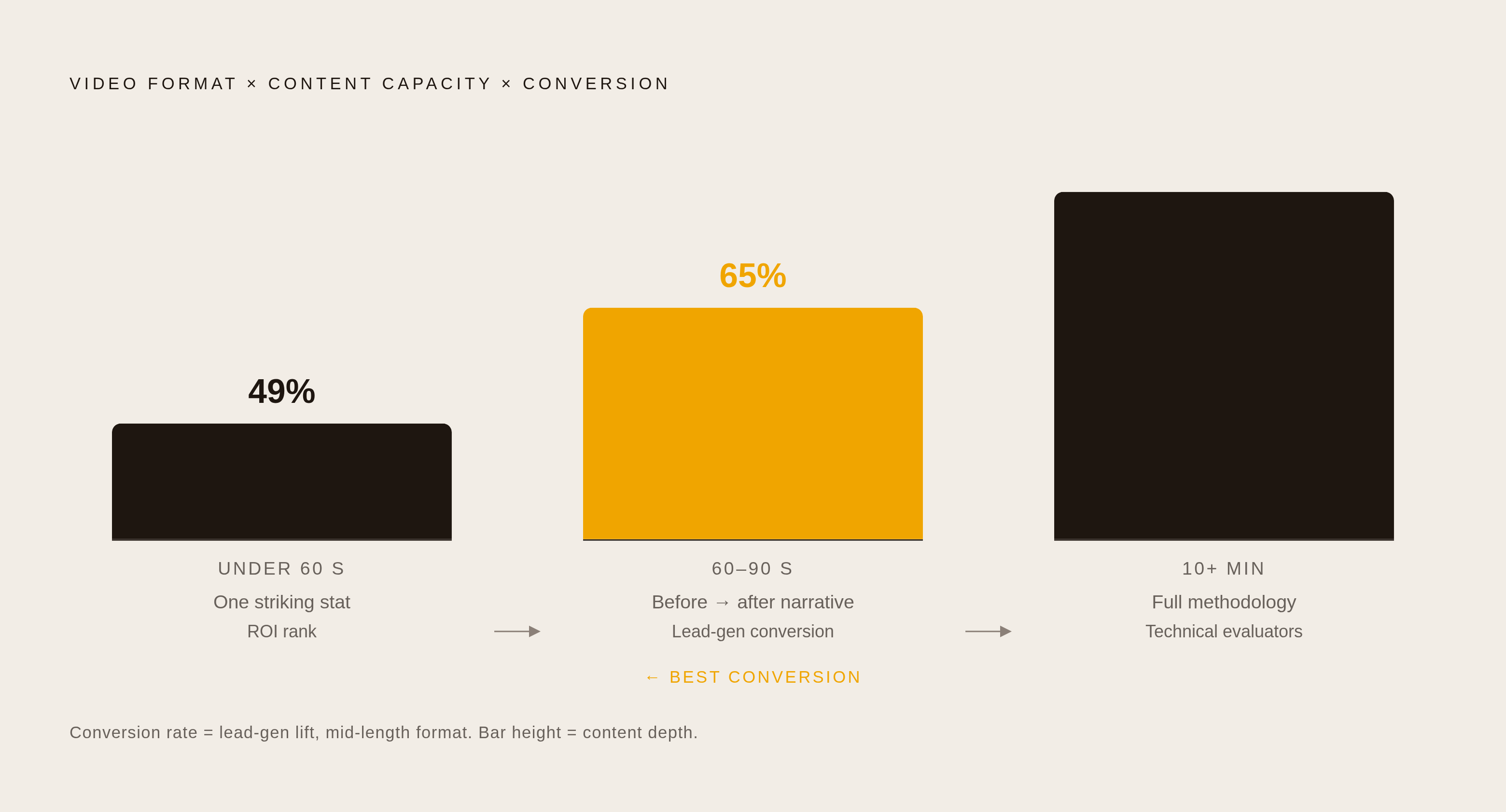
Format is a decision about how much data a piece can carry, and getting it wrong wastes evidence that took real effort to gather. HubSpot's State of Marketing 2026 puts the top three ROI-driving formats all in video: short-form at 49%, long-form at 29%, live-streaming at 25%. They are not interchangeable, and treating them that way is where most format decisions go wrong.
Short-form video, under 60 seconds, exists to carry one striking stat with a human face attached to it. Trying to include a second data point usually just pushes the first one out of memory. Mid-length video, around 60 to 90 seconds, can carry a before-and-after narrative with one or two supporting numbers. Content built this way sees a 65% conversion rate for lead generation, because the audience has already self-selected for genuine interest before the video even starts.
Buying committees now average 11.2 stakeholders and take somewhere between 121 and 218 days to close. That is a room full of people with different informational needs, and they do not watch the same video at the same depth. The finance stakeholder wants the mid-length before-and-after. The technical evaluator wants the ten-minute case study with the methodology left intact. https://greenfroglabs.com/blog/video-marketing-trends
The same data story, told at different depths and aimed at different stakeholders, needs to reach everyone who has to say yes before the deal closes.
Original Data Outperforms Borrowed Industry Statistics
Quoting someone else's industry stat makes a startup sound like a well-read commentator. Quoting a number pulled from its own product data makes it sound like the authority the commentators are citing. Most startups get this backwards, leaning on borrowed statistics because original ones feel harder to produce.
The data is not actually hard to find. Product usage patterns, customer outcome measurements, cohort performance, and support deflection rates sit inside most startups already, usually parked in a dashboard that has not yet been incorporated into a video. Every one of those numbers can become narrative-ready evidence without a research budget.
Specificity is what makes evidence convincing. A testimonial built around one verified, precise outcome, naming the customer, the measured result, and the timeframe, does more work than a generic endorsement, because vague praise is forgettable and a specific number is not. That gap matters even more now that AI search tools shape how buyers find companies: models answering buyer questions favor content built on original data, named sources, and quotable statistics. Publishing original research, however small, makes a company the source other content points back to, instead of a source quietly repeating someone else's numbers.
Production Choices That Protect Data Trust
Quality still matters, and 89% of consumers say video quality affects how much they trust a brand. But quality here means the format, the claim, and the person on camera all match each other. None of them should feel misaligned, and that is a cheaper standard to meet than a studio budget.
AI tools are part of the production stack now, and the data on using them without damaging trust is specific enough to act on. AI-labeled content on TikTok averages a 1.9% engagement rate, while non-labeled content pulls 3.4%. The lesson is not to avoid AI tools. It is to keep the production seams invisible: use the tools, but let the human moment on camera stay human.
Founder-led video and user-generated-style clips regularly outperform expensive studio productions on social platforms, because the data lands harder when the person delivering it is visibly invested in the outcome. A founder stumbling slightly over a sentence while explaining a real result reads as more credible than a polished voiceover reading the same number off a teleprompter.
Sound design gets skipped constantly. Most people scroll with the volume off, so a video built for silent viewing, with burned-in captions, text overlays, and visual storytelling that does not depend on narration, gets 38% higher engagement on Instagram and Facebook than videos that require audio to make sense. A data point that only lives in the voiceover is a data point most viewers never receive.
Distribute Where B2B Buyers Actually Watch
LinkedIn is the home base for this kind of content, and the numbers support that. Video on LinkedIn pulled a 5.90% average engagement rate in Q1 2026, ahead of the platform's overall average of 5.20%.
Native LinkedIn video outperforms a pasted YouTube link by 312%. Upload the file directly rather than linking out.
Embedding video on a landing page increases conversions by 86%, and the effect is strongest for complex products, precisely the products where a data-rich narrative has the most cognitive load to cut through. If the offering needs explaining, video on the page is the most direct path past a wall of paragraph text that buyers are unlikely to finish reading.
One long-form case study, filmed once with the full narrative arc and the full data story intact, can be cut down into mid-length LinkedIn clips, short highlight reels, and silent-caption social cuts, each one built around a different data point as its anchor. That is efficient use of a story that took real effort to gather.
Track Pipeline Attribution, Not View Counts
View counts and impressions are the vanity metric trap, and startups fall into it constantly because those numbers are the easiest ones to screenshot for a board deck. They do not indicate whether the evidence in the video moved a single buyer. Completion rate, demo requests, and pipeline attribution do that job instead, and those are the numbers worth tracking.
Budget scrutiny is not going away. Gartner's CMO Spend Survey finds that marketing budgets are 7.7% of company revenue, and 59% of CMOs say they do not have enough budget to execute their actual strategy. In that climate, a data-driven video has to connect to pipeline, not just rack up engagement, or it becomes first on the chopping block when budgets tighten.
One newer signal is missing from most teams' reporting. For AI-answer visibility, what matters is whether the video's supporting material, including the transcript, the companion blog post, and the structured data sitting behind it, gets cited by AI models when buyers ask relevant questions. Reference rate, not just click-through rate, is becoming part of the scoreboard. A video that never gets watched directly but gets quoted by an AI answering a buyer's question is still doing its job, even if the view counter cannot measure it. 93% of video marketers report strong ROI, and 86% of businesses used video as a marketing tool in 2024. https://www.sellerscommerce.com/blog/video-marketing-statistics/

