Choosing the Right Video Formats for B2B Startups
Startups must match video formats to buyer intent, not production capacity.

Summary
Startups must match video formats to buyer intent, not production capacity.
Enterprises can produce every format imaginable and let the algorithms sort out what lands. A large marketing org cranks out brand films, explainers, demos, webinars, testimonials, and founder content all at once, then waits to see what moves the needle. Startups cannot do this. Budget is finite, bandwidth is finite, and every format decision is a real trade-off. The question isn't "what video should we make?" It's "what video will actually move a buyer at this specific moment?" Those are very different questions, and most early-stage teams are answering the first one when they should be obsessing over the second.
B2B buyers don't watch video in a vacuum. They watch it at a specific moment, in a specific mindset, and the format that works brilliantly at one stage will completely miss at another. I've seen startups sink real production budget into videos that looked genuinely great and moved nobody. The content was fine. The placement was wrong. A beautifully produced demo dropped in front of someone who hasn't yet recognized they have a problem is, functionally, invisible — like handing someone a map to a city they haven't decided to visit. A misplaced video doesn't just waste production budget. It burns your distribution spend too, and quality cannot fix misplacement.
AI tools are compressing production costs fast, which is genuinely good news. But cheaper production also means it's easier to produce the wrong thing at scale. Format discipline matters more when the cost of a mistake drops, not less. One well-placed, well-distributed video beats five scattered ones. That's the whole game — and the rest of this post is about how to play it deliberately.
Top-of-Funnel: Orient Buyers Who Don't Know They're Lost Yet
At the awareness stage, your buyers aren't comparing you to competitors. They're not even sure the problem they're experiencing has a name yet, let alone a category of solution. They're still figuring out whether the problem is worth solving at all. Dropping a product demo on someone at this stage is almost offensive. It assumes context the buyer simply doesn't have.
What actually works:
Explainer videos. Typically 60 to 90 seconds, animated or live action. For SaaS and technical B2B startups especially, animation is worth a serious look. It handles abstract concepts without requiring locations, lighting, or anyone being good on camera. If you've ever had a founder insist they're "fine on camera," you know why that matters. Animation is also easier to keep visually consistent when you're working with a repeatable budget.
Short-form video. Under 90 seconds, often under 30. These live on LinkedIn, YouTube pre-roll, and industry feeds. Your buyers aren't actively searching there, but they're open to being redirected. Completion rates at this length are meaningfully higher. A half-watched video fails to plant the concept you need it to plant.
One thing about short-form that trips people up: plan it as a series, rather than a standalone. One video rarely moves a metric. A consistent weekly series over a quarter builds real category familiarity. Producing a single clip and calling it a strategy is a very common mistake, and a very avoidable one.
What to skip at this stage: demos, pricing comparisons, case studies. All of them assume a level of vendor consideration that simply hasn't happened yet.
Mid-Funnel: Show the Product to Buyers Who Are Actually Looking
Your consideration-stage buyers have done enough research to understand the category. They're evaluating solution approaches now. They want to see the product working, not get a lesson on what the product is. This is where demos and webinars actually earn their place.
Product demo videos are the most produced B2B video type by a wide margin, and for good reason. The demo's job at this stage is specific: show the product in motion, surface the key workflow or outcome the buyer actually cares about, and lower the friction required to book a live call. Mid-length works well here. Roughly 60 to 90 seconds for hosted product pages, up to several minutes for YouTube or dedicated evaluation platforms.
Webinars sit somewhere at the mid-to-bottom boundary. They serve buyers who want structured education on a specific problem and are open to hearing a vendor's perspective. Still deciding, but actively qualifying. The on-demand recording also extends the reach of every webinar significantly. A lot of the real views happen after the live event, sometimes weeks later. That effectively doubles what you get out of each production.
Honest caveat for startups: webinar pipeline impact is real but slow. Webinars are a volume and nurture play. Treating them like a fast-close tool leads to disappointment, and I've watched more than one team make exactly that mistake in Q4. Build an evergreen demo video before you invest in webinar infrastructure. The demo reaches every mid-funnel visitor automatically. The webinar requires active promotion, scheduling, and follow-up every single time you run it. Sequencing matters.
Bottom-of-Funnel: Replace Curiosity With Proof
By the time your buyer is shortlisting vendors, they've already done the education. They know the category. They've watched demos. Now they're asking a different question: will this actually work for us, and can we trust this vendor to deliver? No demo answers that question. A customer does.
Customer testimonial videos and case study videos are the right formats here, and specificity is everything. A named customer describing a measurable outcome does more work than a vague "we love this product." Case study videos with concrete ROI figures are substantially more persuasive. Your buyer at this stage is building a business case internally. They need something concrete to point to in a slide deck or a budget meeting.
Personalized sales videos also belong here. A short, direct-to-buyer recording from an account executive who references the prospect's specific situation. No real production budget required. A camera and a clear message. Low cost, high signal.
Secure one strong customer case study video as early as you possibly can. It feeds the sales team, the website, and paid retargeting simultaneously. Three jobs, one asset.
What to avoid at this stage: awareness-style brand films or educational explainers. They signal to the buyer that you're unaware of where they are in the process. When someone is this close to a decision, that's a genuinely damaging impression to leave.
Founder Video Works the Whole Funnel — Use It That Way
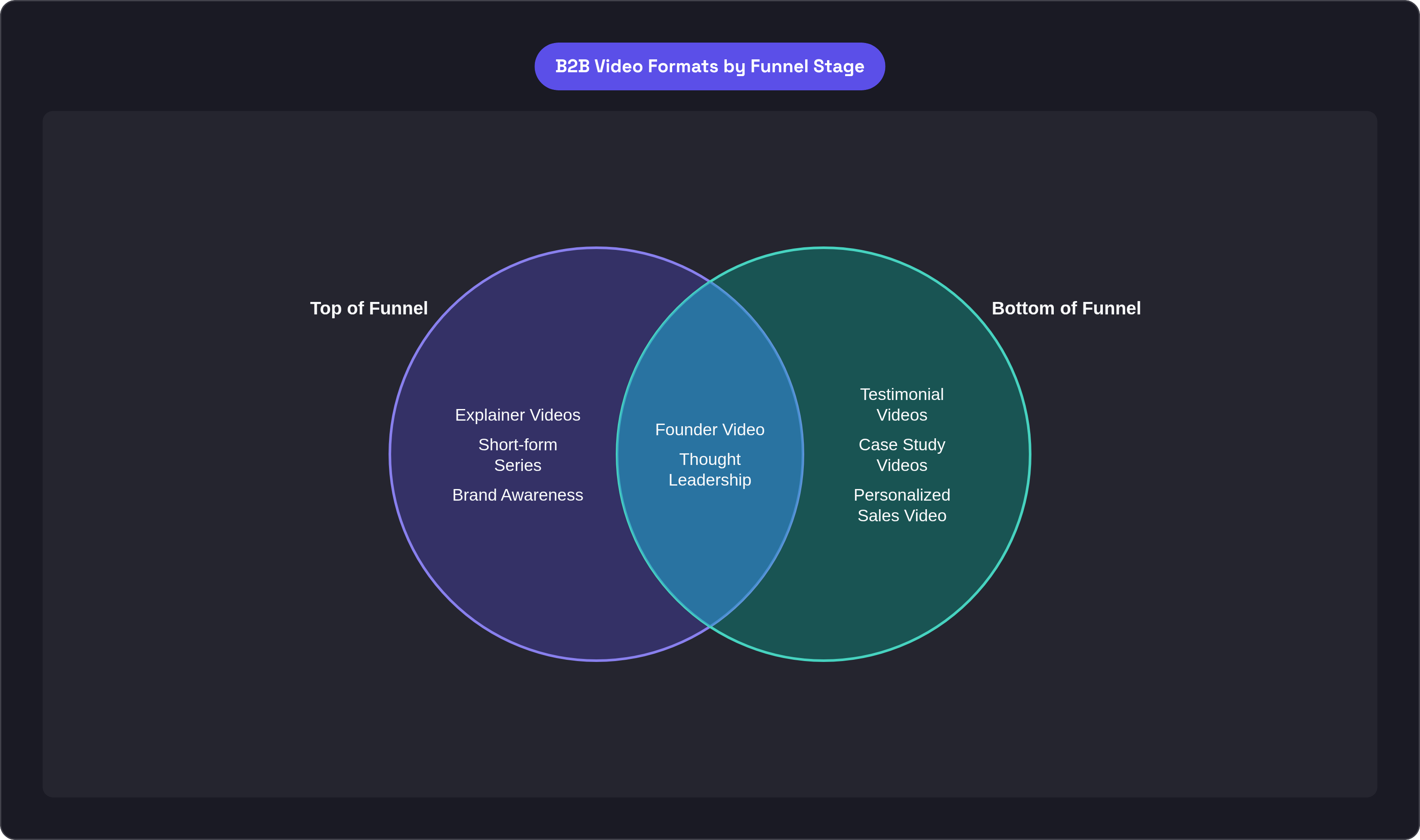
Thought leadership video — meaning a founder, executive, or subject-matter expert talking directly to camera about a problem the audience faces — doesn't belong to a single stage. It functions differently depending on where a buyer encounters it.
At the top of the funnel, it builds category awareness and trust before a buyer is evaluating anyone. The face behind the product is a differentiator that an animated explainer can't replicate. At the mid-funnel, it establishes credibility that de-risks the evaluation. Buyers who trust the founder's expertise are more willing to invest time in a demo.
As a B2B startup, your founder video carries an authenticity signal that larger competitors genuinely cannot manufacture. A founder talking directly about a problem they've lived with, sometimes for years, is more convincing than a polished brand video from a company with a hundred-person marketing team. The conviction shows. No production budget replicates that.
Format-wise: short-form clips under 90 seconds for social distribution, longer recorded conversations or interviews for YouTube and on-demand audiences. This is also where AI editing tools and caption generators actually earn their keep. They keep production light enough to sustain a real cadence without sending every clip to an agency.
The Exact Order to Build Formats When Budget Is Tight
Sequence matters more than volume. Build formats in the order your buyer encounters them, and put the most production quality where it compounds. A demo video seen by every mid-funnel visitor returns more than a polished brand film that few people stumble across. Distribution volume is what determines where quality investment actually pays off. This is the part that gets skipped in most startup video conversations, and it's probably the most important part.
A reasonable sequence for an early-stage B2B startup:
Explainer video for the homepage. Always on, always working, no scheduling or promotion required.
Product demo video for the evaluation layer. Every mid-funnel visitor needs this before they go looking for it somewhere else.
One customer case study video as soon as you have a referenceable customer. Sales team, website, retargeting. Three jobs, one asset.
Short-form series for social, built from repurposed cuts of what you already have. Cut down rather than build from scratch.
One budget principle that gets overlooked constantly: fund distribution as seriously as production. A high-quality video with no promotion underperforms a modest video with consistent placement. Consistent placement is a distribution problem, and distribution deserves real investment, not whatever's left over after the agency invoice.
Your goal isn't a complete video library. It's a deliberate sequence. The right format, at the right stage, reaching the right buyer at the moment they're actually ready to act.