Accessibility and Localization in Technical Video Content
Unified captions and audio descriptions cut accessibility and localization costs in half.

Summary
Unified captions and audio descriptions cut accessibility and localization costs in half.
Two teams build two workflows to solve what is functionally one problem. That is the current state of accessibility and localization in most technical video pipelines, and it is costing companies money they do not need to spend. Technical video content, whether a product demo, a feature walkthrough, an onboarding tutorial, or a customer training series, now reaches global audiences on day one and must simultaneously serve viewers with disabilities, viewers watching without sound, and viewers who speak a different language entirely.
Captions, transcripts, and audio description tracks are not just compliance boxes. They are the exact same infrastructure a localization team needs to ship a video in several other languages. Build it once, use it twice. Miss that, and you are paying for the same foundation twice, on two separate timelines, with two separate teams who have never spoken to each other.
Why Accessibility and Localization Now Converge
For years, the org chart made the decision for you. Accessibility sat with legal or compliance. Localization sat with marketing or product. Different budgets, different platforms, different people who never had a reason to talk to each other.
That split made sense when the two pressures showed up at different times. A company would ship a product video domestically, deal with accessibility complaints later, then eventually get around to translating things once international sales picked up.
That sequence does not exist anymore. Regulatory deadlines and global distribution now land on the same desk in the same quarter. A SaaS company launching a feature video today has to think about screen reader users and prospects who speak another language at the exact same moment, because both audiences are watching the same video on the same day.
The scale involved is not small. Over one billion people worldwide live with some form of disability. The EU alone counts more than 87 million people living with a disability. Research finds that 75% of consumers prefer to buy in their native language, and 76% will abandon a brand entirely if content is not available in one they speak.
Regulatory Deadlines That Already Passed
The European Accessibility Act went into full effect on June 28, 2025. Any new video content reaching EU audiences now has to meet accessibility requirements. Existing content from audiovisual media services gets a longer runway until 2030. Pre-existing content from most other businesses is generally exempt, but new content gets no such grace period.
National market surveillance authorities across EU member states enforce this, and fines run up to €100,000 for non-compliance.
The EAA's quality bar is specific. Captions and audio descriptions must be, in the regulation's own language, "fully transmitted, high-quality, synchronized, and user-controllable." Auto-generated captions do not clear that bar. The standard does not relax for other languages either, so each localized version must meet the same quality bar as the source. That single clause turns professional localization from a nice-to-have into a compliance dependency.
What WCAG 2.1 Level AA Requires
WCAG 2.1 Level AA lays out four concrete requirements for prerecorded video, and the vagueness around this standard is where most teams get into trouble.
Accurate closed captions come first, a Level A requirement folded into AA conformance. Audio descriptions come next under SC 1.2.5. Then transcripts that include visual context, not just spoken words. Finally, keyboard-operable player controls under SC 2.1.1, so nobody needs a mouse to pause, rewind, or turn captions on.
Two distinctions matter more than teams tend to realize. Closed captions are not subtitles. Closed captions identify speakers and describe sound effects, things like "[alarm ringing]," and that is what actually satisfies SC 1.2.2. A subtitle file with dialogue alone does not satisfy it. Separately, a transcript is not a substitute for an audio description. Transcripts satisfy the requirement for audio-only content under SC 1.2.1, but a video with meaningful visual action, someone pointing at a dashboard or a product demo showing a UI flow, still needs a real, narrated audio description track to meet Level AA.
Format matters too, and this is where a lot of otherwise well-intentioned videos fail quietly. VTT files, captions delivered as a separate, adjustable file, beat open captions burned directly into the video. VTT lets the viewer adjust font size, color, and contrast, giving users control that burned-in captions cannot offer.
The Shared Foundation of Accessibility and Localization
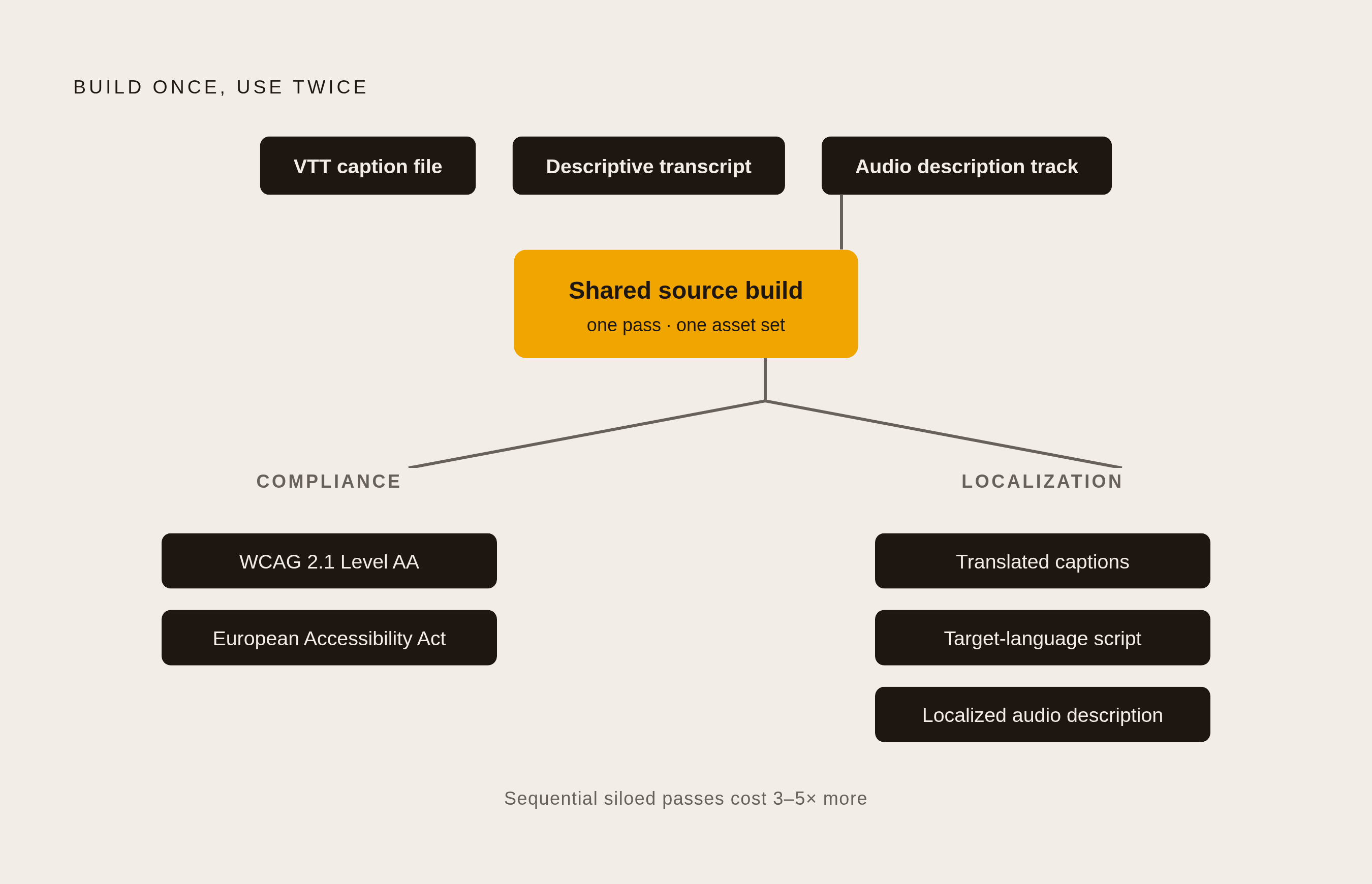
Localization gets mistaken for translation constantly, and that mistake is expensive. Translation swaps words. Localization adapts cultural references, resequences on-screen text, adjusts pacing so narration does not outrun the visuals, and re-times everything against lip movement. It is a bigger job, and it needs more raw material to work with.
That raw material happens to be exactly what accessibility compliance already produces. A VTT caption file is a timed, segmented text document broken into exact chunks with exact timestamps. Hand that to a localization team and they have the scaffolding already built. They are not starting from a blank page. They are translating into a structure that already knows where every line falls. A descriptive transcript works the same way for audio description. It is the source document a target-language narrator adapts rather than something written from scratch.
The EAA reinforces this directly, since its quality standards apply equally across every supported language. That means each localized version needs its own fully compliant caption track and its own compliant audio description. The infrastructure built for accessibility is the infrastructure localization populates. Skip building it right the first time and localization does not get cheaper. It gets rebuilt from zero, in every language, on every video.
Attempting localization without an internationalization foundation already runs 3 to 5 times more expensive than building it in from the start. The same cost multiplier occurs when accessibility and localization run as separate, sequential passes instead of a single build.
A Unified Production Workflow, Script to Asset
The order of operations affects total cost more than any individual tool choice. Build the source language asset completely, video, VTT caption file, descriptive transcript, audio description track, before localization even starts. An incomplete source asset does not produce a slightly rough localized version. It produces a non-compliant one, in every target language, all at once.
Scripting is where this either gets easy or gets expensive. Write scripts with natural pause points built in for audio description, and avoid leaning on visual-only information such as charts, on-screen callouts, or a cursor circling something on a dashboard that has no spoken equivalent. Every second of unspoken visual meaning is a second someone has to write, narrate, and re-time later, and that burden multiplies across every language version.
Before anything goes to translation, captions need to clear a quality gate: 99%+ accuracy in the source language. Errors in the source do not stay put. They compound once translated, so an error rate that seemed manageable in the source language grows worse by the time it has been through a translator working off a flawed transcript into another language.
Terminology needs to be locked before localization starts too. Product names, UI labels, and feature terminology all belong in a glossary and translation memory before a single caption gets localized. Leave that to translator discretion and you get inconsistent terms across language versions, which undermines screen reader compatibility, since screen readers depend on consistent language patterns, and brand consistency, since a single UI term appearing three different ways across three languages signals a breakdown in process.
How Compliance Infrastructure Boosts Search Visibility
Search engines cannot watch video. Neither can AI models. Both rely entirely on transcripts, captions, structured data, and the literal sentences spoken on screen to know what a video is actually about.
The same VTT file built for compliance also makes every spoken word in a video crawlable and indexable. That is keyword density and semantic coverage added to a page without writing a single new sentence of content.
Caption usage in videos rose 572% since 2021, and 254% more businesses captioned their videos in 2023 than in 2022. That is not a niche accessibility habit. It is a market realizing captions are also an SEO play.
AI-referred sessions jumped 527% year-over-year in just the first five months of 2025. AI answer engines pull from text, not footage, when they decide what to cite and what to ignore. A video with no transcript and no captions is functionally invisible to the systems now driving a growing share of discovery traffic.
Engagement Numbers That Justify the Investment
85% of social media videos get watched with the sound off. Captions are not a feature for a small accessibility niche. They are the default viewing condition for most video consumption happening today.
That holds outside social feeds too. 87% of Americans use captions at least sometimes, and nearly half say they use them "always" or "often." The audience that needs captions for accessibility and the audience that simply prefers captions overlap significantly, depending on whether they are on a train, in an open office, or somewhere they cannot use audio.
The retention numbers strengthen the business case further. 80% of viewers are more likely to finish a video when captions are on, and captioned videos see meaningfully higher retention overall. Subtitles alone can lift viewership by as much as 40%. That is a direct engagement multiplier sitting inside a line item most finance teams still file under compliance overhead.
Four Workflow Gaps That Break Everything
Four gaps recur, and every one of them is a process failure, not a technology failure.
The first is trusting platform auto-captions. YouTube's native captions, and most platform auto-generated captions generally, are not built to the 99%+ accuracy threshold compliance requires. Teams relying on them are not just falling short on accessibility. They are feeding a low-quality source asset straight into localization, where the errors compound.
The second is a transcript that technically exists but sits nowhere useful. A transcript that is not surfaced alongside the video is invisible to search engines and AI agents trying to crawl it in context. A transcript buried in a shared drive helps nobody.
The third is treating localization as the last step instead of a parallel track. When localization only happens after everything else ships, audio description tracks almost never get re-timed and re-narrated properly for the target language. The source version might pass every EAA requirement cleanly while the localized version fails anyway, released under the same name, same brand, and same legal exposure.
The fourth is skipping the terminology lock. Technical SaaS vocabulary left to individual translator judgment produces captions that disagree with each other from one language to the next, and that inconsistency undermines both screen reader compatibility and basic brand coherence. Fixing this takes a glossary and about an afternoon. Not fixing it takes much longer, in every language, indefinitely.


