Human Review Checkpoints in an Automated Video Content Pipeline
Automation handles production; human checkpoints keep the brand and risk on course.

Summary
Automation handles production; human checkpoints keep the brand and risk on course.
An automated video content pipeline saves time when people review the work at set checkpoints instead of waiting for someone to remember to ask legal. The key is to separate checks that merely warn from gates that block release. That lets automation do the production work while people stay responsible for the brand, editorial direction, and risk.
Why automated video pipelines still need human judgment at specific moments
Clipping, captions, silence removal, reframing, dubbing, and B-roll suggestions belong to the mechanical layer of production. Automated pipelines can handle that work reliably, leaving people to decide whether the resulting video should exist in its current form. Those are different kinds of work. A clean cut can still tell the wrong story, and a fluent caption can still misname the product.
Hook quality, story selection, brand tone, humor, timing, claims, factual accuracy, and platform-specific creative choices all need judgment. Content for clients or executives also needs final approval. A system can suggest those choices, but someone must accept responsibility for them. When marketing, brand, and legal all have a stake, an undocumented automated decision leaves that responsibility unresolved.
Lemonlight’s production model shows how to put people in charge by having them review work during the workflow, before it is delivered. Without those checkpoints, disagreements and risks can remain unresolved in an asset already in circulation after launch. The hybrid model is therefore a production standard. AI handles the heavy lifting, while explicit, documented approval points reserve consequential decisions for people.
The architecture that makes checkpoints work — hard gates versus soft gates
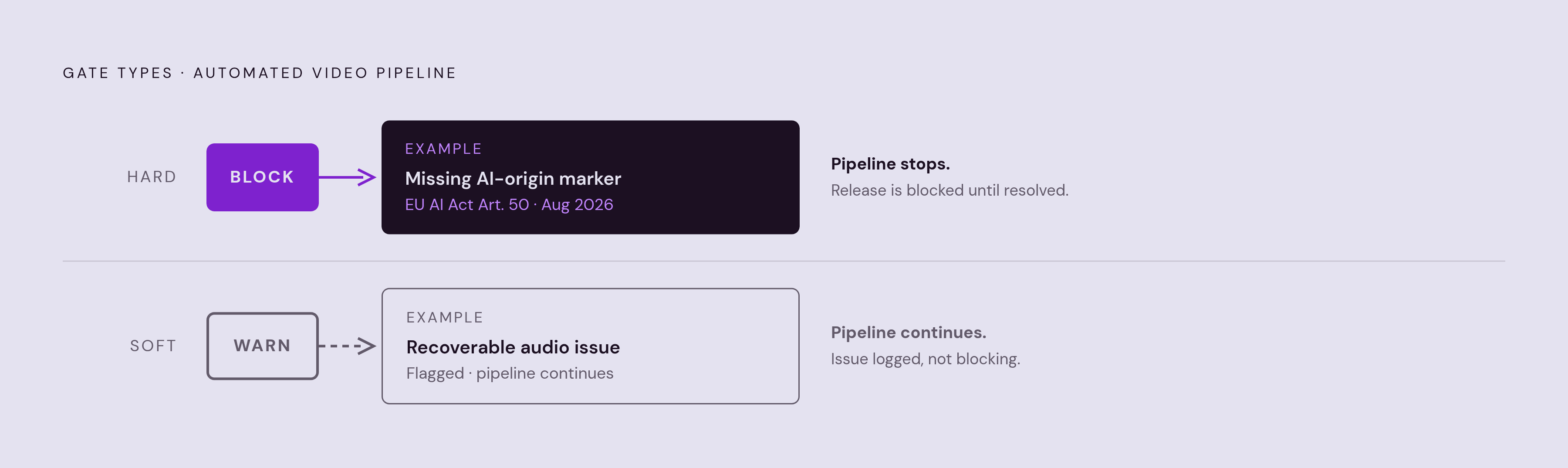
A hard gate stops work or release until a required condition is met. A soft gate flags an issue but allows the pipeline to continue. A warning can be useful without stopping production, but it cannot protect a release that must not proceed with the flagged defect.
Fora Soft distinguishes measurement from quality control by the action attached to a result. A metric in a log measures something, while a metric that fails a build and blocks release controls it. The same distinction applies to editorial checks. A spell-checker’s red underline is a warning. A publishing rule that refuses to proceed until the underlines are resolved is a gate, giving the color red’s warning a consequence.
Hard gates fit failures that are costly or cannot be undone, including an unsupported legal claim, an off-brand asset destined for paid media, or a missing compliance marker. Soft gates fit recoverable issues where false alarms would otherwise stall production. Those categories should be decided once, documented, and enforced by the system. Reopening the debate for every asset turns a release rule into a recurring meeting, which is a remarkably slow form of automation.
The three natural checkpoints and what each one is designed to catch
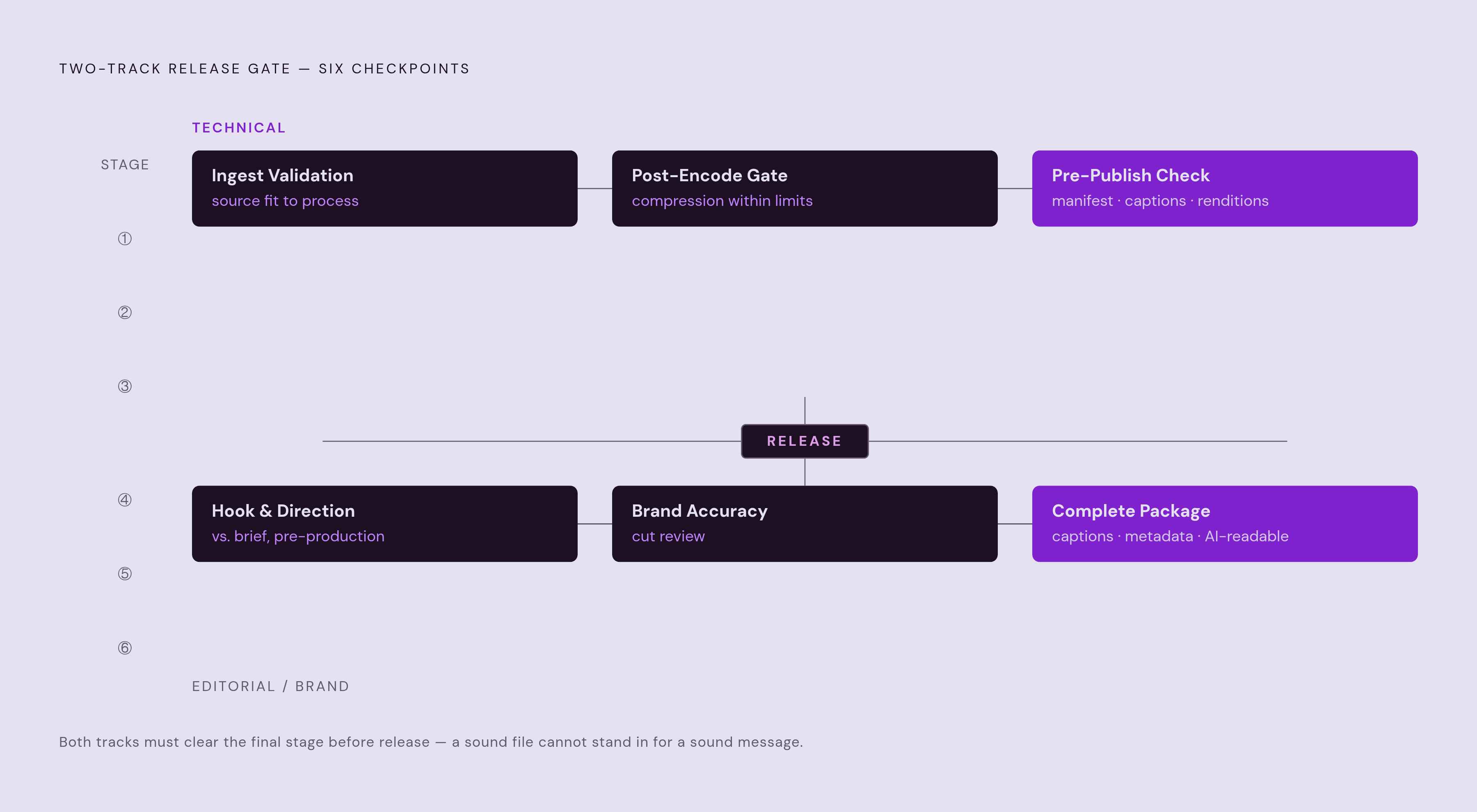
The technical backbone runs from source input through encoding and packaging to delivery. Ingest validation is the first checkpoint, confirming that the source file is what it claims to be before encoding begins. This is the cheapest place to catch trouble. A rejected bad source avoids wasted work at every stage that would otherwise follow. Its question is whether the pipeline has received something fit to process.
The post-encode quality gate checks whether compression has harmed the picture or audio more than is allowed. Perceptual scoring belongs here because this checkpoint assesses the quality of the encoded result. The pre-publish check then examines the deliverable as a whole. It covers manifest integrity, caption file loading, thumbnail match, and rendition completeness. This last check comes as close as possible to the viewer’s experience before release.
For content marketing, the same sequence applies to editorial and brand fidelity. The first checkpoint asks whether the hook and story direction fit the brief before production commits to them. The next checks whether the cut gets the brand right as well as making it through encoding. The final checkpoint checks the complete package, including accurate captions and metadata that AI crawlers can read. Technical and editorial approval address different failures, so a sound file cannot stand in for a sound message.
Where brand and editorial judgment enter the pipeline upstream of production
The brief or outline is the highest-leverage human checkpoint because it determines what the system will produce. Before generation begins, a reviewer sets the goals, who the video is for, its message, and the rules the copy must follow. An error in the brief becomes a parameter that later stages inherit, so polished execution can compound the original mistake.
Lemonlight places the origin of many AI video problems upstream, in a loose brief or a style frame review treated as optional. That shifts the brand reviewer’s role from correcting finished work to approving direction. The reviewer is deciding whether the story and visual approach belong to the assignment at all. This approval prevents the pipeline from spending its effort on a direction that should never have cleared the starting line, while later checks remain necessary because execution can still drift.
The depth of that review can vary with the content. A high-visibility product launch deserves detailed scrutiny of its brief, while a daily social tip can pass a lighter check focused on template compliance and topic fit. These two review tiers share a standard of accountability. Each tier requires approval of direction before production.
The human passes that separate a rough cut from a releasable asset
Once there is a draft, people shift from approving the plan to judging how well it was carried out. High-visibility work gets a deeper creative review, while volume content can be checked against the template and direction already approved for it. Agency-model pipelines use creative director review to select promising variations, guide refinement, and confirm brand alignment before client delivery. A nearly finished draft is still a draft. Cultural references, subtle tone, emotional resonance, and humor need a person who can judge how the piece lands.
Captions make the need especially plain for B2B SaaS teams. Generic speech-to-text models make errors on product-specific terms, company names, and feature names outside standard training data. A demo can therefore explain a feature correctly in the audio while naming something else on screen. That is a credibility problem. The human caption pass must let a reviewer correct vocabulary and override errors so they can fix the text they are asked to approve.
A caption file may load perfectly and still have the wrong feature name, so pre-publish validation must check more than how the file works. Across dozens of versions, reviewers also catch drifting colors, misplaced logos, and wandering tone. Claims and factual accuracy need scrutiny as part of that approval work. These are the reasons the final human pass remains necessary even when automated production brings the draft close to completion.
Why the review bottleneck is a workflow design problem, not a headcount problem
AI can generate clips faster than people can review them, but reducing checkpoints does not resolve the underlying mismatch. It simply lets more output pass without the judgment it needs. Assessing a claim requires attention, while gathering scattered comments consumes time without improving the claim. A workflow that mixes the two makes every approval look more expensive than it needs to be.
That handoff friction is a structural gap in much of the tool category. Stakeholder comments arrive in Slack, email, or Google Docs outside the editing tool. Teams export drafts, gather feedback from those channels, and make the changes by hand. Each cycle adds delay that accumulates across the content calendar. The editing may be automated, but the approval process is still playing email tennis.
For teams facing that backlog, the supported responses are smarter routing, tighter upstream filtering, and tooling that keeps review within the pipeline. Additional reviewers can help during high-volume periods. Tighter AI filtering reduces what reaches the queue. Automatic approval can also serve the lowest-tier content where the only required check is template conformance. That narrow exception automates a set mechanical check while still requiring legal or editorial approval where it is needed.
What compliance now requires at the pipeline level, and why it is a hard gate
The European Commission states that Article 50 of the EU AI Act applies from 2 August 2026. Its official FAQ says providers of AI systems generating synthetic audio, image, video, or text must make AI-generated or manipulated outputs machine-readable and detectable as artificially generated or manipulated. Content covered by that rule must have the required marking before it can be released.
A hard gate must stop release when a marker is missing. Adding one to a later version does not retroactively mark the asset that has already entered distribution. That makes pre-publish review the last opportunity to catch and correct the omission before release. Brand teams that have treated compliance as a warning therefore face an architectural change, with the check blocking publication.
Compliance review also has a separate job in product demos. Factual accuracy and claim verification create their own legal exposure, independent of rules about AI-origin labeling. A correctly marked video can still make an inaccurate product claim. The approval must cover both the required marker and the claims in the content, rather than mistaking a labeling pass for legal clearance.
How review quality at the transcript and metadata stage determines AI search visibility
Transcript and metadata review also affects whether useful video content can be found and cited in AI-generated answers. YouTube transcripts are crawled and cited by AI engines, so the text attached to a video is part of its discoverable substance. A well-titled, well-described video with a clean transcript can be more discoverable in those answers than a blog post on the same topic. That is the positive side of the release gate. It protects not only against errors but also against publishing useful expertise in a form that is harder to interpret.
For B2B SaaS content, precision at the product-name and technical-term level is essential to that opportunity. The caption mistake that weakens a demo’s credibility also weakens the transcript’s account of what the video actually explains. Human correction therefore serves both the viewer and the systems reading the text. Transcript and metadata review is consequently a revenue-adjacent decision.
Timestamped chapters add another layer by giving AI Overviews a roadmap to the moment that answers a query. Chapters and transcripts both need human correction on technical content, because automation alone cannot be trusted to get them right. That review works alongside original insight and structured data, which also have a place in the wider GEO picture. In the strongest pipeline, publication comes when the render is finished and the complete asset has been checked and approved as accurate.

