Video Content Attribution in a Multi-Touch B2B Funnel
Multi-touch models reveal where video actually builds deals across B2B's long journey.

Summary
Multi-touch models reveal where video actually builds deals across B2B's long journey.
Dreamdata's 2026 benchmarks, built on more than 66 million sessions and 3.5 million customer journeys, put the average B2B buying journey at 272 days and 88 touchpoints, a scale that makes single-touch crediting structurally absurd.
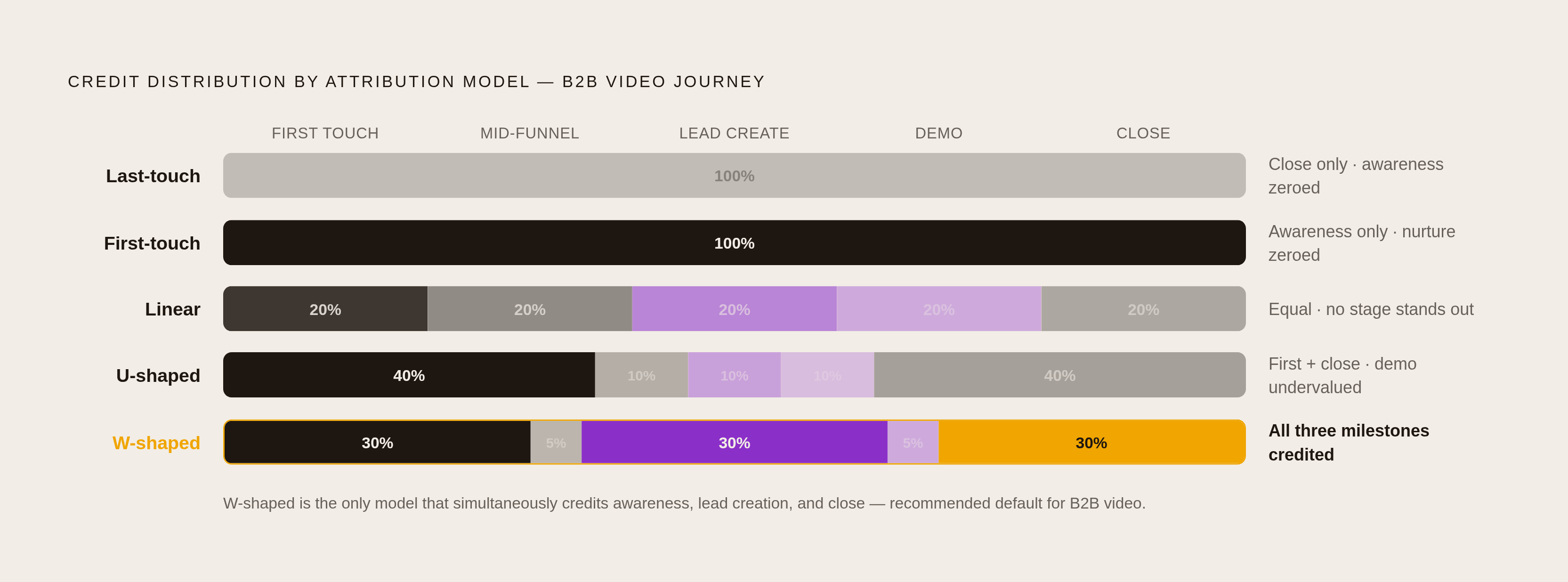
The mechanical issue with single-touch models is that they hand 100% of the credit to one touchpoint and zero to everything else. Picture a prospect who downloads a whitepaper, watches a webinar two weeks later, sits through a demo, and then signs. The webinar might be the thing that actually built the trust that got the deal signed, but if it's not the first or last touch, it earns a zero on the scoreboard.
Video is uniquely bad at fitting into this kind of scoring system because it doesn't stay in one lane. A webinar creates awareness. A demo closes deals. Same format, three completely different jobs, at three different points in the funnel. The rest of this piece builds a framework that assigns credit based on where each video type actually does its work, not where it happens to land in whatever attribution model a team already has running.
Why Dark Funnel Video Escapes Attribution
Gartner's research puts the figure at 70% of the buying journey happening before a prospect fills out any vendor contact form, and Dreamdata's dataset goes further, putting the dark funnel at 81% of the customer journey Gartner 2026. Different numbers, same conclusion: the bulk of the decision gets made somewhere your tracking pixel will never see.
Video is the worst offender here. Webinar clips get shared in Slack channels. YouTube links get forwarded in DMs. Someone reposts a product video on LinkedIn and it arrives with no referral data, recorded as direct traffic. Every visit that arrives through Slack, Discord, WhatsApp, or TikTok appears with zero referral information because these platforms don't pass referral data, and those are precisely the channels where B2B teams are pouring their video budget.
This has a real effect on who wins deals. Forrester's Buyers' Journey Survey found that 68% of B2B buyers already have a front-runner vendor in mind before the purchasing process formally starts, and that front-runner closes the deal roughly 80% of the time. Dark-funnel video consumption, including anonymous product demos and LinkedIn videos watched weeks before a prospect ever visits the website, is a primary mechanism behind how that early preference gets locked in.
There are patches for this, not cures. UTM discipline helps if everyone actually uses it. Share buttons that preserve tracking help when people click them instead of just copying the link. Visitor identification tools can de-anonymize some traffic, and self-reported attribution fills in some of the gaps. None of it closes the hole completely, and that gap will remain visible as the framework gets built out in later sections.
How Attribution Models Distort Video's Value
Every attribution model makes a trade-off, and video usually loses on both ends of it. Last-touch gives 100% of the credit to whatever happened right before the close, so a webinar that spent two months quietly building trust gets nothing while a retargeting ad or a forwarded comparison guide takes the win. First-touch flips the distortion: it rewards the awareness channel, often a video ad or a webinar signup, and ignores every nurture asset that actually moved the deal forward. A B2B SaaS company tripled its content budget under first-click attribution, then cut retargeting spend by 60% because the model said retargeting wasn't pulling its weight. Pipeline dropped 40%, because those first-click visitors never made it through the funnel without the nurture campaigns the model had told them to defund.
Linear attribution spreads credit evenly across every touchpoint, which sounds fair until you realize it treats a skimmed newsletter the same as a fully watched product demo Multi-Touch Attribution Models & Tools Guide 2026 B2B content marketing and pipeline generation benchmarks 2026. It's good for proving video shows up consistently across a journey, but it can't tell you which touch actually did the heavy lifting.
U-shaped attribution, using a 40/40/20 split favoring first touch and the conversion moment, lets an awareness webinar and a late-stage demo both get meaningful credit at the same time, and is the most common model for B2B teams with moderate sales cycles. W-shaped models go one step further, adding a lead-creation milestone with a 30/30/30/10 split, which matters for video because it separates the webinar that created category awareness from the demo that actually created a qualified opportunity Multi-Touch Attribution Models & Tools Guide 2026 B2B content marketing and pipeline generation benchmarks 2026. Those are two distinct jobs, and lumping them together erases the distinction.
Data-driven attribution sounds smart because it's based on actual conversion patterns rather than a fixed rule. However, many mid-market SaaS companies won't hit the required data threshold on video-specific conversion events alone, and when the model doesn't have enough data, it doesn't fail loudly. It quietly reverts to less reliable behavior behind the scenes Multi-Touch Attribution Models & Tools Guide 2026 B2B content marketing and pipeline generation benchmarks 2026.
Account-based attribution solves a different problem entirely: it spreads credit across everyone on the buying committee instead of just the person who filled out the final form. That matters enormously for enterprise video, where a CTO might watch a technical tutorial and a CFO might separately review a testimonial, and neither of them is the one who clicks "request demo."
Without a modernized attribution setup, somewhere between 30% and 40% of marketing budget gets misallocated Multi Touch B2B Attribution: Complete Guide for 2026 Multi-Touch Attribution Models & Tools Guide 2026 B2B content marketing and pipeline generation benchmarks 2026 Marketing Attribution Statistics 2026: 99+ Stats & Insights Expert A…. Teams that implement multi-touch attribution well see 15% to 30% higher marketing ROI, a 19% improvement in budget accuracy, and cost-per-acquisition improvements of 14% to 36% Multi Touch B2B Attribution: Complete Guide for 2026 Multi-Touch Attribution Models & Tools Guide 2026 B2B content marketing and pipeline generation benchmarks 2026 Marketing Attribution Statistics 2026: 99+ Stats & Insights Expert A….
Five B2B Video Types, Mapped by Funnel Stage
B2B demand generation runs on five distinct video types, and each one does a different job at a different point in the journey: product demos, thought leadership interviews, webinars, customer testimonials and case studies, and technical tutorials. Treating them as a single bucket called "video content" is where most attribution setups go wrong.
Product demos are at the bottom of the funnel and can run long, averaging up to 47 minutes. The right way to measure a demo isn't view count; it's what happens after someone watches it: clicks, signups, form fills. Pairing a demo with a one-pager or an ROI calculator tends to drive more conversions directly out of that video, which is a useful reminder that demos rarely close deals on their own.
Thought leadership interviews and webinars live at the top of the funnel, and they are also the formats most consumed in dark-funnel channels such as LinkedIn, Slack, and forwarded DMs. Edelman and LinkedIn's 2025 B2B Thought Leadership Impact Report, drawing on nearly 2,000 global professionals, found that 64% of B2B buyers favor thought leadership over promotional content when sizing up a vendor. The influence is real but almost entirely invisible to a tracking system.
Customer testimonials and case studies do their work late in the journey. Video case studies rank as the highest-impact format for SaaS companies when paired with written case studies, and the right way to measure them is post-view action: demo requests and sales conversations that actually started, not view count or completion rate.
Technical tutorials sit in the mid-to-late funnel and get watched mostly by technical evaluators rather than economic buyers. Their influence spreads across a buying committee rather than concentrating in one person, which is exactly why account-based attribution handles them better than a model built around a single linear journey.
B2B video has also gotten significantly shorter. Average B2B video length dropped from 168 seconds in 2024 to 76 seconds in 2026. Shorter videos generate more views, but each view carries a weaker intent signal, which means engagement metrics alone are becoming less reliable as a measure of actual influence.
Matching Credit to Where Influence Happens
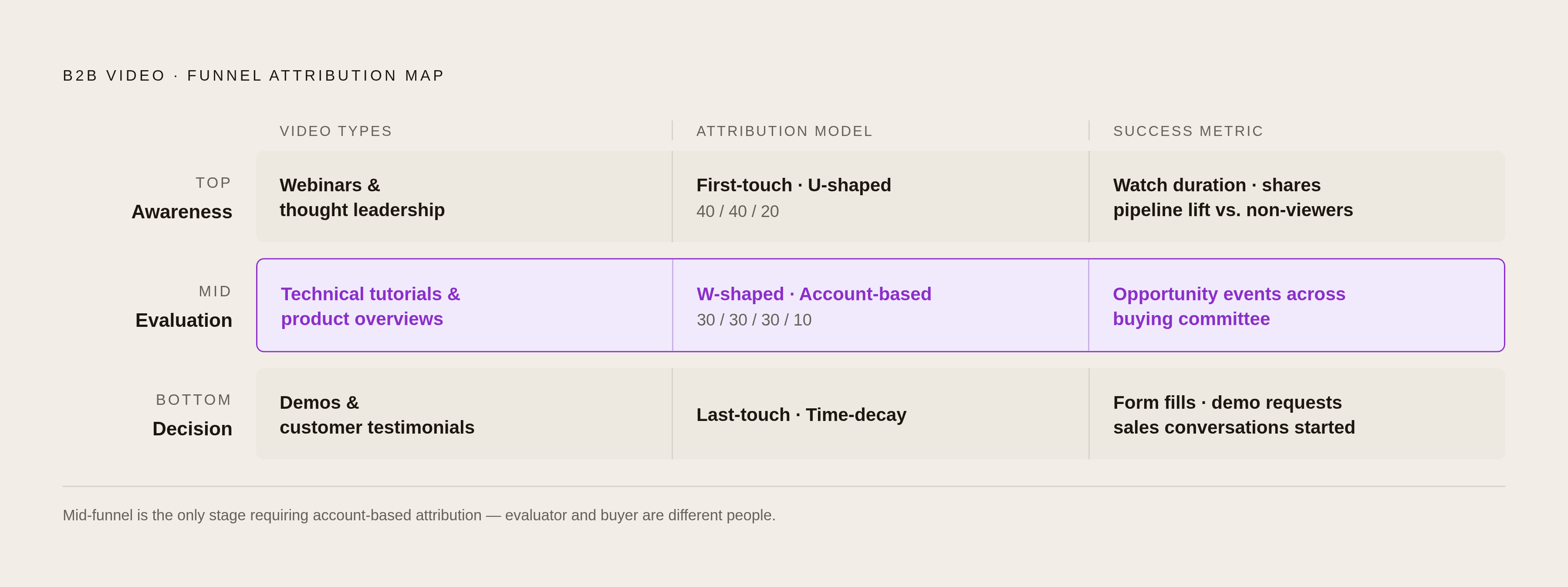
The core principle here is straightforward to state and hard to enforce: credit should follow where the influence actually happened, not where the conversion happened to land. A webinar's job is to create category awareness and shape preference before a deal is even on the table. Judging it by demo-request rate misattributes the work it's actually doing.
For top-of-funnel video such as webinars and thought leadership, the right approach is to measure engagement signals instead: average watch duration, social shares, and pipeline comparisons between people who watched and people who didn't. Attribute using first-touch or U-shaped models, since both preserve credit for the awareness moment. Accept upfront that some of this influence is dark-funnel and won't be visible without asking buyers directly.
For mid-funnel video such as technical tutorials and product overviews, position-based or W-shaped models fit better, because this is where lead-creation and opportunity-creation events tend to cluster. Account-based attribution becomes essential here too, since the technical evaluator watching the tutorial is often a completely different person from whoever eventually books the demo.
For bottom-of-funnel video such as demos and testimonials, last-touch or time-decay models are defensible, because these videos genuinely sit close to the conversion moment. Measure them on post-view action: form fills, demo requests, and sales conversations that started, not on view count or completion rate.
Cohort analysis is a corrective worth adopting instead of fighting model-versus-model debates indefinitely. Group everyone who first encountered a given video type in a given period, then track how that whole cohort moves through the funnel over the next six to twelve months. Comparing cohorts by pipeline volume and cost per acquisition sidesteps the attribution-model argument entirely and focuses on outcomes by group.
Self-reported attribution deserves a permanent seat at the table. Asking "how did you first hear about us" or "what content influenced your decision" at the demo or close stage catches exactly the dark-funnel preference-formation that no tracking model can see. It is also the only tool in this toolkit that can ask the prospect directly instead of inferring from behavioral data.
Research shows brands that map content to specific touchpoints see 40% higher engagement rates, a lift produced by the mapping itself rather than just the content quality.
Tools & Practices That Make This Work
Most teams know they're flying partly blind here, and the numbers back that up. Only 22% of B2B marketers rate their content marketing as very successful, according to CMI's benchmarking research. CMI's report found 33% of B2B marketers struggle to measure effectiveness at all, and 56% still wrestle with attribution even while nearly half say video directly moves revenue. That tension persists because multi-touch attribution is not yet standard practice. Gartner's UK Digital Marketing Survey found only 24% of UK B2B organizations currently use it, meaning most competitors are still crediting one touchpoint per deal.
On tooling, a handful of platforms map cleanly onto the framework's use cases. HockeyStack is built for B2B GTM attribution, tracking complex sales cycles with multiple stakeholders across marketing, sales, and customer success, with full customer journey visualization from an anonymous visit through a closed deal including post-sale expansion. It stands out for account-based attribution of video consumed by buying committees. Dreamdata ties attribution directly to pipeline and revenue and is built for longer sales cycles; it is also the source behind the 272-day, 88-touchpoint benchmark cited earlier in this piece. Funnel combines multi-touch attribution, marketing mix modeling, and incrementality testing in one platform, built on top of a unified Data Hub that pulls in a wide range of connectors. LeadsRx handles cross-channel and omnichannel measurement, including offline touchpoints like podcast and video streaming advertising, which is useful for teams running video across both digital and broadcast channels. SegmentStream uses AI-powered attribution paired with incrementality testing and automated budget allocation, for teams that want their attribution numbers checked against an actual incrementality signal rather than accepted on faith.
The broader trend supports a blended approach rather than a single-model bet. An EMARKETER survey found 35% of US marketers plan to invest in multi-touch attribution over the next year, but close to half also plan to invest in marketing mix modeling, and 36% plan to lean more into incrementality testing. For teams running video across multiple funnel stages, triangulating across a few methods is the practical move.
A zero in video attribution should never go unexplained. A broken UTM, a genuinely dark-funnel channel, and a real gap in influence can all produce the same blank result on a report. A measurement system worth trusting distinguishes between those three causes rather than simply recording that nothing showed up. GA4 is a free baseline tool that defaults to data-driven attribution, requires 300 to 400 monthly conversions to function reliably, is best for teams early in multi-touch attribution adoption or with limited conversion volume, and does not natively handle account-based attribution.
Sources
- Multi Touch B2B Attribution: Complete Guide for 2026
- B2B content marketing and pipeline generation benchmarks 2026
- Marketing Attribution Statistics 2026: 99+ Stats & Insights [Expert Analysis] - Marketing LTB
- Multi-Touch Attribution Models & Tools Guide 2026
- The Modern Content Marketing Attribution Playbook for 2025
- Best B2B Multitouch Attribution Tools Reviews 2026 | Gartner Peer Insights