API Documentation Videos vs Written Docs
Written docs scale and video ages, so use each where developers actually need them.

Summary
Written docs scale and video ages, so use each where developers actually need them.
The Stack Overflow Developer Survey in 2024 covered over 65,000 developers. Of those who rely on technical documentation, 90% specifically use API and SDK docs. Written reference documentation is essentially universal among working developers.
Tutorials are popular too. About 68% of developers use them. But that number spans both written and video tutorials without breaking down further, so the video adoption number is real but fuzzier than it looks.
The number that should make documentation teams genuinely uncomfortable: 44% of developers dig through source code because the documentation isn't good enough. Not because they enjoy reading raw source code late at night. Because the docs failed them first. That's from Postman's 2024 State of the API report, across roughly 5,600 developers.
And then there's this: about 43% of developers rely on colleagues to explain APIs to them. Neither video nor written docs are fully closing that gap. Both formats have blind spots, and informal person-to-person explanation keeps filling them. Every documentation team I've seen treat that stat as someone else's problem eventually ends up wondering why their support load won't drop.
The senior versus beginner split matters here too. Experienced developers trend heavily toward reference text. They know what they're looking for and they want to find it fast. Newer developers are more open to a guided video walkthrough, partly because they don't yet know which reference pages they'll need. That's not a preference difference. It's a knowledge difference — like the gap between someone who knows exactly which tool they need from the drawer and someone still learning what all the tools are for.
Written docs do things video structurally cannot
Here's a workflow video simply cannot support: a developer opens a tab, scans to the relevant section, copies a code snippet, pastes it into their editor, and moves on. That loop takes maybe 45 seconds. There is no video equivalent of that.
A few things written docs do that video can't replace:
- Scannability. Developers don't read API docs. They scan them. Headers, code blocks, parameter tables. They jump around constantly.
- Searchability. Both within the docs and via search engines. Written documentation drives organic discovery in ways video doesn't, because search engines crawl text far better than video content.
- Copy-paste. A working, copyable code example is the core of any useful API reference. No screen recording replaces it.
Stripe is the example people keep returning to, and honestly it's earned. Their written reference docs include annotated code snippets, copy-paste examples, and test credentials placed exactly where developers are looking when they need them. That's not a happy accident. That's a documentation philosophy built around how developers actually move through a task.
There's also an audience that didn't really exist a few years ago. AI coding assistants and LLM-powered agents now read API documentation directly to generate integration code. Structured, machine-readable written docs have a non-human audience that video cannot serve at all. That's a meaningful shift. It changes who documentation is actually for, and a lot of teams haven't caught up to it yet.
The docs-as-code movement, represented by tools like Mintlify, Redocly, and Scalar, takes this further by storing documentation in the same repository as the API itself. That makes drift between the API and its docs structurally harder to ignore. That approach only works with text.
Video shines early, and in specific situations
Video's best use case is showing the end-to-end happy path before a developer knows which reference pages they'll need. It answers the question a developer has before they know how to ask it. Think of it as giving someone directions to a place they didn't know they were going.
A few situations where video genuinely earns its keep:
- Complex authentication flows. When sequence matters more than text precision, seeing the steps in order reduces errors. Watching someone OAuth through a three-step handshake is clearer than a numbered list most of the time.
- Data transformation visualizations. When the relationship between input and output is easier to show than describe.
- First impressions for beginners. Seeing the full picture before the details builds confidence and reduces early abandonment.
Stripe embeds short videos contextually within documentation pages rather than tucking them away in a separate video library you have to go hunt down. That placement detail matters more than most teams realize. A video nobody finds at the right moment is just a video nobody finds.
Twilio structures their video content around developer tasks rather than features. "Send your first SMS" rather than "Messaging API Overview." That framing matches how developers actually search. The outcome is the entry point, not the product.
Video's value concentrates at the top of the funnel. It's most useful before a developer has built any mental model of how the API works. After that, the return diminishes fast. Most teams keep producing video well past the point where it's helping.
Video ages badly, and APIs change constantly
When a UI updates or an endpoint changes, fixing a written doc is a pull request. Fixing a video is a reshoot, or an awkward splice, or most commonly nothing at all. The video just sits there, quietly being wrong. I've seen teams leave outdated screen recordings live for over a year because nobody had budget to reshoot them.
This isn't theoretical. Postman's 2025 data shows 55% of developers struggle with inconsistent documentation, and 34% can't find existing APIs at all. At that scale, any format that's expensive to update becomes a liability. Video is expensive to update almost by definition.
Developer communities are also vocal about low-quality video as a specific frustration. Watching someone slowly type code in a low-resolution screen recording while ambient noise hums in the background is a friction point that comes up repeatedly in forums. The format has to earn the time it asks for. A five-minute video that saves two minutes of confusion isn't a win — it's a net loss with extra buffering.
The maintenance asymmetry is the decisive argument. Video is not a practical primary format for anything that changes frequently. Most of an API changes frequently. The math isn't complicated.
Match the format to the moment
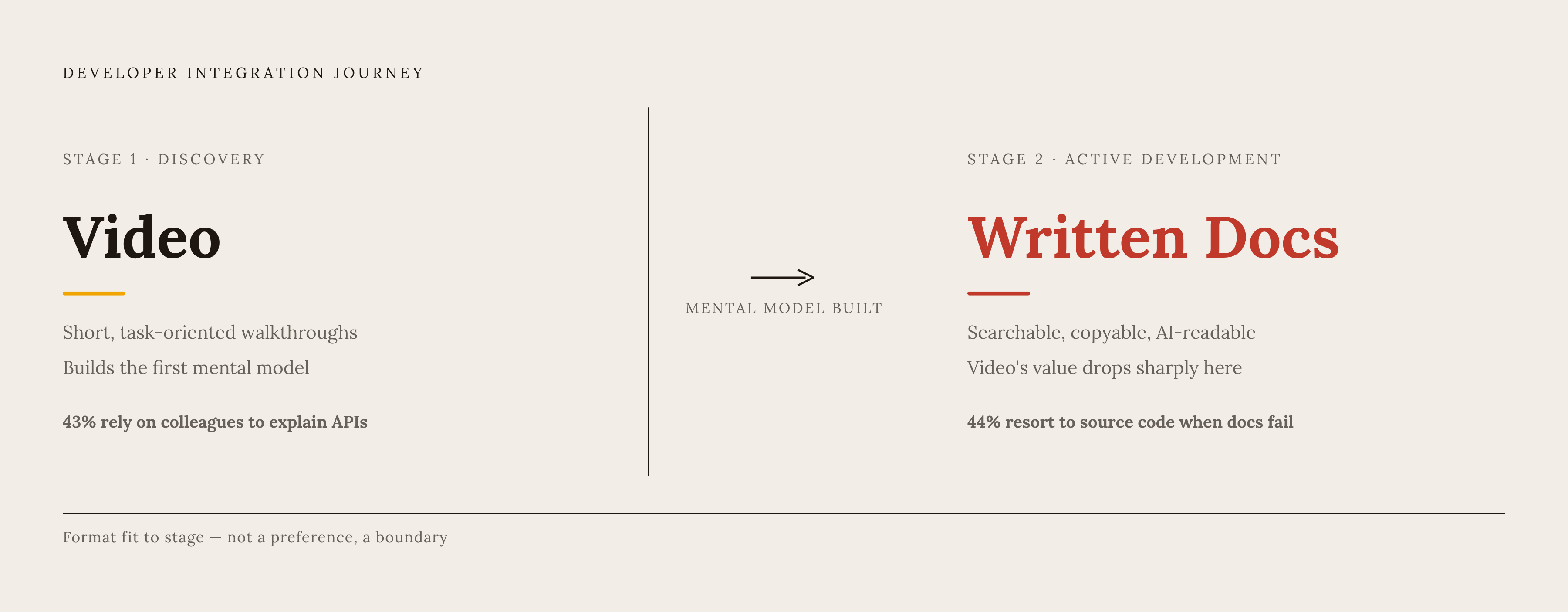
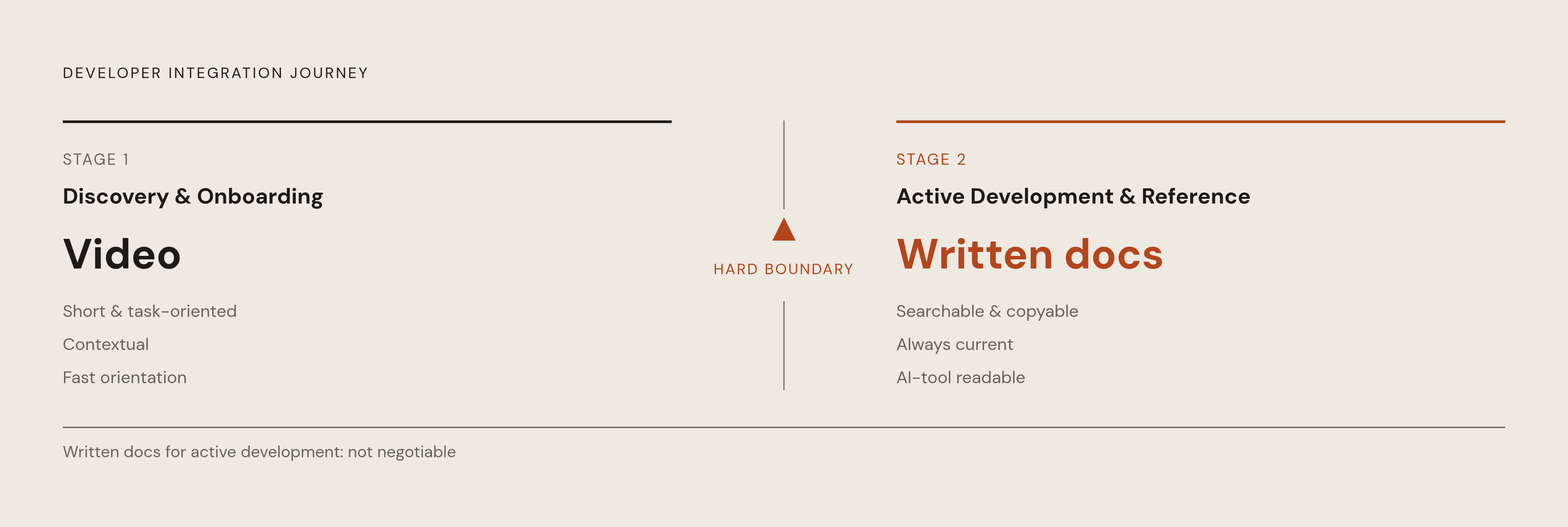
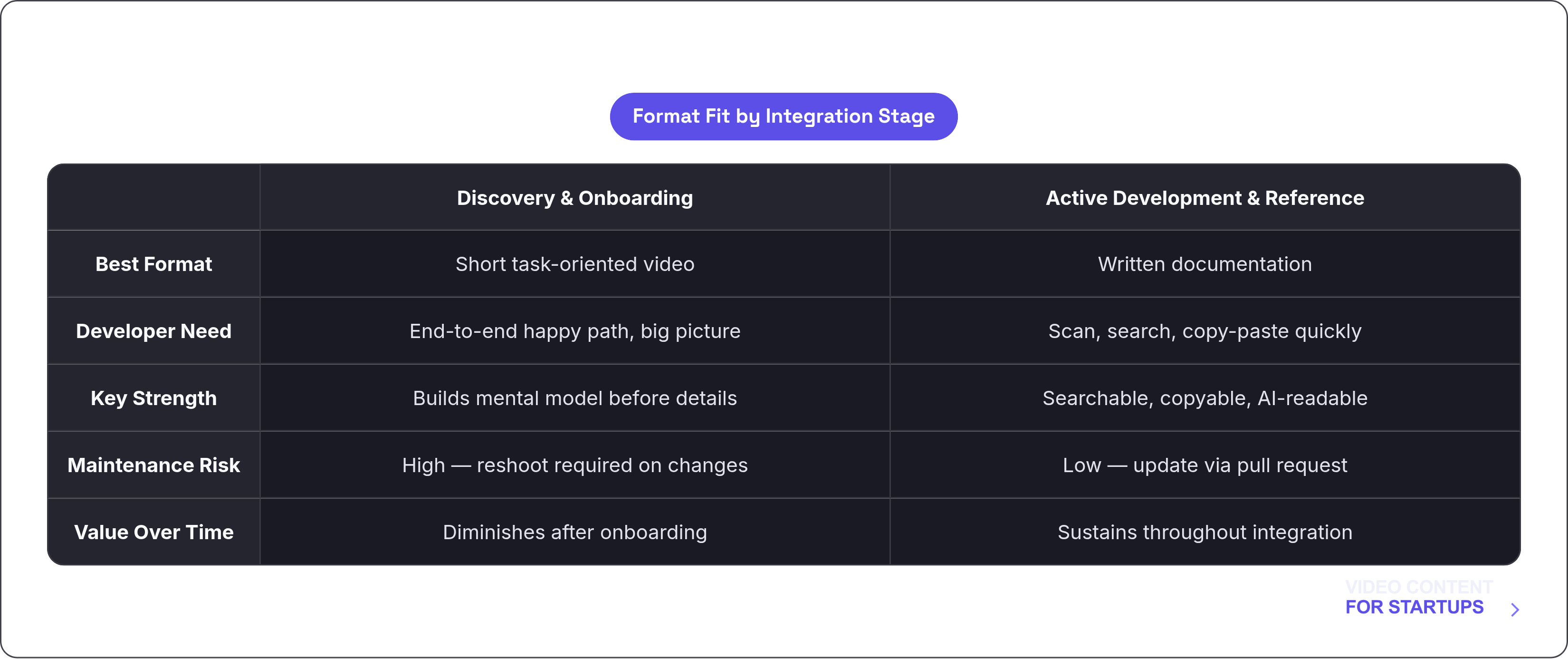
The integration journey has distinct stages, and the format needs are different at each one.
Discovery and early onboarding. This is where video earns its investment. Short, task-oriented, placed contextually in the docs. Skip the feature overview and build a walkthrough of the top five tasks a developer is most likely to attempt first. That covers the vast majority of real use cases without requiring you to video-document everything.
Active development and reference. Written docs. Not negotiable. Searchable, copyable, current, and readable by both humans and AI tools.
The 43% of developers relying on colleagues to explain APIs is a gap that targeted onboarding video can actually help close. If a developer can watch a five-minute task walkthrough instead of Slacking a teammate for the third time this week, that's a win. But the video has to be genuinely good and genuinely current. A stale video of a flow that no longer works the same way doesn't help. It just creates a different kind of confusion.
One note for teams working with limited documentation resources: prioritize the written reference first. Video is a multiplier on a functional written foundation. It's not a substitute for one. Teams that build the video first and hope the written docs catch up are usually disappointed.
AI is collapsing the production gap between formats, but not the usage gap
The workflow used to require a choice. Make a video or write a doc. The emerging pattern now is to record a screen walkthrough and use AI tools to extract steps, screenshots, and written documentation from that single recording automatically. Both formats become outputs of the same input, which is genuinely useful and also slightly strange when you think about it.
Scribe's valuation crossed $1.3 billion in late 2025, built largely on doing this for process documentation. Automated documentation generation is attracting serious money because the production problem is real and the solution is increasingly workable.
AI documentation tools have moved fast. The shift from grammar assistance to first-draft generation happened within a couple of years. Full autonomous documentation workflows are not far off. That's not speculation. The tooling is already headed there.
But here's what doesn't change. AI-generated video still goes stale when an API changes. AI-generated text can be updated in a CI pipeline. The maintenance asymmetry doesn't care how the content was produced. Automating creation doesn't automate relevance, and it doesn't automate accuracy over time.
The format decision is still a reader-need question. AI changes who does the work and how long it takes. It does not change which format actually serves a developer at a specific moment in the integration process. That part is still on you to figure out.

