Syndicating Startup Videos Across Developer Communities
Treat each developer community as a separate audience, not one room wearing different hats.

Summary
Treat each developer community as a separate audience, not one room wearing different hats.
Posting the same video to every developer platform you can find treats developers as one big audience instead of several different rooms, and developers notice. Developer communities are not a single audience wearing different hats. Daily.dev, Reddit, Dev.to, Hashnode, and Discord are separate nodes, each with its own norms, its own trust requirements, and its own format expectations. A video that lands well on one can get flagged, ignored, or quietly buried on another, even when the content itself is solid. Treating syndication as "post everywhere and see what sticks" misreads what these communities actually are, and that misreading costs a startup both reach and reputation.
The deeper shift is in where developers actually go to find things. Fewer developers browse individual company blogs looking for updates; instead, they pull content from feeds, aggregators, and forums built for exactly that purpose. One analysis found that a startup's own blog reaches only about 10% of its potential developer audience on its own. That number alone settles the argument: an owned channel is a starting point, not a distribution plan. The rest of that audience lives somewhere else, and reaching them means showing up correctly, in each separate room, in the format that room expects.
What makes developer communities structurally hostile to promotional video by default
Developer communities are built to resist being sold to, and the bar for what counts as "selling" sits lower than most marketing teams assume. A video dropped into a community without any prior participation from the person posting it reads as an ad the moment it appears, no matter how good the content inside it is. The community doesn't evaluate the video first and decide if it's promotional. It decides that in about two seconds, based on who's posting and whether that person has ever shown up before.
Polish works against you here, not for it. A highly produced video signals effort put into persuasion, and a technically sharp audience treats that signal as a reason to tune out. A real face, a visible process, and language that sounds like it came from someone who actually built the thing beat a slick edit almost every time in these spaces.
The rules backing this up are written down. Lobsters, for instance, runs new accounts through a probationary period before they can post links at all, which filters out exactly the "show up and drop a link" behavior that gets flagged elsewhere. Reddit's rules are similarly specific: r/SaaS caps how many product mentions or links an account can post within a rolling window and requires affiliation to be disclosed, while r/startups bans standalone promotional posts outright and routes anything promotional into a monthly thread instead. Break these rules and the outcome is consistent: the post gets flagged, the account gets banned, and the citation value the video was supposed to generate disappears along with it. These are hard constraints that any syndication plan has to build around from the start, not patch in after the first ban.
Why YouTube is the first platform to get right before syndicating anywhere else
Before a video goes anywhere else, it needs to work on YouTube. That's the platform that carries the most weight for a simple reason: YouTube mentions show a strong correlation with AI visibility across ChatGPT, AI Mode, and AI Overviews, and that correlation is the strongest signal of any kind found in available research on AI citation. No other factor comes close. That makes YouTube the anchor, not one option among several.
The mechanics matter here too. The right order is to publish on the owned site first, give it a few days to get indexed, and only then cross-post elsewhere. YouTube sits at the center of that sequence because the posts that follow on Dev.to, Reddit, and Hashnode will link back to the YouTube video or embed it directly. Each of those links adds to the citation signal.
A canonical tag on a Dev.to or Hashnode repost sends search authority back to the original post, which protects the SEO value of the owned site, but creates a real tension that needs an honest answer. But that same tag reduces how independently that content can get cited on Dev.to or Hashnode themselves, and wide distribution on those third-party platforms is what builds AI citation authority in the first place. These two goals pull against each other. A startup has to pick a posture, whether that's protecting owned-site authority with canonical tags or maximizing independent citation surface by letting reposts stand on their own, rather than assuming it can have both at full strength simultaneously.
One more piece has to be in place before syndication starts: the video can't be the whole asset. Pair it with written narrative, comparison tables, and downloadable material on the owned site. If a developer's question is best answered by a table and all that exists is a video, the citation goes to whoever built the table. The video anchors the cluster; it isn't the cluster by itself.
How Dev.to and Hashnode work for video-anchored technical posts
Dev.to and Hashnode both reward embedding the video inside a full written post. The feed and discovery mechanics on both platforms run on text engagement, comments and reactions, and a standalone video link gives the algorithm nothing to chew on. A substantive post with the video embedded gives readers a reason to comment, and comments are what get a post surfaced to more readers.
Hashnode is built around individual voices, not corporate accounts, and a post published under a company brand account gets noticeably less native traction than the same post published under a named engineer's account. That turns "who publishes this" into a real strategic decision. A founder's byline, or a lead engineer's, carries more weight on Hashnode than a generic company account ever will, and that decision needs to be made before the post goes up, not after it underperforms.
Dev.to has its own adaptation requirement, a mechanical one. Blog content built with MDX or custom React components won't render properly once it's posted there. Those components need to be converted into plain Markdown, or replaced with a link back to the original post. Skipping that step doesn't make the post look slightly rough; it can break the post's formatting outright. This cleanup step is part of the publishing checklist, not an optional polish pass.
How Reddit fits into a developer video syndication strategy (and what it cannot do)
Reddit's job in this sequence is narrow and specific: it promotes links and seeds discussion. It does not host content. The right move is sharing a link to the original article or video in relevant subreddits, think r/programming, r/webdev, r/javascript, depending on the topic, with Open Graph tags set up properly so the link preview actually renders. Uploading video natively to Reddit or pasting a full transcript into a post isn't the function Reddit serves here, and trying to make it serve that function wastes the platform's actual strength.
That strength is real when it's earned. A video cited inside a high-engagement Reddit thread carries more weight for AI citation than the same video sitting only on the company's own site, because AI systems weight platforms with heavy human discussion more heavily than owned content. That boost appears only when the thread gets genuine engagement. A post that gets flagged and buried produces nothing, and a post that triggers a subreddit's self-promotion rules produces worse than nothing. Getting to genuine engagement takes weeks of answering questions and contributing before dropping anything that looks like promotion. There's no faster version of this that avoids tripping the self-promotion filters every active subreddit runs.
Daily.dev makes up the other half of the discovery stack, and it works on a different logic entirely. Developers don't post there to debate, they scroll there to catch up, and the feed rewards content that's already proven itself elsewhere rather than content trying to get noticed for the first time. That makes daily.dev a downstream beneficiary of quality built on other platforms, not a place to seed a video from scratch.
How Discord fits into the sequence (and why it is the last platform to activate, not the first)
Discord runs on a completely different trust model than everything discussed so far. Feed-based platforms like Dev.to or daily.dev are asynchronous: someone posts, someone else finds it later, no relationship required. Discord is conversational and happens in real time, built around live help and ongoing relationships between people who already know each other a little. Dropping a promotional video into a Discord channel without being a known face in that server makes it read as spam immediately, no matter how useful the video actually is.
That's why Discord activates last, not first. A startup that has already published real posts on Dev.to, earned genuine engagement in Reddit threads, and built some name recognition along the way has something to bring into a Discord conversation. A startup trying to skip straight to Discord has nothing to offer that doesn't look self-serving, because it hasn't done the work anywhere else yet that would make its presence welcome.
Discord's real value in this architecture is depth. Sharing a video in a Discord server where the founder already participates regularly can produce sharp, specific, technical feedback that a YouTube comment section rarely generates. That feedback can then improve the written content sitting alongside the video, which loops back into the Dev.to and Hashnode posts and strengthens the whole citation cluster those platforms are building together.
The sequencing logic that ties all five platforms together into a single distribution architecture
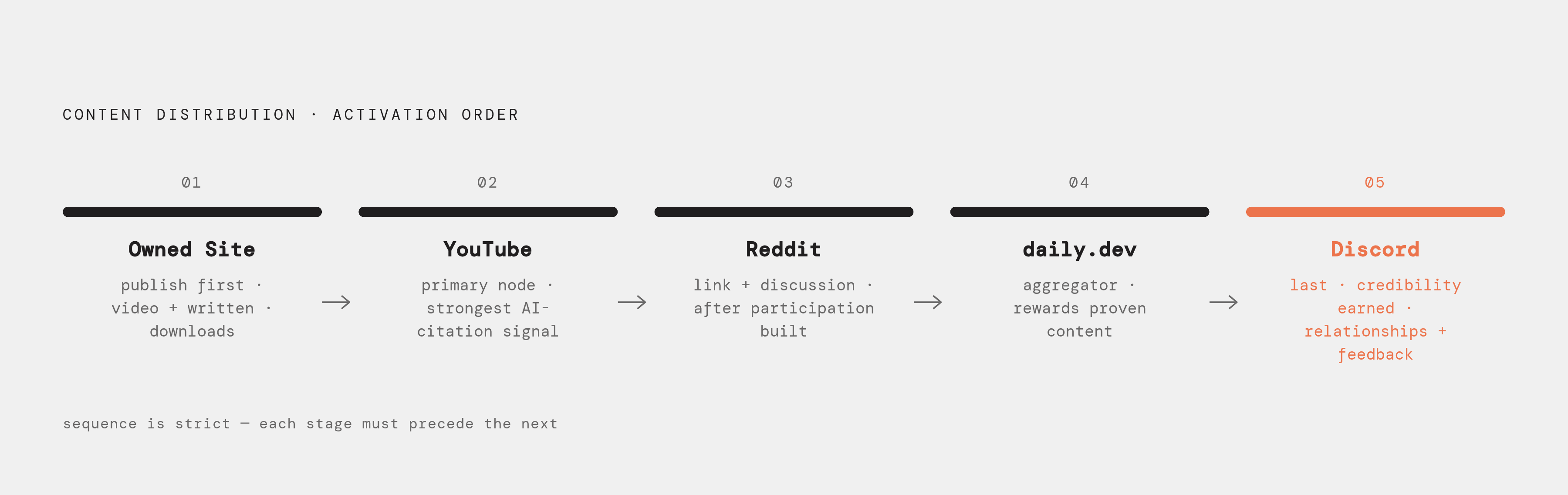
Start on the owned site, with the video paired with written content, tables, and downloadable assets built around it. Move to YouTube as the primary distribution node, since it carries the strongest AI-citation correlation available. Bring Reddit in once community participation is already established, using it for link promotion and discussion. Let daily.dev pick up the content as an aggregator surface that rewards what's already proven itself upstream. Activate Discord last, once credibility already exists elsewhere, using it for relationship-building and feedback.
None of this is a one-time push. AI systems favor fresh content. A product demo syndicated once and then left alone loses its AI visibility over time on a measurable timeline. The architecture needs a refresh cadence built in from the start, with updates and republishing planned the same way the initial distribution was planned.
Measuring whether any of this is working means matching the metrics to how long the program actually takes to pay off. Referral traffic, comments and reactions, branded search volume, and assisted conversions tell the real story. Views and impressions don't, because they say nothing about whether the right audience showed up or stuck around. Pipeline movement from syndication efforts typically takes months to appear in the numbers, and closed-won revenue takes longer still. A reporting cycle shorter than that measures how much content went out the door, not whether any of it actually worked.
