Embedding Video in B2B Content to Increase Dwell Time
Video keeps B2B buyers watching longer than text can force them to stay.

Summary
Video keeps B2B buyers watching longer than text can force them to stay.
A reader can scan a page of text in seconds, eyes jumping straight to the bolded bits and bailing out the moment they get bored. A 75-second product demo doesn't work that way. The instant someone presses play, they've signed up for a minimum chunk of time, whether they meant to or not. That's the entire mechanism behind why video changes dwell time on B2B content: it's not that video is more interesting than text (though it often is), it's that video physically enforces a commitment text can never make you keep.
Skipping through a video takes effort. You have to grab the scrubber, guess where the good part is, or hit the little arrow a few times. Most visitors don't bother. They just let it play. A wall of text invites skimming by design, so prose lets people wander off after four seconds, while video holds them in place.
This matters more now because B2B buying has gotten slower, more self-directed, and more crowded with decision-makers than it was three years ago. Buying committees have grown, so more stakeholders with different jobs, different vocabularies, and different patience levels all need to get up to speed on the same purchase. Video is the one format efficient enough to brief all of them at once, at the exact moment they're ready to absorb it.
Every section ahead, format, length, placement, AI visibility, is really just this same mechanism showing up in a different costume. Keep that one idea in your back pocket: press play, commit to time. Everything else is commentary.
How search and AI systems read video dwell time
Google does not have a dashboard that reads your Google Analytics and bumps your ranking because people watched your video for 90 seconds. That claim is false, and it's worth being upfront about it before going further, because the real mechanism is more interesting anyway.
What actually happens: video-driven engagement extends sessions and lowers the rate at which visitors bounce back to the search results page. That behavior feeds into Google's NavBoost system, which tracks interaction signals Google already collects, longer sessions, fewer quick returns to the search results, and treats them as evidence of quality. So dwell time isn't a lever you pull directly, but a byproduct that appears in signals Google was already measuring.
Video pulls one more trick besides holding attention. Informative videos with detailed, written-out descriptions create a transcript layer that AI engines can index on their own, separate from whatever prose sits on the page around it. That means a single video can feed two different audiences: humans who watch it, and AI systems that read what was said in it. More on that later. For now, the point is simple: held attention changes how search treats a page, and transcripts change how AI systems read it.
Video's place in the B2B buyer's content diet
None of this works in a vacuum. It works because B2B buyers already want video, in volume. Eighty-eight percent of B2B buyers report watching video to learn about a company's products or services in the past three months. Nobody needs convincing to press play. They're already reaching for the remote.
The buying committee dynamic makes this more important, not less. Bigger committees mean more people with different backgrounds trying to evaluate the same vendor, often without ever sitting in the same room. A two-minute video can carry a complex value proposition to an engineer, a finance lead, and a department head independently, each watching on their own time, each getting the same clear version of the pitch. Text requires each of them to do the translation themselves. Video does it once, for everyone.
That's the setup, and now the question is which kinds of video actually earn that attention, and which ones waste it.
Video formats that enforce the engagement window in B2B contexts
Not every video holds a viewer in place equally well. Format decides how much of that minimum commitment a viewer actually honors before clicking away, and getting the format wrong at a given funnel stage burns the engagement window before it can do any good.
Four formats have the clearest record of moving B2B buyers toward a decision: product context demonstrations (distinct from a traditional sales demo), customer result showcases, category education clips, and personalized prospecting videos.
Product context demonstrations earn their keep by removing friction right when a buyer is building a shortlist. A workflow question buried in a FAQ page asks a lot of a busy buyer: find the page, trust that it's current, then decode whatever technical language is sitting there. A two-minute video skips all three steps and just shows the thing working.
Customer result showcases beat written case studies because buyers trust what a real person says on camera in a way that polished copy never quite earns. The specificity has to be real, and the context has to hold up, because these are the videos that get forwarded around a buying committee, and nobody forwards something they can't vouch for.
Personalized prospecting videos, 45 to 75 seconds, open with a direct line referencing the prospect's company by name in the first five seconds, and they get reply rates substantially higher than plain text outreach. Seeing your own name before you've even pressed play changes the math: click rate goes up, and so does the odds you watch the whole thing.
Category education clips do their work earlier, before a buyer has settled on a shortlist at all, which is the single highest-leverage moment to shape their thinking. These clips are built to travel, picking up search traffic and LinkedIn distribution among buyers who are still figuring out what they even need.
Match the format to the stage. A polished product demo shown to someone who hasn't yet defined their problem loses that buyer before the mechanism ever gets a chance to work.
How video length affects the engagement window
Pressing play buys you a window, but the window isn't infinite. Length decides how much of it survives to the end, and completion, not just plays, is the number that actually carries the dwell-time signal.
The average B2B video got noticeably shorter between 2024 and 2026, landing at 76 seconds. Platform algorithms changed, and busy professionals kept voting with their thumbs for short, dense, useful clips over long ones. The market moved toward brevity on its own, no one had to force it.
Length and completion interact differently depending on what the video is for. The shortest clips rack up the highest completion rates, but they can run out of room for anything genuinely complex. Mid-length videos strike the balance most B2B teams actually need, enough time to make a real point, short enough that people stick around for it. Longer videos still have a job: tutorials, full case studies, and in-depth product demos work fine at length, as long as they live somewhere built for patient viewers, like YouTube.
Platform changes the math. LinkedIn rewards short videos heavily, with completion rates for brief clips far outpacing longer ones. YouTube is the opposite kind of room: its best-performing B2B videos run to several minutes, because the people watching are there on purpose, actively researching, not scrolling past on a break. The exact same five-minute video that dies a quiet death on LinkedIn can hold a full session on YouTube.
Long-form video is its own special case. Completion rates on lengthy, gated content drop off noticeably, but the leads that make it through are excellent. Anyone willing to sit through a full webinar has already told you something important about how serious they are.
None of this adds up to "shorter is always better." It adds up to matching the length to the platform and to how much depth the buyer actually needs at that stage. The 76-second average is a signal about where the market has settled, not a rule to apply to every video a team makes.
Video placement on the page
A great video in the wrong spot never gets watched. Placement decides when the engagement window opens, and a video stuck below a visitor's bounce point never gets the chance to open it.
A short summary video at the top of a blog post raises that page's average session duration almost immediately, which signals quality to search algorithms before a reader has even finished the opening paragraph. The video does the work of keeping someone around before the text has had any opportunity to lose them.
Gated content needs its own placement logic. Drop lead-gen forms inside a video ad right around the halfway point. A viewer who's made it that far is already invested, so the form catches them at peak interest instead of interrupting them before they've decided the content is worth their contact information.
The same logic applies to how AI systems read a page. A large share of all citations pulled by large language models come from the first 30% of a page, a pattern researchers studying ChatGPT responses have called a "ski ramp" distribution: heavy at the top, thin everywhere else. Video summaries, transcripts, and key statistics placed in that opening section do double duty, serving the human reader scrolling down and the AI system retrieving text at the same time.
The practical rule: put a transcript or a structured summary of any embedded video in the page's opening section, not buried near the bottom. That one placement choice serves three different readers at once: the visitor who never presses play, the search crawler that can't watch video in the first place, and the AI engine that only reads text.
LinkedIn has built its entire 2026 algorithm around this same logic, making placement there a structural advantage. The platform now favors native video, dwell time, and genuinely educational content over anything promotional or carrying an outbound link. It measures how long someone actually watches before they scroll on, and longer viewing time directly expands how far a post travels to new audiences.
LinkedIn has also rolled out a short-form vertical video feed, which makes vertical formatting and subtitles non-negotiable. Most LinkedIn video gets watched with the sound off, so subtitles keep someone watching instead of scrolling past in silence, and that finishing drives reach.
What's winning on LinkedIn right now is educational video with real storytelling and strong visuals, the kind that makes a product update feel worth watching. Buyers have gotten wary of text that smells like it came out of an AI model, and a real person talking on camera supplies a kind of trust that written content can't fake its way into.
Video content, especially on YouTube, as an AI citation asset
Getting named inside an AI-generated answer is turning into something close to a parallel to ranking on a search results page, and video, especially on YouTube, is one of the least-used ways to earn that mention. Being cited here means something specific: the brand gets named or recommended inside a synthesized answer, not merely sitting somewhere in a training dataset that nobody will ever surface.
Foundational GEO research (Aggarwal et al., KDD 2024), tested across a large set of queries, found that adding machine-extractable provenance, direct quotations, statistics, cited sources, produced the largest gains in AI visibility, up to roughly 40%. A video transcript built around named sources and specific figures is a near-perfect implementation of exactly that finding: it hands an AI system the quotes and numbers it's already been shown to reward.
Content that AI engines cite also tends to be meaningfully newer than the content Google ranks organically, with AI systems pulling from noticeably fresher URLs than a typical search results page. The lesson there is to keep publishing, since consistency is what earns citation over time, not a one-off library piece.
Adding JSON-LD schema produced no meaningful citation lift on Google's AI Mode or on ChatGPT in a large-scale study, and actually produced a small but statistically significant decline on Google AI Overviews. Schema is retrieval hygiene. It helps machines parse a page correctly, but it is not a lever for earning more citations. Teams chasing AI visibility get more out of better transcripts and fresher publishing than out of structured data markup.
ChatGPT becoming Tally's top referral source is a real, named example of what this visibility is worth commercially. Treat the GEO findings as durable fundamentals. General heuristics transfer unevenly across tools, and once everyone is doing the same tactic, the advantage it offered erodes. YouTube presence and transcript quality hold up regardless, because they're genuinely useful to the systems reading them, not a loophole waiting to close.
Sequencing these decisions in practice
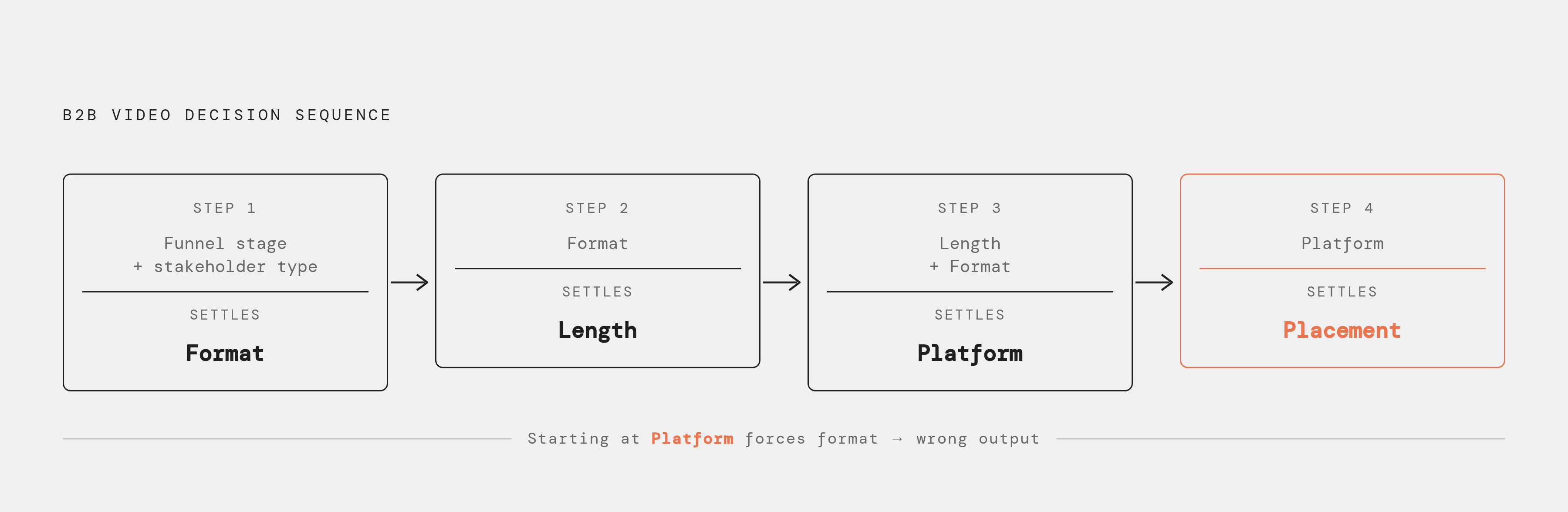
All of this only pays off if the decisions get made in the right order. Format, length, placement, and distribution channel have to be chosen in that sequence, format first. Teams that pick a platform first and then force content to fit it routinely end up with the wrong format for the engagement window they're trying to build.
The order runs like this: start with funnel stage and the type of stakeholder watching, and that decision settles the format. Format settles the right length. Length and format together settle which platform makes sense. Platform settles the placement discipline, whether the video lives natively or gets embedded, whether it opens the page or sits mid-scroll, where the transcript sits relative to the video itself.
For B2B SaaS teams, that sequence lands somewhere specific. Product context demonstrations belong on the company website and on YouTube. Category education clips belong natively on LinkedIn, where the algorithm is built to reward exactly that kind of content. Personalized prospecting videos, 45 to 75 seconds, belong in direct outreach, at first contact, at the follow-up after silence, and at the final breakup message.
Measuring views and completion rate is the baseline, not the finish line. The teams that actually improve are the ones connecting video engagement to pipeline stage, tracking which buyers watched which videos before they moved forward, and using that evidence to decide what to produce more of. That same discipline needs to extend to AI visibility: tracking not just clicks and impressions, but whether AI models actually name the brand when buyers ask the questions that matter. That's what turns the YouTube-and-transcript strategy into something a team can test and prove.