Gating Video Content for Lead Generation in SaaS
Discipline your gating strategy to match video funnel role, not treat all content the same.

Summary
Discipline your gating strategy to match video funnel role, not treat all content the same.
Most SaaS teams treat video gating like a hotel door lock: every room gets one, whether it's the lobby or the penthouse. That reflex quietly produces worse pipeline, not better. The fix is a discipline gating framework that matches each video to its funnel role and lets the intent signal decide the capture call.
Why the default "gate everything" policy quietly destroys pipeline quality
Blanket gating is a policy masquerading as a strategy. Same form field. Same lead score. Different universe.
A gate is a trade, and both sides need to hold up their end. The viewer gives you contact details and expects something worth the interruption. When the video doesn't clear that value bar, you get exactly what the exchange deserves: a skip, a bounce, or a fabricated submission. Any B2B team gating at volume should assume a meaningful share of its "leads" are not real contacts. Somewhere in your database, there's a decision-maker named "asdf asdf" with the title "not interested."
Lead count is not the win. A gated video can produce more contacts while producing worse pipeline. What matters is what those people do after the form, not that they filled it out. A clean email from someone who watched most of your product walkthrough and clicked the pricing CTA is worth fifty throwaway submissions from people who wanted to see the last thirty seconds of an explainer. Counting both the same way doesn't just mislead you. It trains your reporting to celebrate the wrong behavior.
The two capture mechanisms most teams treat as one
Video lead generation covers two distinct mechanisms, and conflating them is where most gating mistakes start. The first is form-based capture: a viewer submits contact details through a gate before or during the video. The second is behavioral capture: the platform scores intent from watch depth, replays, and in-player clicks without requiring a form at all. One asks the viewer to prove interest. The other watches it happen.
A video-qualified lead, or VQL, comes from how deep someone goes, not from a form they fill out. Percentage watched, replay behavior, CTA clicks inside the player. These signals can be scored and routed to sales before the viewer fills out anything. The behavior is the qualification. The form is just contact data.
Watch-depth milestones and in-player CTA clicks give you a trail of behavior that a static form field cannot. If most viewers drop off after section one of a three-section demo, that's a script problem, not just a metric. The form never tells you that. When you tie video platform data to CRM and marketing automation tools, you see engagement against named contact records, not trapped in aggregate analytics. Video stops being a passive content asset and starts behaving like an active revenue signal. Video platforms that track both form submissions and engagement depth give marketing a more honest picture of what content is actually working.
How each video type maps to a funnel stage and a capture call
Every video in your library plays one of four funnel roles, and getting the role wrong means the capture mechanism fights the content instead of working with it. Think of it as a casting problem. You wouldn't put an awareness video in the lead-capture role any more than you'd cast your eccentric uncle as the straight man in a drama.
Awareness videos exist for reach and initial education, not capture. Short-form social clips, explainers, brand story videos. A new visitor who hasn't yet understood the product should not hit a form before they understand the basics. Homepage explainers, short product overviews, FAQ clips, and educational videos all work better open. The job is to build familiarity, and a gate cuts that job short.
Consideration videos serve a warmer audience. Product walkthroughs, customer testimonials, comparisons. These are for prospects who understand the problem and are now evaluating whether your tool solves it. Walkthroughs show usability. The most effective testimonials are screen-recorded interviews: a customer walks through their actual dashboard with real data and real results. Watch depth here is a stronger signal than almost anything else in the funnel. When someone replays the integration section twice, that's intent you can act on.
Decision videos carry the final objection-removal job. Personalized demo videos, implementation walkthroughs, video sales letters. At this stage, personalization beats polish. A video that speaks directly to the prospect's specific needs is the most efficient way to give them a reason to choose you. A gate is justifiable here because the viewer has enough intent for the trade to make sense. They've earned the right to be asked.
Outreach videos play a completely different game. Personalized sales clips exist to get a reply, not a form fill. The capture mechanism is a response, not a submission. Gating these would kill the purpose, like asking someone to sign a waiver before opening a gift you sent them.
The practitioner test cuts through all of it: would you give your own work email to watch this? Applied honestly, it disqualifies most explainers, most short demos, and most social content from ever being gated. It qualifies original research, in-depth training series, and premium event replays. Just as gating should follow genuine value rather than a blanket policy, content worth publishing and worth citing by AI models earns its placement through evidence of usefulness, not through automation or volume.
Where to place the gate when gating is the right call
Once a video has earned a gate, the execution question gets more granular. You have four placement options, and each fits a different content value and funnel stage. Post-play, where the gate appears after the video finishes. Mid-video, which interrupts at a natural break. Choosing based on personal preference rather than content type is where many teams lose conversion they could have kept.
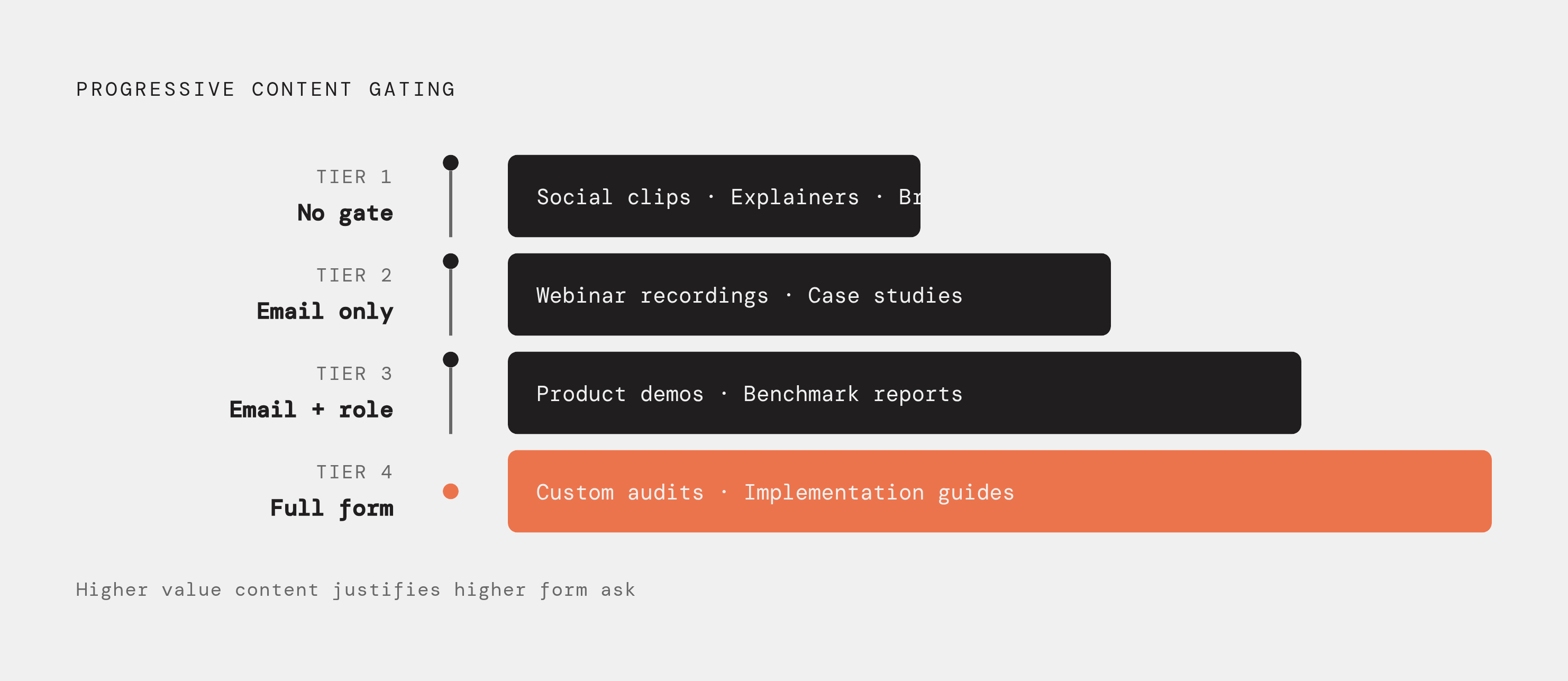
The most workable structure is progressive gating, where the ask scales with the perceived value of the exchange. No gate at all for social clips, explainers, and brand content. Email only for webinar recordings and extended case studies. Email plus role for product demos and benchmarking reports. Full form for custom audits and implementation guides. Each tier costs the viewer a little more because each tier delivers a little more.
Form length is a direct conversion lever, and it's one of the easiest ones to pull. Single-field forms convert substantially higher than forms with nine or more fields. Match the ask to the value. For a serious demo, name, work email, company, and role might be fair. But the form should never feel greedy relative to what the viewer is getting.
Gate enforcement is a separate problem from gate placement
Here's an uncomfortable truth: a form wrapped around an unprotected, shareable link is not a gate. It's a suggestion. Gating a video only works if the platform actually enforces the gate. Otherwise, one person fills out the form, copies the URL, and drops it into a chat channel where forty colleagues watch it free.
Tokenized delivery is the technical fix. Generating a viewer-specific, time-limited URL rather than a static permanent one means a link copied out of a gated email expires or fails to replay outside its original session. The gate becomes what it was supposed to be.
But even a technically sound gate has a data problem underneath. The fake-submission issue compounds any enforcement gap. When the gate holds, a meaningful share of submissions on gated video content will still be throwaway emails from buyers who want access without engagement. The gate tells you who claimed interest. The playback tells you who actually showed it.
Why gated video is structurally invisible to AI answer engines
Gating has always carried a reach cost, but AI answer engines have made that cost larger and more concrete. Crawlers and AI engines cannot read behind a form, so a gated video cannot be cited, summarized, or surfaced in AI-generated answers, no matter how good it is. Your best explainer could answer the exact question a buyer is asking, and the AI will never know it exists.
This matters because AI answer engines are now a primary discovery surface for B2B buyers. Being cited in the answer is the new ranking, and it behaves differently. An ungated video becomes part of the answer layer buyers actually see. A gated video becomes part of the form-fill report only your marketing team reads.
For ungated video to earn AI citations, it needs structure. VideoObject and Clip schema signal what the video is about and where key moments are, making it more likely to appear in rich results or answer boxes. Short-form video carries additional weight because YouTube is among the top-cited domains in AI Overviews. The choice to gate or ungate is also a choice about whether that content can be named by AI models when real buyers ask real questions. It's a cost that doesn't appear in a form-fill report, but it's real and it's accumulating.
The 70/30 split and the cost-per-opportunity math that justifies it
The working framework most teams should start from is a 70/30 split: produce the majority of content ungated to build audience, establish expertise, and drive organic and AI-answer traffic, and reserve gating for the minority of assets that clear a genuine value bar. It's a tested starting point that the evidence supports, not a universal law. Your mix will shift with your content library and your funnel.
The objection is predictable: ungating sacrifices lead volume. The math says otherwise, but only if you measure at the right level. The "expensive" leads are often cheaper when measured correctly. CPL is a vanity metric. Cost per opportunity is the bill you actually pay.
The ungated majority does a compounding job that gated content cannot. It builds the audience that makes the gated minority work. A visitor who watched your open explainer and decided your company explains things clearly is a different prospect from a cold form-fill, and that trust difference shows up in conversion rates downstream. Ahrefs is the canonical example of the ungated library model. The company built an open educational video library that compounds organic traffic and positions the brand as the default educational resource in its category, rather than gating tutorials to capture leads directly. The tutorials do the selling. The forms come later, from prospects who already trust what they've seen.
The measurement infrastructure a discipline gating framework requires
A disciplined gating framework is only as good as the measurement system behind it. If you lack per-viewer behavioral data tied to named CRM records, you cannot tell a high-intent viewer who never filled out a form from a low-intent lead who did. The framework becomes a policy you enforce by feel, which is exactly the thing you were trying to escape.
The foundation is integration. Video platform data connected to CRM and marketing automation turns watch time, completion percentage, replay events, and CTA clicks into signals against named contact records. Video stops being a passive content asset and becomes an active revenue signal. You can see which accounts watched which walkthroughs, who replayed the pricing section, who clicked the demo CTA twice.
The fake-submission audit is a required baseline. Any team gating video at volume should audit its form-fill list for throwaway emails and personal addresses. A CPL figure calculated on a poisoned list is not a CPL figure at all. It's a work of fiction with a spreadsheet attached.
On the AI-visibility side, you need to measure more than clicks and impressions. Whether AI models actually cite and name your brand when buyers ask relevant questions is a different signal from search ranking. A zero on that signal needs an explanation, because a broken measurement and a real authority gap must never look the same. This is the discipline Letterbrace builds into every content program it runs: tracking not just search outcomes but whether AI engines read, cite, and name the client, so the cost of gating a piece of content is visible in full rather than hiding behind the form-fill revenue it appears to generate.
The practical output is a weekly or monthly view covering each video asset: its gate or no-gate status, form-fill volume, lead-to-MQL conversion, behavioral engagement depth, and AI-answer citation presence. That's enough signal to make the gate-or-ungate call on evidence rather than assumption. The framework stops being a policy and starts being a system you can tune.