Briefing Subject Matter Experts for Technical Video Interviews
A clear brief transforms expert interviews from rambling transcripts into usable research material.

Summary
A clear brief transforms expert interviews from rambling transcripts into usable research material.
Most technical video interviews fail before anyone hits record. The problem isn't the subject matter expert. It's the brief, or rather the lack of one. Without a document that assigns an editorial role, the SME fills an hour with whatever comes to mind, and the transcript reads like a tangled phone call. This piece explains what a good brief must contain, how the session should be built around it, and why getting this right now determines whether AI systems cite your content or skip it entirely.
Why most technical video interviews produce transcripts that writers cannot use
The transcript of an unbriefed interview is a paperweight disguised as research. You'll find long digressions, repeated points, and answers organized around what the expert finds interesting, not what your audience needs to know. One analysis found that the average expert interview transcript runs about 60% redundant information or irrelevant side trips. That means more than half of your recording time produces nothing you can publish.
This is a structural failure, not a talent problem. SMEs bring the substance. Writers bring the structure. The interview is the only mechanism that connects those two, and without a brief that defines an editorial role for the expert, that mechanism never engages. The SME defaults to internal framing. Internal framing means company jargon, assumed context, and priorities shaped by org charts rather than customer questions. Your audience can't follow any of that, and your writer will spend hours cutting it away to find the few usable sentences hiding inside.
The expert isn't failing you here. You failed the expert. You invited someone with deep knowledge to talk for an hour without telling them what you're trying to prove, what role they play in proving it, or what you'll actually do with their words. That's not an interview. That's a podcast episode with no plan and no audience.
What a brief is actually doing when it works
A good brief is not a prep document that gets the SME ready. It's an editorial instrument. When it works, it hands the expert three things before the session begins: what the content is trying to argue, what their specific contribution to that argument is, and what you'll do with what they say. That's the whole mechanism. Theses, roles, and output targets.
The frame shifts once you see it this way. You're not asking an expert to perform. You're asking them to help an audience they care about reach a conclusion they understand. SMEs generally want that. They built the product, they live the domain, they have opinions about how customers should think. A brief that shows them the user perspective gives them a reason to shape their answers. It's a collaboration, not an interrogation.
Some teams worry that structured briefing makes experts sound rehearsed. The opposite is true. Every expert appearance is a performance in the best sense. Not fake. Respectful of the audience and the medium. A brief helps the expert articulate authentic expertise so it lands cleanly instead of wandering. Regular media training, even a 90-minute workshop, can boost an expert's on-camera confidence and delivery by an average of 40%. The difference isn't scripting. It's giving someone who knows their subject the framing to say it well.
The one-page brief: what goes in it and why each element earns its place
The brief earns its place only if it contains information that changes how the SME will speak. Everything else is overhead that goes unread. Five elements belong in it: the editorial thesis in one sentence, the SME's assigned role in arguing it, the specific questions you'll ask, the desired takeaway from each question, and the time allocation for each segment. Nothing more.
Sending questions in advance matters more than most teams think. It's not about coaching answers. It's about giving the expert time to surface accurate, current information instead of reaching for half-remembered details under pressure. A senior engineer asked about last quarter's migration will give you the precise number if they saw the question Tuesday and the interview is Thursday. Asked cold on camera, they'll give you an approximation and a caveat. Only one of those makes it into your article.
What doesn't belong is just as important. Long background reading, your company's full history, an industry survey the SME already knows better than you do. All of that signals the content team didn't do its homework. It shifts prep burden onto the expert, the one person whose time is most expensive. The one-page constraint is functional. A longer document won't be read in full. A shorter one forces you to decide what the interview must accomplish before it happens. That decision is the entire point.
Structuring the session itself: phases, timing, and question sequence
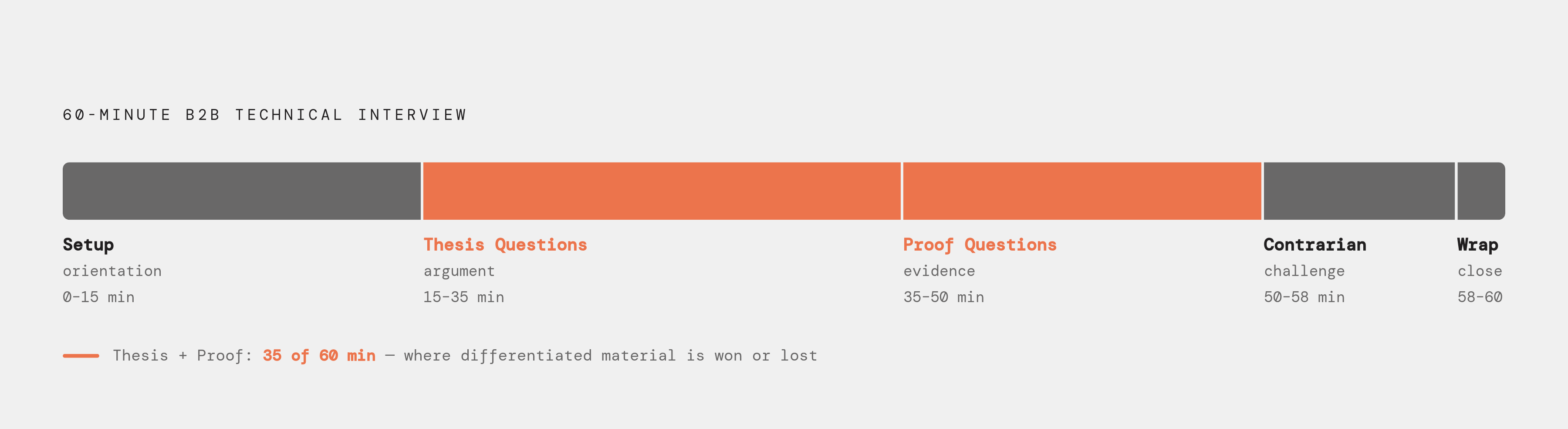
The session guide does the editorial work the brief set up. Divide the hour into named phases with time allocations, and you prevent the SME from filling available time with whatever surfaces first. For B2B technical content, the five-phase structure works reliably: setup question in the first 15 minutes, thesis questions from 15 to 35, proof questions from 35 to 50, contrarian questions from 50 to 58, and a two-minute wrap. That sequence moves from orientation to argument to evidence to challenge to close.
The thesis question is the engine. Don't open with a broad topic prompt. Restate the article's editorial claim and ask the SME whether they agree, disagree, or want to refine it. That forces a reaction to a specific position. The disagreement or refinement you get back is often the most usable material in the whole session. Scenario-based questions work the same way at the proof stage. Present a real-world situation and ask how the expert would approach it. You surface problem-solving reasoning that generic topic questions never reach.
Sequence matters. Start with broader context, move to specific technical claims, then hit the hardest challenges. Jumping across topics breaks the expert's narrative thread and leaves you with disconnected clips you can't assemble into anything. Keep sessions between 45 and 60 minutes. Shorter sessions shortchange the proof and contrarian phases, which is exactly where the most differentiated material lives.
Video-specific setup the brief must address and the SME cannot be assumed to know
The content producer owns the technical conditions of a recording. Not the SME. The brief must say so explicitly, because an expert who agreed to share expertise did not agree to figure out production. Audio comes first. The default laptop mic or earbud setup is almost always inadequate for video content you intend to publish. Either ship the SME a microphone or name a specific type and explain why it matters. Lighting is simpler but no less important. No backlighting. Front-facing natural light when possible. An SME should be able to set this up in under two minutes if the instruction is specific enough.
Recording is non-negotiable, and the brief should say that in plain terms. Use a dedicated tool. Otter, Fathom, Fireflies, or a Zoom transcript all work. Memory doesn't preserve specific phrasing or numbers accurately. Recording also frees the interviewer to stay fully present instead of furiously taking notes. This belongs in the brief, not in a verbal reminder at the top of the call. By then it's too late to fix a bad setup. The SME needs time before the session to test and adjust. A blown recording cannot be recovered. You just rebook the expert and apologize.
How to write questions that produce material an editor can actually use
Question quality determines whether the interview yields quotable, argument-supporting material or accurate but editorially inert explanation. The difference is almost entirely in framing. A question answerable with yes or no produces a yes or no. A question that demands explanation, comparison, or evaluation produces material a writer can work with. That's the whole skill.
Use the journalism standard. Who, what, why, where, when, how. Ask who would use this and when they would not. That surfaces use-case nuance generic topic questions miss entirely. Follow-up questions are the most underused tool in the brief. "Can you give me a specific example?" and "What would you do differently?" recover precision from vague answers without interrupting the expert's flow. Put them in the brief as fallback prompts. Don't hope you'll remember them mid-session.
Avoid three traps. Don't ask the SME to summarize what your audience already knows. Don't embed the answer you want inside the question. Don't cram multiple topics into one sentence. All three produce answers a writer can't excerpt cleanly. A weak question like "Is security important for your platform?" gets one word. The reframed version, "Which of your security decisions came from a customer incident, and what changed afterward?" gets a story, a mechanism, and a named detail. That's what editors can use.
What recording and transcription discipline does to the economics of the session
A well-run, properly recorded 60-minute interview yields material for multiple outputs, not one. The difference between a reusable library and an unusable transcript traces almost entirely to the brief. One recorded session, transcribed and indexed by topic, can support two or three articles. It also prevents re-interviewing the same SME on the same topic three months later because nobody kept usable notes. The brief's phase and question structure is what makes the transcript indexable. Otherwise you have a wall of undifferentiated text that nobody will open twice.
The writer-time math runs in both directions. A well-run session compresses post-interview production because the material arrives in usable shape. A poorly run session expands it, because the writer must excavate coherent points from digressions. Every transcript should land in a searchable archive. The brief's structure becomes the taxonomy that makes that archive navigable. The pattern works. Workwize grew its monthly pipeline to $1,156,360 over 23 months through an interview-driven content program. The asset compounds.
Why AI citation is now the strongest argument for briefing SMEs correctly
The most direct consequence of a poorly briefed interview is no longer a thin article. It's invisibility in AI-generated answers, which is increasingly where B2B buyers start their research. Generic explanations can be produced from what a model already knows, without opening any source page. First-person expert reasoning, named examples, and non-reproducible technical positions must be cited from a source, because the model cannot generate them independently. That's the whole difference.
The brief makes AI citation possible because it structures for proof and contrarian phases. A session built around a specific thesis produces attributed, positioned, evidence-backed claims. Those are what AI systems prefer to cite over generic explanation. The brief is, indirectly, a generative engine optimization instrument. Teams argue over whether to call this AEO, GEO, or just optimizing for generative search. The terminology is contested. The strategic implication isn't. Your content needs expert-attributed, non-reproducible material to get cited rather than synthesized away. That material only comes from a well-briefed interview.
Briefing SMEs purely for keyword-optimized explanation produces content AI can often replace on its own. The overlap between AI citations and top organic results is only 12% for standalone AI models. Standard SEO-framed briefing misses most of where B2B buyers now encounter brands.
Turning the brief into a repeatable process rather than a one-off effort
The briefing process compounds only when it's standardized. A template, a question bank, and a transcript archive. Each session builds on the last instead of starting from scratch. A reusable one-page template with fixed slots for thesis, SME role, questions, desired takeaways, and time allocations eliminates the prep overhead that makes teams skip briefing when deadlines tighten. The brief becomes the default.
Build a question bank. Catalog questions that produced strong material by topic and reuse them. Flag questions that produced digression or inert explanation and revise them. Over time the bank encodes editorial judgment the whole team can apply. Expand the SME cohort deliberately. During every session, ask who else might have relevant expertise. Build relationships with product, engineering, and customer success before content needs arise, not when you're scheduling interviews under deadline pressure. Async works too. For lower-stakes contributions or time-constrained experts, structured written question exchanges using the same discipline extend the process without requiring a recording every time.
Measurement closes the loop. Track whether content from SME interviews earns search traffic and AI citations, and compare it against content produced without structured expert input. That's what turns the briefing process from a best practice into an evidence-graded operation. It gives you grounds to improve the brief itself, not just the articles it produces. Most teams don't do this. 67% of B2B marketing teams still rely on last-touch attribution, which tells you almost nothing about influence. The teams that measure this properly are the ones whose experts show up, whose transcripts read clean, and whose content gets cited when a buyer asks an AI for advice.