Async Video Review Workflows for Distributed Teams
The five structural moves that stop async video reviews from stalling indefinitely.

Summary
The five structural moves that stop async video reviews from stalling indefinitely.
Distributed teams keep buying better video tools and keep getting the same broken review cycle. The recorder, the player, and the comment box aren't the problem. Nobody designed a process to go around them.
Feedback shows up in three different places at once (an email here, a Slack message there, a comment buried in the tool itself), no single person owns the final call, version files multiply without any naming logic, and reviewers wander back in to re-argue points that got settled two rounds ago. None of that is a tooling failure. A video platform can timestamp every comment to the frame and it still won't stop someone from reopening a decision that was already made, because the platform was never asked to enforce that.
A live meeting has exactly one structural advantage over async review, and teams rarely notice it until it's gone: someone in the room eventually says "we're done," and the meeting ends. Async review strips that moment out entirely and replaces it with nothing. No bell rings. No one stands up. The review just sort of... stops, or doesn't, depending on who checked their notifications that day.
What async collaboration actually needs to function is five things working together: clear context before anyone opens the file, visible contribution so input doesn't vanish into a DM, feedback anchored to something specific, a decision that gets written down, and a next step that someone actually triggers. Skip any one of those links and the chain doesn't bend, it snaps.
Stages of a Structured Async Review Cycle
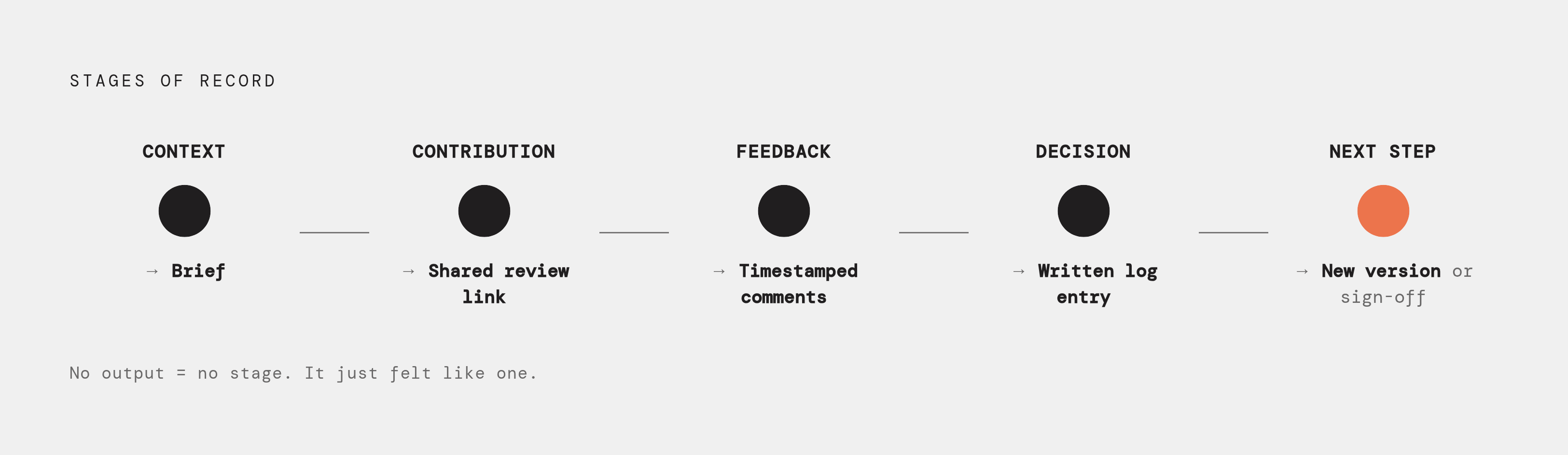
A working async review cycle has five stages, and they happen in a fixed order every time: context, contribution, feedback, decision, next step. A named owner closes the round with a decision in writing. And the next version or sign-off gets triggered explicitly, not assumed into existence.
Async review works like a relay race, not a potluck. Async review has been run like a potluck for years. That's how you end up with three people bringing potato salad and nobody bringing the main dish, which in this metaphor is the decision.
Each of those five stages needs a named output, not a vibe. Context produces a brief. Contribution produces a shared review link everyone can access. Feedback produces timestamped comments inside a defined window. Decision produces a written log entry. Next step produces either a new version or a formal sign-off. If a stage doesn't produce something concrete that another person can point to later, it didn't really happen, it just felt like it did.
Missing the deadline is why rounds stall and decisions never close. "Whenever you get a chance" Whenever you get a chance" isn't a deadline. Open-ended windows are exactly where decisions go to stall, because nobody wants to be the one who nags, and nobody wants to be nagged, so everyone just waits the other out.
Writing a video brief that makes feedback useful before recording starts
Most vague feedback traces back to one missing document: a brief that tells reviewers what decision the video is actually supposed to drive. Without it, reviewers guess, and guessing produces comments like "feels off" or "not loving this," which are about as useful to an editor as a weather report for a different city.
A brief doesn't need to be long. It needs four things: the decision the review is meant to produce, who's reviewing for what, the deadline for the round, and any constraints that are already locked (brand guidelines, legal language, a client-approved script). A simple structure looks like this:
| Field | Example | |---|---| | Decision needed | Approve tone and pacing for public release | | Reviewer lanes | Legal: claims and rights. Brand: tone and identity. Product: factual accuracy. | | Deadline | 3 business days from share date | | Locked constraints | Script approved by legal on March 4; do not reopen wording |
Scoping each reviewer to a lane does more work than it looks like on paper. When everyone's lane is defined, a product reviewer's comment on accuracy doesn't accidentally reopen a tone decision that brand already closed. That cross-contamination (one reviewer's note dragging a settled issue back into play) is one of the most common ways a two-round review turns into a five-round review.
The brief also needs to live next to the recording, not off in a Slack message that scrolls into the void within the hour. A text field in the review tool, or a pinned comment, keeps the brief and the artifact in the same place. If the context and the content are ever in two different apps, someone's going to review the wrong one.
Anchoring feedback to the timeline, not to a thread in a separate channel
Where a comment lives matters as much as what it says. Feedback that arrives in Slack, email, or a shared doc instead of inside the video itself forces the editor to do manual translation work: reading a note like "around the two-minute mark, maybe a bit earlier" and trying to reconstruct exactly which frame someone meant. That translation step is where delays creep in and where edits go wrong.
Timestamped, frame-anchored comments remove the guesswork. The comment is attached to the moment it's about, so the editor doesn't interpret, they just go to the marked frame and make the change. Someone points at exactly the right line on a map, instead of describing the general vicinity of where they think the restaurant might be.
Kollaborate's versioned review rounds show this mechanic clearly: comments anchor to exact moments in the video, and those comments get grouped into rounds with their own statuses. Frame.io works on the same logic, letting stakeholders drop frame-accurate comments async, which suits productions where directors, editors, and clients are never logged in at the same time anyway.
The rule that keeps this from falling apart: all feedback for a given round has to live inside the review tool before the window closes. Otherwise the deadline isn't a deadline, it's a suggestion, and suggestions don't stop reviews from stalling.
Moderating comment threads so they close, not accumulate
A round that ends on schedule but leaves half its threads dangling hasn't actually closed anything. It's deferred the argument to the next version, where it comes back louder and with less context attached, like a houseguest who left mad and came back for round two with reinforcements.
Moderation is the step that prevents that. One named person, not the whole reviewer group, reads each thread in full and decides whether it's resolved, contradicted by a later comment, or genuinely still open. That person marks the thread accordingly before anyone writes the final decision. Kollaborate's comment threads can get dense fast on a busy review, so active moderation during the window is a discipline requirement, not a platform shortcoming to route around.
Loud isn't the same as right, and a good moderation step keeps those two things from getting confused.
Capturing the decision in writing next to the artifact that shaped it
An async review only pays off if the decision it produces gets written down next to the artifact that shaped it. A decision that only exists in a Slack thread scrolls away within days, and when the same question resurfaces six weeks later (it always does), nobody can find the answer, so the team just has the argument again from scratch.
This is the stage that closes the loop on the five-part cycle from earlier: context, contribution, feedback, decision, next step. The decision stage is where all that collected feedback either turns into a real outcome or evaporates. Three fields, maybe two minutes to fill out, and they prevent the single most common reason review cycles reopen: nobody agreeing on what actually got decided last time.
The written decision isn't a replacement for the video or the comment thread but a summary, so anyone joining the project late can read the outcome without sitting through the entire review history like it's required homework.
Managing versions so reviewers always know what they are looking at
Version confusion causes more wasted review rounds than any other single mistake. A reviewer leaves a note on an older cut, convinced it's current, and the team burns an entire round resolving a problem the editor already fixed two versions ago. It's the creative-review equivalent of replying to an email that already got answered, just with more people copied.
A clear naming convention fixes most of it for free. Each new upload should also mark the previous link as superseded, so a reviewer joining late can't accidentally comment on a cut that's already been retired.
Kollaborate's self-hosting option, letting teams run the platform on their own servers and storage, is the feature reviewers point to most often as its standout. That structure also happens to make version confusion harder to produce: a comment on version 1 stays attached to version 1, full stop, and there's no ambiguity about which server or which link someone was looking at.
High-functioning teams also set a revision limit before the project starts, not after the third round has already spiraled. When that cap gets hit, escalation looks simple in practice: a 30-minute live call to resolve whatever threads are still open, followed by one written decision that closes the round for good.
When to keep a review async versus calling a live session
Async isn't the right mode for every decision, and pretending otherwise is how teams end up trying to resolve a genuine disagreement through comment replies at 11 p.m. across four time zones. Some decisions need a room, or at least a call, more than they need a timestamp.
The test isn't "how important is this." Plenty of important decisions resolve fine async. The disagreement is either about facts and scope, or about values and priorities. Facts and scope resolve in a thread: is the claim accurate, is the pacing too slow, is the logo the right size. Values and priorities need people actually talking, because nobody changes their mind about what matters most to them by reading a comment that says "disagree."
A hybrid protocol handles this without forcing anyone to make a judgment call every single project: run rounds one and two async, and only call a live session if round three's threads are still open.
Tool categories that support the process
Tools only matter once the process is already defined. A team that knows its five stages, has named a decision owner, and has set a revision limit will know exactly which tool features solve real problems and which ones are just shiny.
Two categories cover most of this work. Confusing the two is like using a megaphone to take minutes at a meeting. It's loud, but it's not built for the job.
Loom, Vidyard, Claap, and Berrycast sit in the messaging category. None of these four are built for structured multi-round review with versioned approval gates, and that's fine; it's not what they're for.
Frame.io in particular is built around frame-accurate comments for stakeholders who never share a working schedule, which is most production teams most of the time.
If a tool doesn't do one of those four things, that's a gap the process has to cover manually, and manual gaps are exactly where this whole cycle breaks down.
Build privacy standards for what gets recorded at all into the process, regardless of tool choice. Screen recordings can scoop up customer data, internal chats, or credentials without anyone meaning for that to happen. Setting explicit rules on what's off-limits before rolling recording tools out company-wide saves a very uncomfortable conversation later.
AI Features in Review Tools: Moderation and Decision-Capture
AI summarization is changing what the moderation step costs, and that matters because moderation is the step teams skip most often when they're in a hurry. An AI-generated summary of a comment thread, or an auto-extracted list of action items, lowers the time cost of reading through everything, which makes it more likely the step actually happens instead of getting waved through.
Async design reviews increasingly lean on AI to turn scattered threads into something resembling a clear decision. The practical shift is that the moderator's job changes from reading and synthesizing everything from scratch to reviewing a draft summary and confirming it's accurate. That's a faster job, and a much easier one to actually institutionalize across a team, because "check this summary" is a habit people will keep up, while "read forty replies" is a habit people abandon by the third project.
Loom's auto-transcription deserves credit here too: making videos searchable keeps information from disappearing into a file nobody reopens. But searchable isn't the same as decided. A transcript search can tell someone what was said. It can't tell them what got approved, by whom, or what the next round is scoped to cover. Teams that treat transcript search as their decision record will eventually lose that context too, only on a longer timeline than teams with no record.
The real risk with AI summaries is that they're good at producing something that reads like consensus even when the underlying thread was anything but. Disagreement has a way of getting smoothed flat in summary form, the sharp edges rounded off into something that sounds agreeable to everyone and was actually agreed to by no one. The moderator still has to read the original thread before signing off on an AI summary as the basis for a written decision. The tool can do the first draft. A person still has to decide if the first draft is telling the truth.


