Diagnosing a Zero-Performing Video Before Cutting the Program
Measure, distribute, and validate strategy before killing a video program.

Summary
Measure, distribute, and validate strategy before killing a video program.
A video that shows zero results is a symptom. It usually means one of three specific things broke before the video ever got a fair shot: the measurement couldn't see what happened, the distribution never put it in front of the right people, or the strategy behind it was off from the start.
Canceling a video program on a flat zero is an easy call to make and a hard one to take back. Production costs money, leadership wants to see return, and a video that appears to generate nothing looks exactly like waste on a spreadsheet. But that zero only earns a cancellation once three separate failure modes have been ruled out, in order, because they are not equally fixable. A measurement gap disappears the moment the instrumentation gets fixed. A distribution omission can be corrected without changing a single frame of the video. A strategy misalignment might genuinely call for cutting the program, but only after the first two have been cleared. Skip that sequence and cancel on a false zero, and something that was actually working gets cut with no way to ever find that out.
How a measurement gap produces a zero that isn't real
Before anyone passes judgment on a video's performance, the measurement system must first be capable of detecting performance. A view doesn't become a result until it connects to a contact record and a number somewhere in the pipeline. Everything upstream of that connection is potential sitting in a vacuum, not proof of anything.
Three specific instrument failures reliably produce a zero that isn't a real zero. Hosting the video on a player with no per-viewer analytics means nobody can see who watched, for how long, or what they did next. Engagement data that never makes it into the CRM means sales has no idea which viewers are warm, so nobody acts on it even when the interest is sitting right there. And last-click attribution models hand all the credit to whatever touchpoint happened last, which erases every piece of content that built the relationship before that final click.
That last one deserves a closer look because it's structural, not a one-off glitch. Picture a buyer who reads three blog posts, watches a demo video, opens four emails, and then clicks a paid ad right before converting. Last-click attribution gives the entire win to the ad. The video did real work in that journey. It never reaches the data, which is a different problem from the video not mattering.
The fix here is a better measurement model. Multi-touch attribution surfaces the revenue influence that last-click models throw away entirely, giving credit to the content that actually moved the buyer along rather than whatever happened to be standing closest to the finish line.
There's also a newer measurement surface most teams haven't built yet, and it's worth building. If a video's transcript gets picked up and cited by generative AI systems like ChatGPT, Perplexity, or Google AI Overviews, that video may be feeding brand authority nobody's dashboard is set up to count. That value can't be confirmed by checking one engine or running one prompt. It takes measurement across multiple engines, multiple prompts, and multiple time periods before the pattern means anything.
The conclusion at this stage is simple: if the instrumentation can't even confirm whether the zero is real, the problem is sitting in the dashboard, not the program. Fix the measurement first. Everything downstream of a broken instrument is a guess dressed up as a conclusion.
How distribution omissions kill a video that was working before anyone watched it
Say the measurement checks out and the zero is confirmed as real. Where the video actually went after it was made matters, because publishing to a single channel and calling that distribution is one of the most consistent ways B2B video gets killed before it ever had a chance. A video that never reached the right audience in the right format didn't fail. It never actually got tested.
Two separate distribution errors tend to get lumped together, and they need to be pulled apart. One is putting the video on the wrong channel for its format. The other is picking the right channel but handling it the wrong way once it gets there.
Format-platform mismatch occurs constantly. Take a four-minute product walkthrough posted as a YouTube link on LinkedIn. That video is now competing inside a feed where a "view" only requires two seconds of continuous playback, a lower threshold than the three-second thumb-stop that governs a platform like Meta. The same four-minute walkthrough, placed on a dedicated landing page with a clear conversion event attached to it, can perform in an entirely different universe. The content didn't change. The arena it was dropped into did.
Native upload is the second half of this, and it's mechanical rather than creative. Platforms are built to reward content that keeps people inside the platform. A video uploaded directly into a platform's own native player gets a structural advantage over an external link pointing somewhere else, a matter of mechanics in how the algorithm is wired to behave, not of taste, production polish, or judgment.
Most teams skip a question that should get asked before a single frame gets shot: what is the named primary distribution channel, what is the named secondary channel, and what is the measurable conversion event this video is supposed to produce? Without answers to those three questions locked in ahead of production, there's no real test running. There's just exposure, and exposure without a defined outcome tells nobody anything useful.
If distribution turns out to be the culprit, the correction is still cheap relative to redoing the video. Change the channel, fix the upload method, add captions, attach a real conversion event, and run it again before anyone touches the program's budget line.
How strategy misalignment creates a video no distribution fix can save
Once the instrumentation is confirmed solid and the distribution has been corrected, a video that is still sitting at zero has a strategy problem. It was built without a clear funnel stage, a clear persona, or a conversion event it was actually designed to produce, and no amount of channel-fixing changes that.
Strategy misalignment occurs in three distinct forms, and each one calls for a different fix. Format-funnel mismatch is when the video type doesn't match the buyer stage it got assigned to, like running a deep technical walkthrough in front of someone who hasn't decided they have a problem yet. Persona mismatch is when the content answers questions an internal team cares about instead of the questions actual buyers are asking. Length without justification is when the video's runtime is too long to work as a quick discovery piece and too short to deliver real depth, so it serves neither purpose well.
Watch time is the instrument that tells these cases apart. Strong watch time paired with weak click-through points to a packaging problem. The content is doing its job. The call to action or the destination it points to is not, and that's a fixable gap, not a reason to cut anything. Weak watch time paired with weak click-through is a different signal. That combination points to a topic or persona problem that no amount of repackaging will solve, and that's the one condition where cutting the program might genuinely be the right call.
A steep drop-off in the opening seconds is a distinct sub-case. That's a mismatch between what the thumbnail or title promised and what the video actually delivers. Viewers showed up expecting one thing and found another, and that's a framing failure sitting upstream of the content itself, not a production quality issue.
Cutting a video program is only legitimate when four conditions are all true at once: near-zero sessions confirmed over a defined lookback window, no referring domains or citations pointing to it anywhere, the topic no longer relevant to the current audience, and no plausible version of the content that survives even a full rewrite. If even one of those four conditions is missing, the right move is to fix or repurpose first. This is a decision rule, not permission to clear out the backlog because a number looked bad in a quarterly review.
Running the triage in order and knowing which verdict each step can return
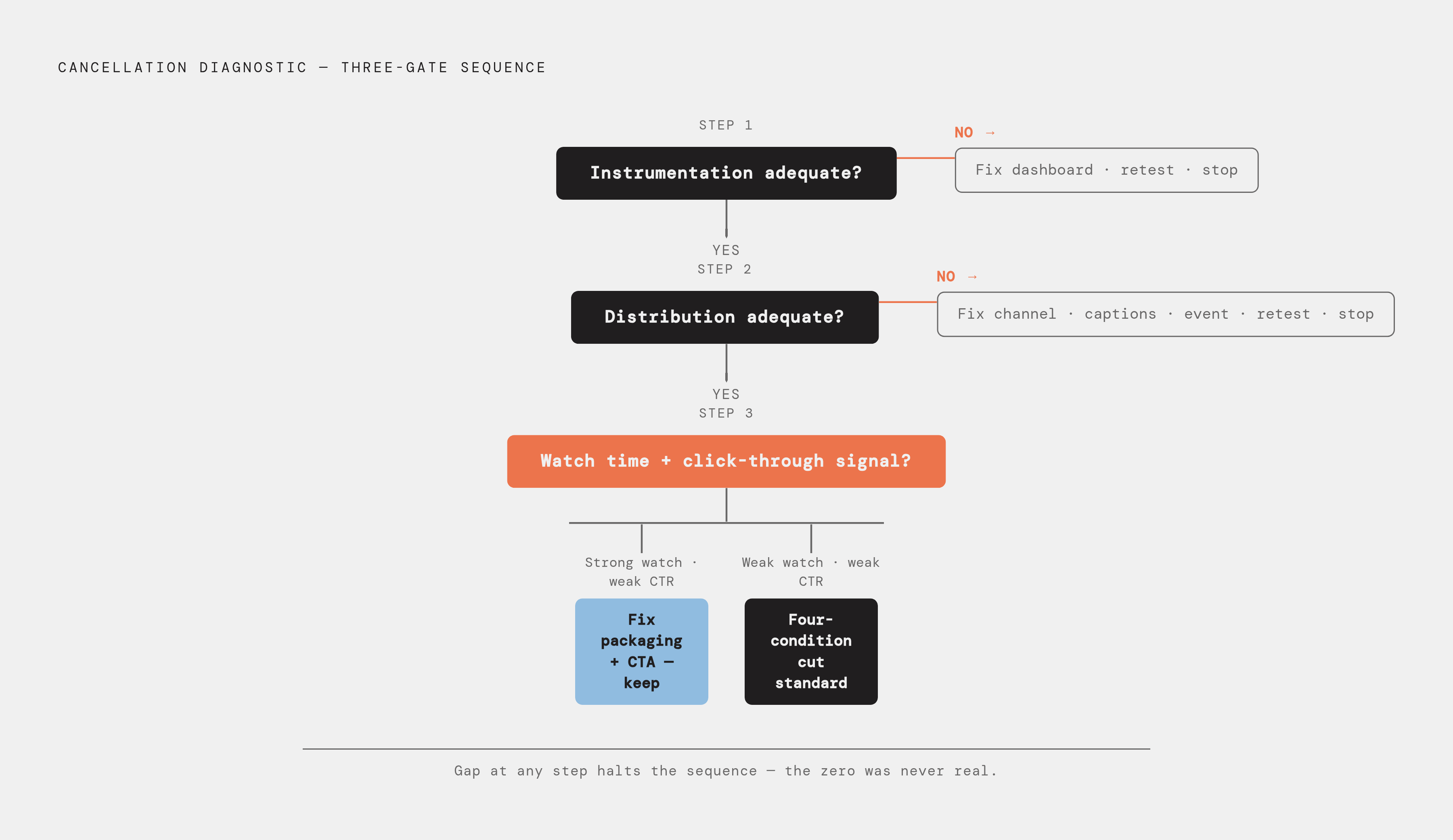
The three failure modes get worked in a fixed order because each step narrows down what the next step is even allowed to conclude. Finding a measurement gap at step one stops the process right there because neither distribution nor strategy can be evaluated honestly while the instruments reporting on them are broken.
Step one asks whether instrumentation is adequate. If yes, move to step two. If a measurement gap appears in the dashboard instead, fix the dashboard first and retest before any decision gets made about the program's future.
Step two asks whether distribution was adequate for the format and the channel it landed on. If yes, move to step three. If a distribution omission turns up instead, correct the channel, the upload method, the captions, or the conversion event, then retest before any program decision gets made.
Step three asks what the watch time and click-through data actually show together. Strong watch time with weak click-through means fix the packaging, the CTA, or the destination, and don't cut anything. Weak watch time paired with weak click-through means a topic or persona problem, and that's the point where the four-condition cut standard gets applied for real.
Most videos that get canceled without this triage get canceled on a false step-one zero. They get cut before the program ever had a fair test run against it. The decision isn't wrong in those cases so much as it's early, made on evidence that hadn't finished forming yet.
Building the instrumentation to catch this isn't a nice-to-have for the reporting team. Teams that can actually prove ROI to leadership see meaningfully higher budget increases than teams that can't, which turns the instrumentation decision into something with competitive weight behind it, not just diagnostic value. The team that can show its work gets the next budget cycle. The team that can't is still arguing about whether the zero was ever real.


